
Martin Lex is the pen name of the 7S1L safety desk: SOLAS, lifesaving and firefighting gear, muster drills, emergency signals and safe work on board. Portrait is illustrative.
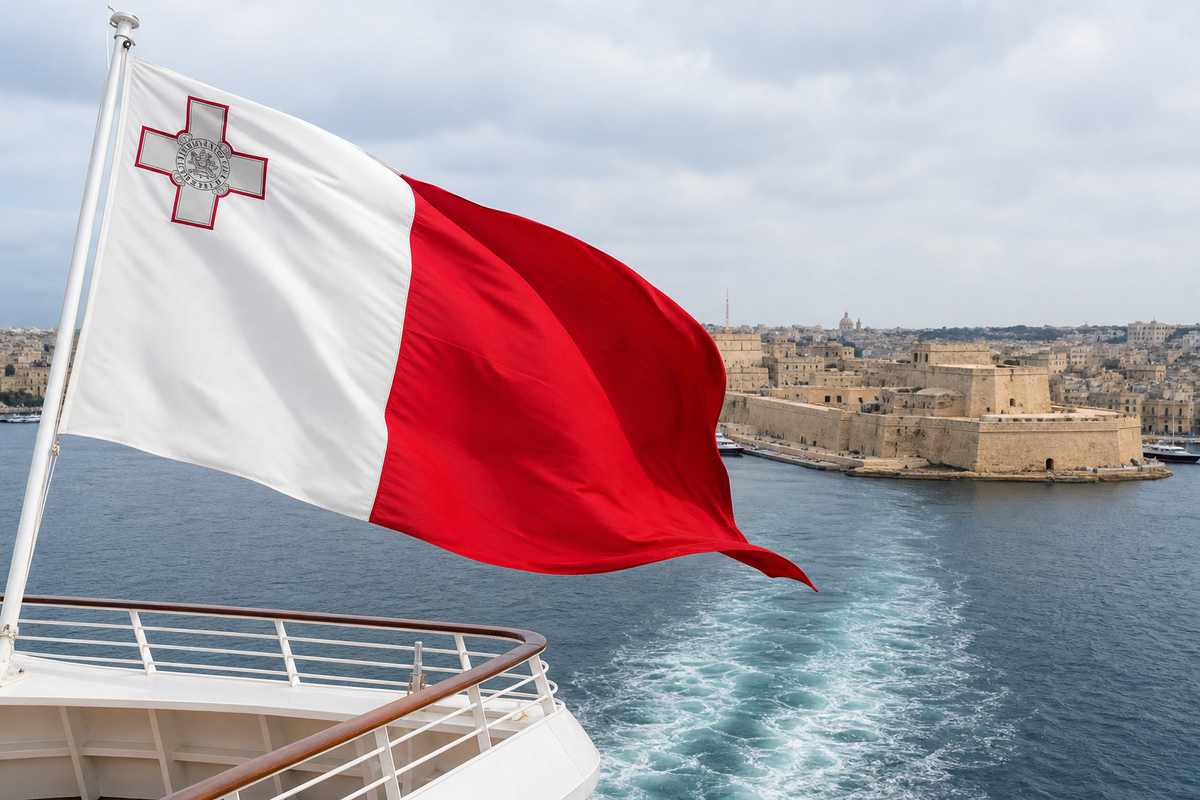
Malta flies on more merchant tonnage than any other flag in the European Union, around 81 million gross tons, sixth in the world. The same register stands on the ITF's list of flags of convenience, and it is one of the five FOC flags with the most ITF agreements in force, next to Panama and Liberia. Both facts are true at once, and together they describe the job: an EU administration above you, an open registry business model around you. Malta flag labor law is where those two realities meet, and it decides what your SEA is worth.
The AB from Cebu and the second engineer from Gdynia sign the same agreement under the same Maltese statute. The EU layer treats them differently. The difference lives in clauses most people skim at the crewing office, which is why this article walks through them slowly.
Before you sign a contract under the Malta flag, know which laws apply. You can check your seafarer contract free in the MLC Checker Tool: pick Malta and the report reads your SEA against MLC 2006 and the verified Malta flag facts.
Malta flag labor law: the statute behind your SEA
The Merchant Shipping Act, Chapter 234 of the Laws of Malta, and beneath it the Merchant Shipping (Maritime Labour Convention) Rules, S.L. 234.51. Part III of those rules, Articles 20 to 28, is the part that governs your employment agreement. The Merchant Shipping Act works as the special law for seafarers: Malta's general employment act only fills the gaps the maritime rules leave open. The rules are kept current. The MLC amendments of 2022 were transposed in February 2025, including the guarantee that wages are due whether or not the ship earns freight. A bad quarter for the charterer is legally not your problem.
Part III tracks Standard A2.1 of the MLC in practice: a written agreement signed by you and by the shipowner or the shipowner's representative, a signed original in your own hands, and the chance to read the terms and ask questions before ink touches paper. If a crewing agent slides the SEA across the desk at the terminal and wants a signature before the van leaves for the berth, that is not a Malta problem. That is a walk-away signal on any flag, and our guide to SEA red flags treats it as one.
The gap-filler construction has one practical consequence. Your SEA, any collective agreement written into it, and the maritime rules decide almost everything. So put two questions to the crewing agent before sign-on: which collective agreement is incorporated in the SEA, and is it an ITF agreement. The answers set your wage scale, your overtime rate, and who stands behind you in a dispute.
On wages, the MLC standard behind the Maltese rules is blunt: payment at intervals no longer than a month, a monthly account showing what was paid, and an allotment system so part of the wage reaches your family at home. An oiler checking his payslip in the mess room should see the same lines every month, freight or no freight. If the allotment stops arriving, that is a fact for the complaint procedure, not for patience.
The EU flag illusion
Here is the part crews get wrong at sign-on. An EU flag does not put every crew member into an EU social security system. Under the EU coordination rules, the flag-state principle covers seafarers who are EU, EEA or Swiss citizens or residents. A non-EU seafarer can be kept on home-country arrangements instead. On a register whose crews mostly come from outside the Union, that is the standard case, and it means the pension and insurance lines of your SEA carry the weight that a national system carries for your European shipmates. Read them like they are your pension, because they are.
Two boundary notes. The Maltese MLC rules carve out fishing vessels and non-commercial yachts, so a job on a Maltese superyacht sits under different subsidiary rules. And crew composition is not regulated by nationality at all: the register is open, which is exactly why the ITF lists it.
The practice version. Three questions for the crewing agent, in writing: which country's social security system receives contributions for you, who pays the employer share, and which document in your file proves both. An EU resident third officer falls under the Maltese system through the coordination rules and can verify contributions later. A Filipino bosun cannot. Whatever protection he has is the protection the SEA names. "The company takes care of it" is not an answer. It is the reason the question exists.
One more thing the register's size hides: Valletta is painted on cruise ship sterns too, and a cruise SEA under the Malta flag stacks hotel-side schedules, service charge structures and guest-facing hours on top of the same Maltese statute. That contract deserves its own read: cruise ship crew contracts and MLC rights.
How the Malta flag handles MLC compliance
Malta deposited its ratification of the MLC 2006 with the ILO on 18 January 2013, as the 12th EU member state to ratify. The convention did not stay in Geneva. It sits inside Maltese law through S.L. 234.51, which is why a dispute under a Maltese SEA cites Maltese rules and not only an international text.
Certification follows the convention. A Malta-flagged ship of 500 gross tons or more on international voyages carries a Maritime Labour Certificate and a Declaration of Maritime Labour Compliance: Part I drawn up by the flag administration, Part II by the shipowner, with a copy posted on board where crew can read it. At sign-on you can ask to see both. A chief officer who cannot point to the DMLC is telling you something about the ship.
Then there is the EU layer, and it separates Malta from the open registries it shares the ITF list with. Directive 2009/13/EC wrote the core of the MLC into EU law. Directive 2013/54/EU obliges every EU flag state, Malta included, to run a real monitoring system for MLC compliance: qualified inspectors, effective onboard complaint procedures, and mechanisms to verify that ships flying the flag actually meet the standard, in force as national law since 31 March 2015. On a Maltese ship the MLC carries two supervision layers at once, ILO reporting and EU law, with the European Commission checking whether Malta does its flag state job.
 Free crew appSeafarer Contract CheckCheck your contract clause by clause against MLC 2006 and flag state regulations. The check is free. On iPhone, Android or in the browser.
Enforcement and the record
Transport Malta's Merchant Shipping Directorate keeps a dedicated MLC complaints address and can sanction a shipowner up to closing the ship's registration. The escalation path with the contacts is in our Malta complaint guide, and the verified flag facts are on the Malta flag page. On port state control Malta stands on the Paris MoU White List, around 14th on the 2024 performance list with more than 4,000 inspections behind the ranking. The ITF still names Malta among the flags that generate abandonment cases in its database work. A white list and an abandonment file can belong to the same flag.
Before you sign: the Malta checklist
Seven checks. Ten minutes. Before the pen moves.
- Governing law: note which law the SEA names. The maritime rules of S.L. 234.51 apply on a Maltese ship either way, but a foreign governing-law clause is worth a direct question to the agent.
- Collective agreement: which CBA is incorporated, and is it ITF-covered. Compare the wage lines against it, including overtime and leave pay.
- Social security: which country, which scheme, who pays the employer share. Shown in a document, not promised in a sentence.
- Repatriation: who pays, from which ports, and when the entitlement starts. Under the MLC repatriation is the shipowner's cost, and the clause should read that way.
- Certificates: Maritime Labour Certificate and DMLC on board and current. Ask at the gangway if you have to.
- Complaint procedure: you are entitled to a copy of the onboard complaint procedure. If nobody hands it over with the SEA, request it on day one.
- Your original: keep a signed original of the SEA in your own kit bag, not only in the ship's office drawer.
Paper first, kit second. When the SEA reads clean, sign-on day gets simpler: documents in one folder, a sign-on set in the bag, a seafarer hoodie for the night flight into Luqa or wherever the joining port actually is.
Where Malta sits in the bigger flag picture: our guide to flags of convenience and your contract.
The 90 second version
This flag in one video:
How the Malta flag rates in port state control
Port state control keeps score on every flag. The regional inspection regimes publish each year which registers get detained most, and the ITF keeps its own list of flags of convenience. This is where Malta stands on the current lists:
- Paris MoU (Europe and Canada): white list, rank 16 of 69, performance list valid July 1, 2026 to July 6, 2027.
- Tokyo MoU (Asia Pacific): high performance, inspections and detentions 2022 to 2024.
- ITF: listed as a flag of convenience, 2025 list.
- MLC 2006: party to the Convention.
These lists count detentions, not contracts. A white list flag can still sit under a bad SEA, and a black list flag tells you how much backing to expect from the administration when something goes wrong on board. The current rating of every flag we cover stands on the Malta flag page, and the app report names MLC 2006 plus the flag at the top of every check, with the same rating next to it.
Source note
Transport Malta and S.L. 234.51 Merchant Shipping (MLC) Rules, ITF FOC list, EU Regulation 883/2004 coordination rules, Paris MoU performance lists, the ILO note on Malta's MLC ratification, and Directive 2013/54/EU on flag state responsibilities.
This article is editorial context for crew, not legal advice. For a live dispute under a Malta SEA, bring the contract to the ITF, your union, or a maritime lawyer before you act.
FAQ
Is Malta a flag of convenience?
The ITF lists Malta as a flag of convenience because the register is open: shipowners with no connection to Malta can flag in. At the same time Malta is an EU flag state with the MLC 2006 written into national law through S.L. 234.51. Both descriptions are accurate, and your SEA has to work under both.
What labor law applies on a Malta-flagged ship?
The Merchant Shipping Act, Chapter 234 of the Laws of Malta, together with the Merchant Shipping (Maritime Labour Convention) Rules, S.L. 234.51. Malta's general employment act only fills the gaps those maritime rules leave open, so in practice Malta flag labor law for crew means the Act as the frame and the MLC rules as the content.
Do seafarers on Malta-flagged ships get EU social security?
Only seafarers who are EU, EEA or Swiss citizens or residents fall under the flag-state principle of Regulation 883/2004. Non-EU crew can be kept on home-country arrangements, which makes the social security clause of the SEA the document that actually protects them.
Has Malta ratified the MLC 2006?
Yes. Malta deposited its ratification with the ILO on 18 January 2013 as the 12th EU member state to do so, and it transposed the 2022 MLC amendments into its national rules in February 2025.
How do I complain about conditions on a Malta-flagged ship?
Use the onboard complaint procedure first, then escalate to Transport Malta's Merchant Shipping Directorate, which keeps a dedicated MLC complaints address, or to a port state control officer at the next port. The full escalation path with contacts is in our Malta complaint guide.
7SHORT1LONG® is a Seafarer Identity Brand. An EU flag is only as good as the paper you keep.
YES, WE ARE CREW.
Gear for the watchSeafarer T-Shirts · Crew Best SellersBuild your Sign On Set · Build your Sailor Set