Martin Lex is the pen name of the 7S1L safety desk: SOLAS, lifesaving and firefighting gear, muster drills, emergency signals and safe work on board. Portrait is illustrative.
Italian maritime employment runs on collective agreements the way Italian ships run on bunkers. The CCNL for shipping, a national collective agreement negotiated with the unions, sets the scales and conditions, and the Navigation Code of 1942 sits underneath as the statutory frame. The detail that matters at sign-on is which part of that CCNL your contract points at, because since 1998 there have been two tracks. That split is the core of Italy flag labor law. It decides what your payslip looks like for the whole contract.
Before you sign a contract under the Italian flag, know which laws apply. You can check your seafarer contract free in the MLC Contract Check against MLC 2006 and the verified Italy flag facts.
The international register and Section 13
Italy created its Registro Internazionale by law in 1998 for ships in international trade. Registration requires an agreement filed with the seafarer unions, and the crewing rule is lean: the captain plus two other crew members must be Italian or EU nationals, with bareboat variants that can reduce the EU requirement to the master alone. For everyone else the unified shipping CCNL keeps a dedicated section, Section 13, the non-dom section, for crew not domiciled in Italy. Alternatives are the collective agreement of your own country of residence if it is equal or better, or an ITF Total Crew Cost agreement signed with your home union. The employers' association Confitarma has put the share of crew employed under a non-dom agreement on these ships at around 80 percent. The Italian scale and the non-dom scale are different documents with different numbers. Which one is yours is written in your SEA.
In practice the register decides the room and the section decides the money. Before you accept a berth, ask the crewing agent two questions and write the answers down. One: which agreement applies to my rank on this ship, the Italian CCNL scale, Section 13, my home-country agreement, or an ITF TCC agreement? Two: can I see the current wage scale for my rank before I sign? An agent who cannot name the agreement, or names it but cannot show the scale, is telling you something.
Take a concrete case. A Filipino AB hired in Manila for an Italian-flagged bulk carrier will almost never sail on the Italian scale. The realistic outcome is Section 13 or a TCC agreement signed with a home union such as AMOSUP. Both are lawful. The job is to know your track before the gangway, not after the first payday in the mess room.
Why the register runs this way
The Registro Internazionale is a subsidy machine, approved by the European Commission: owners receive a tax credit equal to the income tax on crew wages, an exemption from social security contributions for their seafarers, and taxation of only a fifth of shipping income, a scheme budgeted at 5.4 billion euros through 2033. An employer whose crew costs are subsidized by design has every reason to hire on the cheapest lawful track. That is not a scandal, it is the architecture. Knowing it tells you what to negotiate: the agreement reference, not the base wage line alone.
One practical lever follows. Registration requires an agreement filed with the seafarer unions, so a written agreement exists for every registered ship. Asking for the reference is not a favor. The owner filed that document to get the subsidy.
What Italy flag labor law looks like in your SEA
MLC 2006 gives you the right to review your seafarer employment agreement and take advice before signing, and both parties must sign it (Standard A2.1). Where a collective agreement forms part of your terms, the SEA has to say so, and the agreement has to be available on board. Under the Italian flag that clause is the whole game. "CCNL Section 13" and "CCNL national scale" are a few characters apart on paper and a long way apart in euros.
Two red flags worth naming here. An SEA on an international register ship that references no collective agreement at all. And a wage annex carrying an old date while the agent talks about the current scale. Both belong on the list in our guide to seafarer employment agreement red flags.
Cruise ships under the Italian flag
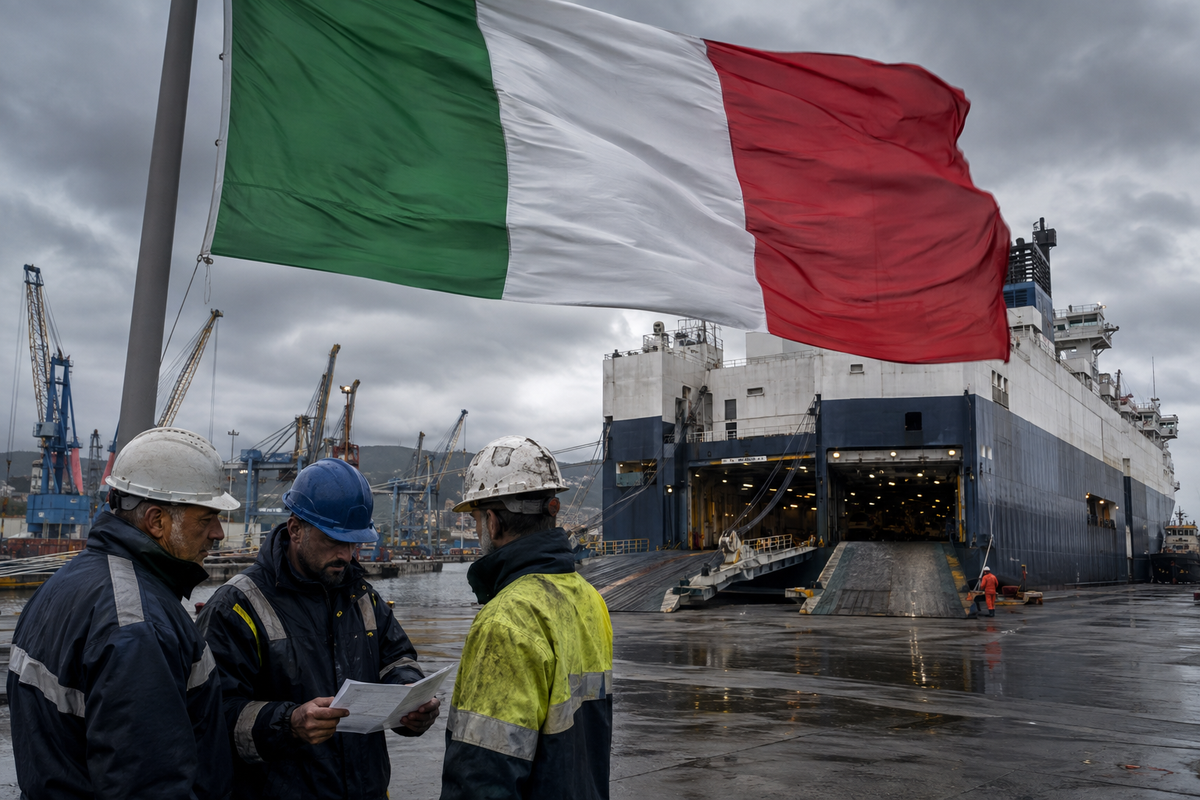
Italy is one of the few large flags where major cruise fleets fly the national flag. Costa Crociere registers its ships in Genoa. So does AIDA Cruises, the German-market brand in the same Carnival group: the whole AIDA fleet carries Genoa on the stern. That puts thousands of crew under Italian flag jurisdiction every day, from the pastry cook starting at 04:00 to the AB in a seafarer hoodie rigging the gangway in Savona.
For cruise crew the mechanics are the same as on a bulk carrier. MLC 2006 sets the floor, and the agreement named in your SEA sets your money. What your contract must contain, from repatriation to hours of rest, is in our guide to cruise ship crew contract rights under the MLC.
The strong points
Italy is not on the ITF flag of convenience list, unlike the French, German and Madeira international registers. Port state control performance is top tier, second on the Paris MoU list built from 2022 data and fifth the year after. EU and EEA crew get the full Italian collective agreements, and the MLC floor is documented in Italy's declaration of compliance for every certified ship.
Malta, the EU register with the most tonnage, sits on the ITF list. Italy does not. How the Maltese system works from a crew seat is in our Malta flag labor law breakdown.
 Free crew appSeafarer Contract CheckCheck your contract clause by clause against MLC 2006 and flag state regulations. The check is free. On iPhone, Android or in the browser.
How Italy handles MLC compliance
Italy ratified the Maritime Labour Convention on 19 November 2013, as the 52nd ILO member state, and it entered into force for Italy on 19 November 2014. Italian-flagged ships of 500 GT and over trading internationally carry a Maritime Labour Certificate and a Declaration of Maritime Labour Compliance. Part I comes from the administration and states how Italy implements each MLC requirement. Part II comes from the shipowner and states how the ship complies in practice. Both must be on board and available to the crew.
If life on board does not match the paper, the MLC route is the on-board complaint procedure first, then the flag administration, then port state control at the next berth. On an Italian ship in a Paris MoU port that last option has teeth, because the inspector works from the same DMLC you have in your hand.
Before you sign
Crew who fly into Genoa, Savona or Civitavecchia for joining day sort their sign-on set the night before travel. Sort the paperwork with the same care. The checklist for the Italian flag:
- Ask which CCNL section or agreement covers you and get the current wage scale for your rank in writing.
- If a TCC agreement applies, check it is registered with your union before you rely on it.
- Read the SEA line that names the collective agreement. It must match what the agent told you.
- Check the contract length against what was promised. What counts as normal is in our guide to seafarer contract duration.
- Confirm sickness and repatriation clauses against the MLC lines.
- Confirm who your legal employer is: the owner, a manager, or a manning agent. The name on the SEA is the name you would claim against.
The verified administration contacts are on our Italy flag page, and the full comparison across Europe's registers is in our flags of convenience guide.
The 90 second version
This flag in one video:
How the Italy flag rates in port state control
Port state control keeps score on every flag. The regional inspection regimes publish each year which registers get detained most, and the ITF keeps its own list of flags of convenience. This is where Italy stands on the current lists:
- Paris MoU (Europe and Canada): white list, rank 11 of 69, performance list valid July 1, 2026 to July 6, 2027.
- Tokyo MoU (Asia Pacific): medium performance, inspections and detentions 2022 to 2024.
- ITF: not listed as a flag of convenience, 2025 list.
- MLC 2006: party to the Convention.
These lists count detentions, not contracts. A white list flag can still sit under a bad SEA, and a black list flag tells you how much backing to expect from the administration when something goes wrong on board. The current rating of every flag we cover stands on the Italy flag page, and the app report names MLC 2006 plus the flag at the top of every check, with the same rating next to it.
Source note
This article is editorial context for crew, not legal advice. For a dispute over an Italian SEA, talk to your union, an ITF inspector, or a maritime lawyer.
Sources: Codice della Navigazione and Italy's DMLC Part I, the unified shipping CCNL of December 2020 (Ministry of Labour records), Chambers shipping practice guides on Italy, the European Commission decision on the Italian scheme, Paris MoU performance lists, the ILO note on Italy's MLC ratification, and the ITF flag of convenience list.
FAQ
Is the Italian flag a flag of convenience?
No. Italy is not on the ITF flag of convenience list, which named 48 registries in 2025. The French, German and Madeira international registers are on that list. The Italian Registro Internazionale is not.
What labor law applies on an Italian-flagged ship?
Italy flag labor law rests on the Navigation Code of 1942 and the national shipping CCNL. On international register ships, crew not domiciled in Italy usually sail under Section 13 of the CCNL, a home-country collective agreement of equal or better value, or an ITF TCC agreement. MLC 2006 sets the floor in every case.
What is the non-dom section of the Italian CCNL?
Section 13 of the unified shipping CCNL covers crew not domiciled in Italy on Registro Internazionale ships. The employers' association Confitarma has put the share of crew on these ships employed under a non-dom agreement at around 80 percent.
Has Italy ratified the MLC 2006?
Yes. Italy ratified the Maritime Labour Convention on 19 November 2013 as the 52nd ILO member state to do so, and it entered into force for Italy on 19 November 2014.
Do Costa and AIDA ships fly the Italian flag?
Yes. Costa Crociere and AIDA Cruises register their ships in Genoa under the Italian flag. Which agreement applies depends on your domicile and on what your SEA names, not on the brand.
7SHORT1LONG® is a Seafarer Identity Brand. Two tracks, one flag. Know your section.
YES, WE ARE CREW.
Gear for the watchSeafarer T-Shirts · Crew Best SellersBuild your Sign On Set · Build your Sailor Set