
Martin Lex is the pen name of the 7S1L safety desk: SOLAS, lifesaving and firefighting gear, muster drills, emergency signals and safe work on board. Portrait is illustrative.
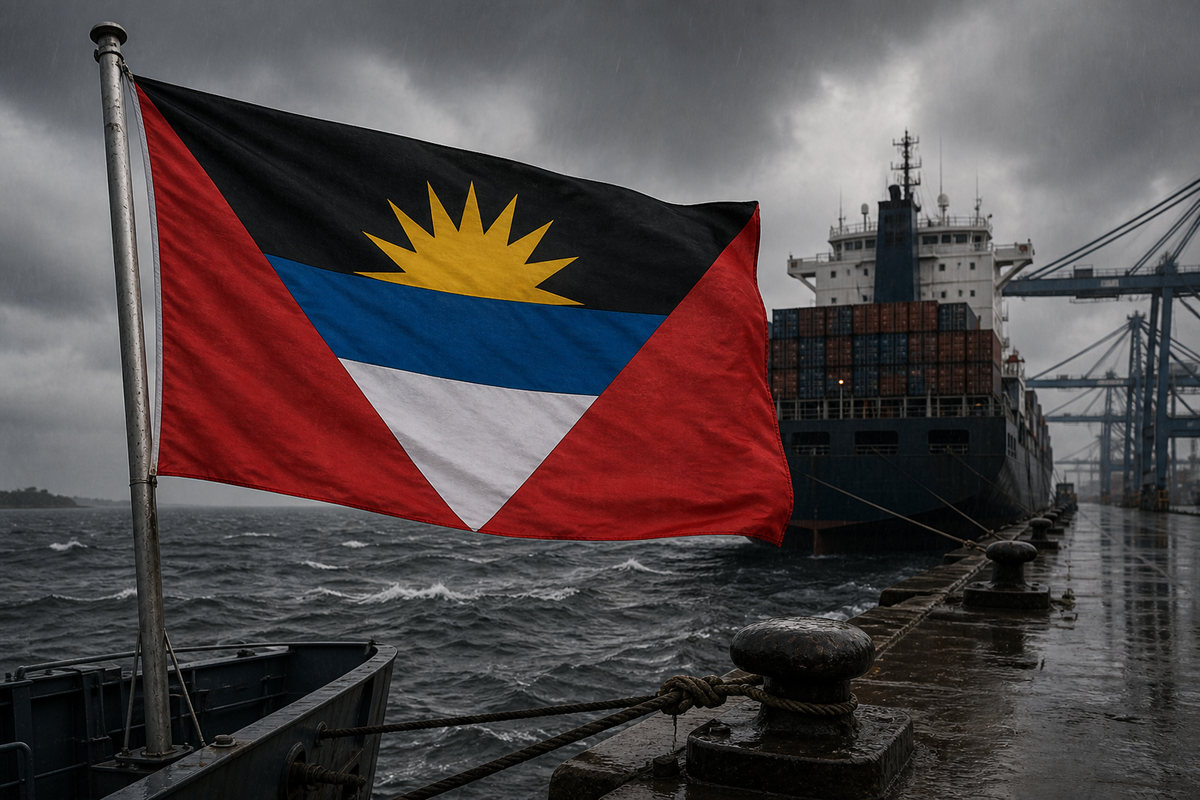
The Antigua and Barbuda flag has a peculiar geography. The port of registry is St. John's in the Caribbean. Two of the registry's three offices are in Germany, in Oldenburg and Elsfleth, where its inspection division sits, a legacy of the decades when this flag carried a large share of the German-owned container fleet. If you sailed feeder ships out of Hamburg, you have probably stood under this flag without ever seeing the island. Antigua flag labor law works the same way: compact, owner-friendly, and administered a long way from St. John's.
Before you sign a contract under the Antigua and Barbuda flag, know which laws apply. You can check your seafarer contract free in the Seafarer Contract Checker against MLC 2006 and the verified Antigua flag facts.
The floor is the offer unless you change it
The legal frame is the Merchant Shipping Act 2006, the MLC regulations of 2012 and the registry's directives. The registry's own circular on employment agreements says the quiet part in writing: ADOMS prescribes no SEA format, requires no collective agreement, and owners are free to employ seafarers at individual conditions so long as the MLC minimums are met. On this flag the convention floor is not a safety net under your contract. It very often is the contract. The minimum notice for early termination is set at seven days, the shortest the MLC permits.
One genuinely crew-friendly line stands out: the maximum service period before your repatriation entitlement is nine months, set by the registry's directive and required to be stated in the SEA. That is three months shorter than the MLC's outer limit. If your contract says more than nine months under this flag, it is wrong on its face.
What Antigua flag labor law means clause by clause
Start with the collective agreement question, because on this flag it decides everything else. In the crewing office, before the medical, ask which CBA covers the ship and ask to see it. On an Antigua and Barbuda ship the honest answer can be "none", and that answer is legal. If there is no CBA, every number in your SEA is exactly what you will get. No union scale sits behind it. Nothing tops it up.
Wages are where that lands first. The MLC sets no binding wage figure for most ranks, only a machinery for national minimums and the ILO guidance figure for an AB. An owner hiring at individual conditions can lawfully offer the low end of the market. Compare the offer against the current ILO figures before you accept, not after. The numbers and what they cover are in our seafarer minimum wage guide for 2026.
The seven day notice clause deserves a slow read. Seven days is the MLC minimum, and it must apply to both sides: the owner cannot reserve a shorter notice for himself than he gives you. Check that the clause names the same period in both directions, and check what it says about repatriation cost if you are the one who terminates. The MLC also requires that a seafarer be allowed to leave on shorter notice, or none, for compassionate reasons such as a family emergency. If the SEA is silent on that, it is a warning sign, and the wider list is in our seafarer employment agreement red flags guide.
Then the duration line. Nine months is the registry's hard cap before repatriation, but plenty of ratings sign for less. What matters is that the SEA states the exact term and the conditions for extending it, because a vague "until vessel convenience" clause turns a six month agreement into a nine month one without your signature. How contract lengths actually run across ranks and trades is in our guide on how many months a seafarer contract lasts.
One practical note on the trade this flag actually does. Antigua and Barbuda tonnage has spent decades on North Sea and Baltic feeder routes, so the flag on the stern is Caribbean and the weather on deck is not. Crews joining in Bremerhaven in January pack a proper seafarer hoodie next to the boiler suits. More than one cadet has learned that on the first cargo watch.
How this flag handles MLC compliance
Antigua and Barbuda ratified the MLC 2006 on 11 August 2011 and brought it into national law through the 2012 regulations under the Merchant Shipping Act. ADOMS, the Department of Marine Services and Merchant Shipping, is the competent authority. It runs the register from St. John's and handles most day to day fleet business through its German offices, with the inspection division in Elsfleth. Guidance reaches ships as numbered ILO circulars: the consolidated MLC guidance in Circular 2016-001, and Circular 2024-003 confirming the convention amendments in force since 23 December 2024.
Certification works the standard way. Ships of 500 GT and over on international voyages carry a Maritime Labour Certificate and a Declaration of Maritime Labour Compliance. Part I of the DMLC is the flag's statement of what national law requires. Part II is the owner's statement of how the ship meets it. Ask to see Part II when you join: it is where the owner has written down, in advance, what he claims to do about wages, hours of rest, and repatriation, and a port state control officer will read it against reality.
If the reality does not match, the MLC gives you a complaint path. Every ship must carry an onboard complaint procedure that names the contact points, and using it cannot lawfully be held against you. Beyond the ship, complaints go to ADOMS as flag state or to the port state control officer in the next port. The registry's verified contact details are listed on the flag page linked below.
 Free crew appSeafarer Contract CheckCheck your contract clause by clause against MLC 2006 and flag state regulations. The check is free. On iPhone, Android or in the browser.
What the record shows
The ITF lists Antigua and Barbuda as a flag of convenience, and it is one of the five FOC flags with the most ITF agreements in force, which tells you union coverage is common and worth asking for. On port state control the flag sits on the Paris MoU White List, but near its lower edge: 35th of 40 white flags on the current list, with 95 detentions across three years of inspections. And when the superyacht Alfa Nero sat abandoned in Falmouth Harbour, it was Antigua's own High Court, acting as the port state, that awarded the captain and 18 crew their unpaid wages in December 2023. The island enforces. The flag's floor is still the floor.
For contrast, the other big Caribbean register runs a different trade entirely: cruise tonnage, larger crews, and a heavier CBA presence. How that plays out in the contract is in our Bahamas flag labor law guide.
Before you sign
Ask whether an ITF or other collective agreement applies, because nothing on this flag requires one. Check the notice period, the repatriation clause against the nine month cap, and the sick pay clause. The verified registry contacts are on our Antigua and Barbuda flag page, and the wider comparison across open registries is in our flags of convenience guide.
The short version, in the order a bosun would check it:
- Get the CBA question answered in writing. If no collective agreement applies, treat every SEA clause as final, because it is.
- Check the contract term against the nine month cap. Anything longer is invalid on its face under this flag.
- Read the notice clause both ways. Seven days is the legal minimum and it must be the same for owner and crew.
- Find the compassionate termination provision. A family emergency at sea is not the moment to discover it is missing.
- Check the wage annex line by line: basic, overtime rate, leave pay, allotments, and the currency of payment.
- Read the sick pay clause. The MLC lets owners limit sick wages to as little as 16 weeks, so know what your SEA actually grants.
- Confirm the SEA states your repatriation destination and who pays. On sign-on day at the terminal, with the agent waiting and the sign-on set still in the seabag, it is too late to negotiate any of this.
The 90 second version
This flag in one video:
How the Antigua and Barbuda flag rates in port state control
Port state control keeps score on every flag. The regional inspection regimes publish each year which registers get detained most, and the ITF keeps its own list of flags of convenience. This is where Antigua and Barbuda stands on the current lists:
- Paris MoU (Europe and Canada): white list, rank 35 of 69, performance list valid July 1, 2026 to July 6, 2027.
- Tokyo MoU (Asia Pacific): medium performance, inspections and detentions 2022 to 2024.
- ITF: listed as a flag of convenience, 2025 list.
- MLC 2006: party to the Convention.
These lists count detentions, not contracts. A white list flag can still sit under a bad SEA, and a black list flag tells you how much backing to expect from the administration when something goes wrong on board. The current rating of every flag we cover stands on the Antigua and Barbuda flag page, and the app report names MLC 2006 plus the flag at the top of every check, with the same rating next to it.
Source note
This article is editorial context for working seafarers, not legal advice. For a live dispute under this flag, contact the ITF, a maritime lawyer, or the registry itself. Sources: ADOMS Circular 2018-003 on SEAs, ADOMS, ILO on the 2011 ratification, ADOMS ILO Circular 2016-001 Rev 1 (MLC guidance), ADOMS ILO Circular 2024-003 (amendments in force December 2024), the registry's administration page, ITF FOC list, Nautilus on the Alfa Nero wage award, and Paris MoU performance lists.
FAQ
Is Antigua and Barbuda a flag of convenience?
Yes. The ITF lists Antigua and Barbuda as a flag of convenience. It is also one of the five FOC flags with the most ITF agreements in force, so union-covered ships are common even though the flag itself requires no CBA.
What labor law applies on an Antigua and Barbuda flagged ship?
The Merchant Shipping Act 2006 of Antigua and Barbuda, the MLC regulations of 2012 and ADOMS directives. Your SEA, plus any collective agreement that applies, sits on top of that floor.
How long can a seafarer contract be under the Antigua flag?
Nine months is the maximum service period before your repatriation entitlement, set by registry directive and required to be stated in the SEA. That is three months shorter than the MLC's outer limit.
What is the minimum notice period under Antigua flag labor law?
Seven days, the shortest the MLC permits. The period must be the same for shipowner and seafarer, and shorter or no notice must be possible for compassionate reasons.
Has Antigua and Barbuda ratified the MLC 2006?
Yes, on 11 August 2011. ADOMS implements it through the 2012 regulations, ILO circulars, and Maritime Labour Certificates with a DMLC on ships of 500 GT and over on international voyages.
7SHORT1LONG® is a Seafarer Identity Brand. Nine months is the cap. Hold the line at the signature.
YES, WE ARE CREW.
Gear for the watchSeafarer T-Shirts · Crew Best SellersBuild your Sign On Set · Build your Sailor Set