Martin Lex is the pen name of the 7S1L safety desk: SOLAS, lifesaving and firefighting gear, muster drills, emergency signals and safe work on board. Portrait is illustrative.
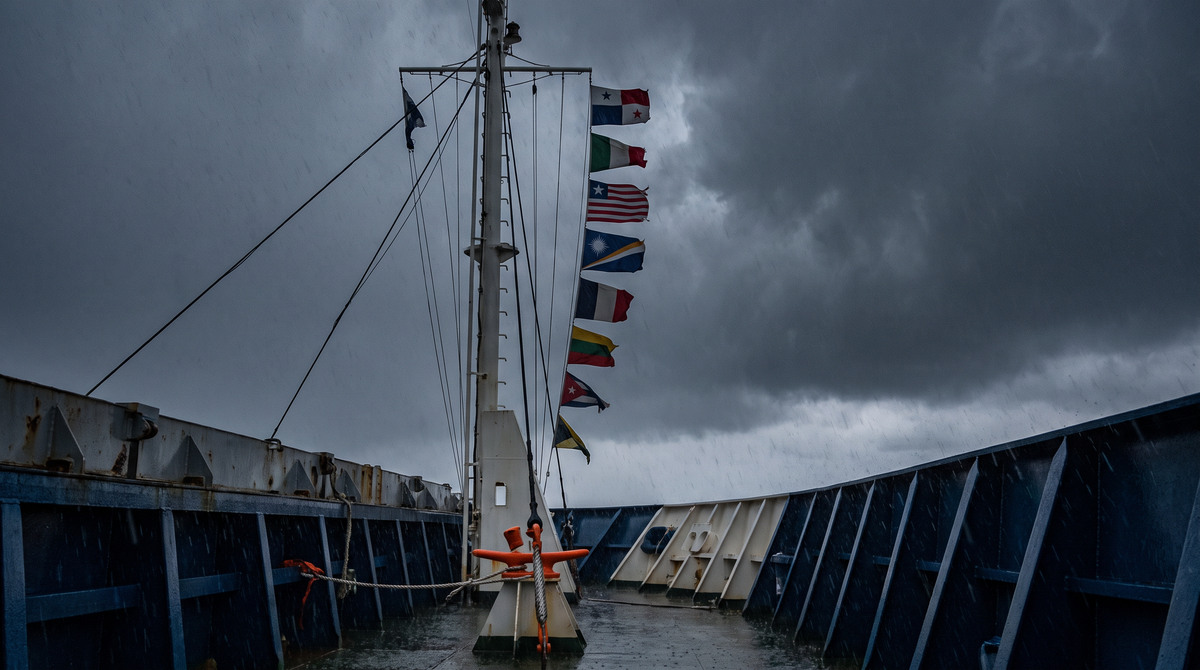
Look aft on any ship you join. The flag flying there is a legal decision someone else made about your job. It decides which country certifies the ship, which administration answers your complaint, and which national labor law fills every gap your contract leaves open. Much of the world fleet trades under flags of convenience, so this is not an edge case. It is the default condition of the job. An AB on a Liberian bulker and an AB on a Dutch coaster can do identical work for very different rights.
Before you sign a contract under any flag state, know which laws apply. You can check your seafarer contract free in the Seafarer Contract Checker: it reads your SEA clause by clause against MLC 2006 and the verified facts of the flag you select.
The two minute version
The numbers from this guide in one video: the 48 registries on the ITF list, the 16 week sick pay cliff, the one year claim deadlines, the second registers, and the four lines to read before you sign.
What a flag of convenience is
The ITF has campaigned against the system since 1948, and its definition is short: a flag of convenience ship flies the flag of a country other than the country of its real, beneficial owner. UNCLOS asks for a genuine link between a ship and its flag state; the ITF position is that in an FOC registry there is none. That argument is decades old. What is not in dispute is the mechanics: whichever flag is on the stern, that state writes the labor law under your SEA.
The ITF currently lists 48 registries as flags of convenience. The three biggest, Liberia, Panama and the Marshall Islands, together carried about 45 percent of world capacity by deadweight at the start of 2025 per UNCTAD. Two of those three registries are run by private companies in Virginia, USA. The Bahamas registry works out of London. This is normal in shipping and legal everywhere. It still matters to you, because the law under your contract follows the flag, wherever the office happens to be.
The floor under every flag discussed here is the Maritime Labour Convention, 2006. It sets minimums: a written SEA, wages paid at least monthly, 10 hours of rest in any 24, 2.5 days of leave per month, repatriation at the shipowner's cost. The differences between flags live above and around that floor, and sometimes in how thin the floor is allowed to be.
Why shipowners choose flags of convenience
The reasons are commercial and mostly boring. Registration fees and tonnage taxes in an open registry cost less than home-flag taxation. Crewing rules are the bigger lever: an owner under a strict national flag faces national wage levels and collective agreements, while the same owner under an open registry can hire from any country at market rates, with no nationality quotas and no home social security contributions for non-resident crew. Add speed. Commercially run registers process a flag change in days.
The ITF calls the result a race to the bottom on wages and conditions. The registries call it competition between service providers. Both descriptions fit, on different ships. A well run open registry with a real inspection branch is a different employer environment from a register that sells its flag and asks nothing afterwards. The public record tells them apart better than mess room reputation does, and the sections below show where that record lives.
The three flag families
Open registries. Panama, Liberia, Marshall Islands, Bahamas, Malta, Cyprus, Antigua, Barbados, Curacao and others. Anyone can flag in. National labor law for seafarers is usually a purpose-built maritime code, and national social security typically covers residents only. The MLC minimum has a way of becoming the exact offer: 16 weeks of sickness cover, one quarter overtime surcharge, seven days of notice.
Second registers. Denmark's DIS, Norway's NIS, Germany's GIS, France's RIF, Portugal's MAR in Madeira, Spain's REC in the Canaries, Italy's Registro Internazionale. These are European flags with a built-in carve-out: crew who do not live in the flag country can be employed on home-country terms, outside the national collective agreements that protect resident colleagues. The ITF lists the French, German and Madeira international registers as flags of convenience even though the parent flags are not.
National flags. The United Kingdom, Netherlands, Greece, Croatia, Hong Kong, Singapore and others. Here national maritime law carries real weight, though almost every one keeps its onshore employment act away from seafarers. The UK minimum wage, for one, generally stops at the shoreline for non-resident crew on internationally trading ships.
What actually changes with the flag
Four things, in most contracts we see. Social security: whether anyone pays into a pension for you, or whether your SEA is the whole safety net. Sickness cover: how fast full wages drop to a third, and when liability ends. Deadlines: Panama and Liberia give you one year to bring most contract claims. Collective agreements: whether one applies to you at all, and whether your residence decides which one.
There is a fifth thing: where you argue. The governing law clause in most SEAs names the flag state, and the jurisdiction clause often points to its courts or its arbitration rules. A Filipino oiler on a Maltese ship whose dispute clause names Valletta should know that at sign-on, not at the dispute. The complaint path follows the same logic: onboard procedure first, then the flag administration, then the port state control officer ashore. Which of those doors actually opens depends on the flag.
Abandonment is the extreme end of the same question. The ITF counted a record 410 vessels and 6,223 seafarers abandoned in 2025, and more than 80 percent of the ships flew flags of convenience. The flag will not stop a bad owner. Knowing the flag tells you who must act when it happens, and how strong your paper is.
The counterforces: certificate, port state control, ITF agreements
A weak flag is not the end of the story. Three mechanisms push back.
The Maritime Labour Certificate. Ships of 500 GT and over on international voyages must carry a Maritime Labour Certificate and a Declaration of Maritime Labour Compliance issued under the flag state's authority. The DMLC spells out how that flag implemented each MLC requirement on that ship. Both must be on board and available to crew. Asking to see them at sign-on is normal, not hostile.
Port state control. The flag certifies, but the port inspects. PSC officers in Rotterdam, Singapore or Houston board foreign ships, check the certificate against reality, and can detain a vessel for serious MLC breaches: unpaid wages, expired SEAs, rest hour records that contradict the logbook. The regional PSC regimes publish flag performance lists every year, so a flag's detention record is public information, not dockside rumor.
ITF agreements. On many FOC ships an ITF approved collective agreement sits on top of the MLC floor, negotiated because the ITF inspectorate in ports worldwide can make life difficult for owners who refuse one. If your SEA references an ITF approved CBA, your paper is stronger than the bare minimum. If the recruiter cannot say whether one applies, ask in writing and keep the answer.
How to check a ship's flag before sign-on
You do not need the ship in front of you. You need its IMO number. Ask the manning agent for the vessel's name and IMO number as soon as a ship is named. Any legitimate agency has both on file. Hesitation here is a data point in itself.
Then look the ship up on Equasis (equasis.org). Equasis is financed by public money, supervised by maritime administrations with EMSA and the IMO at the table, and free to use after registration. It shows the current flag, the registered owner and ISM manager, the classification society, and the ship's port state control history including detentions. Two minutes of reading. It can save you a nine month contract under a register you never agreed to.
Compare what Equasis shows with what the draft SEA says. If the contract names one flag and the registry shows another, ask the company why before you sign, not after. Then run the contract itself against the flag's verified facts; the walkthrough is in How to Use the MLC Contract Check.
Check the flag before you sign
Every register we cover has a verified flag page with the administration behind the SEA, the governing law and the MLC complaint contact. All 59 flag pages are on the flag guide index. Start with the registers that carry the most crew: Panama, Liberia, Marshall Islands, Bahamas, Malta and Cyprus among the open registries, Denmark (DIS), Norway (NIS), Germany and France (RIF) among the second registers, and the United Kingdom, Netherlands, Singapore and Hong Kong among the national flags.
For the flags with the most crew on board we also keep complaint guides on this blog: Panama, Liberia, Marshall Islands and Malta. Panama is the biggest register of them all, and what Panamanian law actually grants a seafarer is covered in our guide to Panama flag labor law. The ten contract points to read before any of this matters are in 10 Red Flags in a Seafarer Contract.
One more thing for the bag. The flag on the stern says whose law owns the ship. What you wear on the gangway says who you are. The sign on set was built for exactly that day, and the seafarer t-shirts carry the same message ashore.
Watch: one video per flag state
The overview above covers the system. This series covers the registries one at a time. Between 30 August and 24 September 2026 we published a short film for each of the twenty six flags in the flag guide index: what the governing law actually is, how long sick pay runs before it stops, how long you have to bring a claim, and whether a non-resident seafarer has any social security at all.
Start with Panama, the only one of the big four still run by the flag state itself, and the registry with the most abandonment cases on the ITF record:
The full series, grouped by the same three flag families used above:
Open registries
- Panama: What Seafarers Sign Up For.
- Liberia: The American Rulebook at Sea.
- Marshall Islands: Read the Fine Print.
- Malta: EU Paperwork, Open Registry Crewing.
- Bahamas: What Cruise Crews Should Check.
- Cyprus: EU Flag, Open Registry Reality.
- Antigua and Barbuda: The MLC Floor Is the Offer.
- Curacao: Your SEA Is the Safety Net.
- Barbados: A Registry Run From London.
European second registers
- Denmark (DIS): Sorted by Home Address.
- Norway (NIS): Home Country Pay, Nordic Flag.
- Germany (ISR): The Second Register on the FOC List.
- France (RIF): When French Labor Law Does Not Apply.
- Portugal (MAR, Madeira): The EU Register on the MLC Floor.
- Spain (REC, Canary Islands): Read the Governing Law Clause.
Red Ensign Group
- United Kingdom: Where the Minimum Wage Stops.
- Isle of Man: MLC Rules, No Manx Labor Law.
- Bermuda: Onshore Law Stays Ashore.
- Cayman Islands: Your Contract Names the Law.
- Gibraltar: Red Ensign on the FOC List.
National registers
- Hong Kong: Cap. 478, Not the Employment Ordinance.
- Singapore: Strong Flag, Check the CBA.
- Greece: The Collective Agreement Is the Wage.
- Italy: Two Tracks, One Flag.
- Netherlands: The Equal Pay Fight.
- Croatia: Two Agreements and 183 Days.
Each film names the statute, the article number and the deadline, so you can hold it against your own seafarer employment agreement before you sign. The written guide for each registry is linked in the flag guide index above.
White, grey, black: how the flags rate in port state control
The Paris MoU sorts flags into a white, grey and black list once a year, by how often their ships were detained in European and Canadian ports over the last three years. The Tokyo MoU does the same for the Asia Pacific region, and the ITF keeps its own list of flags of convenience. Since September 2026 the checker covers 59 flag states, and every flag page and every app report shows these ratings next to the flag. On the Paris MoU list valid July 1, 2026 to July 6, 2027, the 59 flags fall out like this:
White list (36): Cayman Islands, Sweden, Norway (NOR / NIS), Denmark (DIS), Japan, Singapore, France (RIF), Finland, Netherlands, Luxembourg, Italy, Hong Kong, Germany, Portugal (Madeira / MAR), Bahamas, Malta, Isle of Man, Bermuda, China, United States, Marshall Islands, Cyprus, Spain (Canary REC), United Kingdom, Greece, Saudi Arabia, Ireland, Gibraltar, Liberia, Croatia, Barbados, Türkiye, Antigua and Barbuda, Panama, Faroe Islands, Belgium.
Grey list (11): South Korea, India, Sierra Leone, Thailand, Russia, Philippines, Egypt, Saint Vincent and the Grenadines, Cook Islands, Bangladesh, Tuvalu.
Black list (10): Saint Kitts and Nevis, Palau, Togo, Guinea-Bissau, Belize, Vanuatu, Vietnam, Comoros, Tanzania (Zanzibar), Cameroon.
Not ranked by the Paris MoU (2, too few inspections): Curacao, Indonesia.
29 of the 59 are on the ITF list of flags of convenience. A black list flag is not a verdict on your contract. It tells you that port state control will look harder at the ship, and that the administration behind your SEA has a record of ships it did not keep in order. Read the flag page before you sign, and read the SEA twice.
Source note
Facts in this article rest on the ITF flags of convenience campaign page (definition, genuine link), the ITF list of current FOC registries, the UNCTAD Review of Maritime Transport fleet shares as of January 1, 2025, ITF abandonment reporting for 2025, the Maritime Labour Convention, 2006 (ILO), and Equasis for ship and flag lookups. This article is editorial context for working seafarers, not legal advice.
FAQ
What does flag of convenience mean?
A flag of convenience is a ship registration in a country other than the one where the ship's real owner is based. The ITF currently lists 48 registries as FOCs. The label matters to crew because the flag state's law sits under every seafarer employment agreement on board.
Why do shipowners register ships under flags of convenience?
Lower registration fees and tonnage taxes, freedom to hire crew from any country at international market wages, and fast service from commercially run registries. The savings often come out of crew terms, which is why the ITF has campaigned against the system since 1948.
Are flags of convenience legal?
Yes. Under UNCLOS every state sets its own conditions for granting its flag, and open registration is standard practice worldwide. For crew the practical question is how much protection the chosen flag actually delivers.
What are the biggest flags of convenience?
Panama, Liberia and the Marshall Islands. Together they carried about 45 percent of world capacity by deadweight at the start of 2025, per UNCTAD. All three are on the ITF FOC list.
How do I find out which flag a ship flies?
Look the ship up by name or IMO number on Equasis, a free public database supervised by maritime administrations. It shows the current flag, owner, manager and port state control record. Compare the result with the flag named in your contract before you sign.
Does MLC 2006 apply on flag of convenience ships?
Yes, wherever the flag state has ratified the convention, and nearly every major open registry has. Ships of 500 GT and over on international voyages must carry a Maritime Labour Certificate proving compliance. Enforcement runs through the flag administration and through port state control.
7SHORT1LONG® is a Seafarer Identity Brand. The flag is their business decision. Reading it is yours.
YES, WE ARE CREW.
Gear for the watchSeafarer T-Shirts · Crew Best SellersBuild your Sign On Set · Build your Sailor Set