Martin Lex is the pen name of the 7S1L safety desk: SOLAS, lifesaving and firefighting gear, muster drills, emergency signals and safe work on board. Portrait is illustrative.
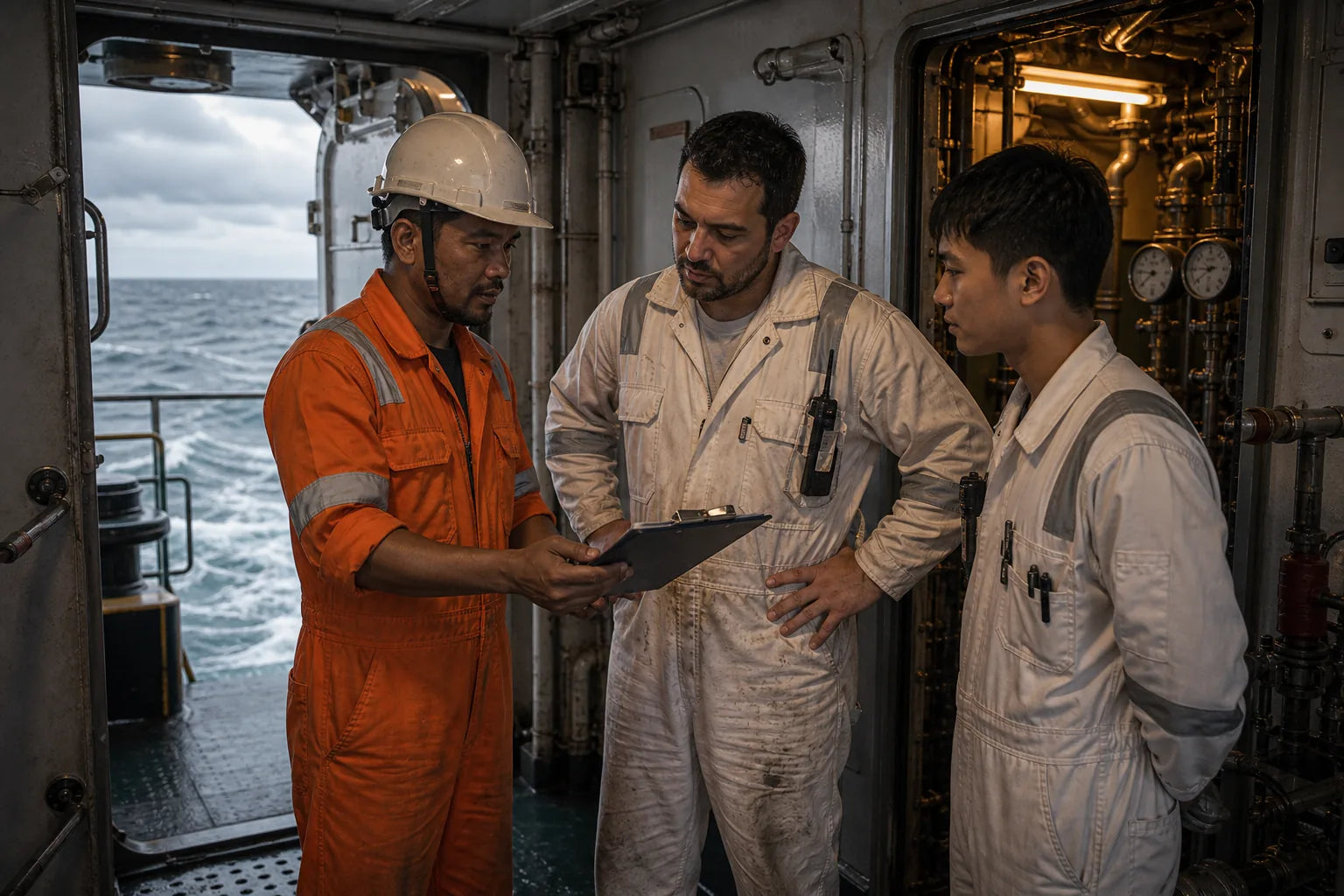
Working at sea is not the same as liking the ocean. Life at sea jobs run inside a shipboard system: watches, departments, drills, contracts, cabins, paperwork, inspections, port calls, weather, and the people who keep the vessel moving.
Life at sea can be meaningful. It is not soft. Anyone joining a ship should understand the work before romanticizing the horizon. This guide covers what the jobs are, how people actually get in, what paperwork every route demands, what a working day contains in three different departments, and what the contract says when the recruiter stops talking.
Common jobs at sea
Deck crew handle navigation support, mooring, cargo work, safety equipment, deck maintenance, and gangway routines. That is the AB, the ordinary seaman, the bosun, the deck cadet.
Engine crew maintain propulsion, power, pumps, generators, and machinery spaces. That is the oiler, the motorman, the fitter, the wiper, the ETO.
Cruise hotel crew handle cabins, restaurants, bars, guest services, cleaning, and passenger-facing operations. On a large cruise ship they outnumber deck and engine combined.
Other maritime jobs include galley crew, electricians, medical staff, offshore workers, security teams, cadets, port workers, pilots, and surveyors.
The deck and engine split shapes everything on board, from watch schedules to mess room seating. How those two worlds actually run, and how they needle each other, is covered in Deck vs Engine: The Two Worlds of a Merchant Vessel. The ship type matters just as much. A bulk carrier, a tanker, a container ship, and a cruise ship are four different working lives hiding under the same word "seafarer".
How people get into working at sea
There is no single door into working at sea. There are three main ones, and they lead to different careers.
The cadetship route
Future officers usually start as cadets through a maritime academy or a university program. Three to four years, split between classroom phases and sea phases on a working vessel, ending in a certificate of competency as a junior deck or engine officer. Some cadets pay tuition. Others are sponsored by a shipping company that expects them on board after graduation. Selection is competitive, the sea phases are real work, and the cadet is the lowest-ranking person in the department the whole way through. Becoming a deck cadet is its own process with its own hurdles, and it deserves its own article.
The ratings route
Not everyone goes through an academy. Ratings enter with basic safety training and a national entry-level qualification, join as an ordinary seaman on deck or a wiper in the engine room, and build sea time. With enough recorded service and the required courses, an OS can work up toward AB, a wiper toward oiler or motorman. In crewing countries like the Philippines, India, and Indonesia, that path normally runs through a licensed manning agency recruiting for shipowners. It is slower than the officer route and the ceiling is lower. It is still a real profession, and plenty of bosuns run their deck better than any diploma could.
The cruise hotel route
Cruise lines hire stewards, waiters, bar staff, cooks, and guest services crew through approved hiring partners in the applicant's home country. Hospitality experience ashore counts more here than maritime background. After the interview and the medical, the new hire still needs the same basic safety training as everyone else on board, plus passenger ship crowd management training, because on a cruise ship every steward is also part of the emergency organization. One warning applies to all three routes: a legitimate agency does not charge you for the job. What recruiters may charge, and what they may not, is broken down in Manning Agency Fees.
The paperwork every route runs through
The details differ by flag state and rank, but four things sit at the bottom of nearly every seagoing career. This is an overview, not an application guide.
STCW Basic Safety Training. Four modules under the STCW Convention: personal survival techniques, fire prevention and firefighting, elementary first aid, and personal safety and social responsibilities. Roughly a week in a training center, with pool sessions and live firefighting, and a refresher requirement every five years. Nobody signs on without it, from captain to cabin steward.
A seafarer medical certificate. An approved doctor examines eyesight, hearing, and general fitness for sea service. The certificate is generally valid for up to two years, and cruise lines often run their own stricter pre-employment medical on top of it.
A seaman's book. The seafarer's record book, issued by a maritime administration, documents every vessel, rank, and period of sea service. For a rating trying to upgrade, those stamped pages are the career.
Visas and travel documents. Depending on the trade route: a passport with enough validity left, and transit or crew visas such as the US C1/D for joining or leaving ships in American ports. The company or agency normally tells crew which ones a specific contract needs.
What daily life looks like
The ship works in time blocks: watches, meals, rounds, drills, maintenance, cargo operations, inspections, rest hours.
A crew member wakes for the 04:00 to 08:00 watch, works a port call, cleans a cabin section, troubleshoots equipment, or stands by during mooring before most people ashore have started their day. The coffee in the mess room is not ready at 03:40.
Living space is limited. Privacy is limited. The mess room, the gym, the smoking area, the laundry, and the cabin routine become part of mental survival.
Eat, watch, work, sleep, repeat. The loop is so recognizable that it ended up printed on a seafarer daily life hoodie. Crew laugh at it because it is accurate.
One day, three departments
Job titles say little. Here is what the hours actually contain.
Deck rating on a bulk carrier
06:00, deck rounds with the bosun. Check the lashings, check the forecastle after a night of spray. Then the day work: chipping rust off a hatch coaming, priming, painting, greasing wires. Lunch at 12:00 sharp, because the cook does not negotiate. In the afternoon, rig the pilot ladder and stand by forward for mooring stations, heaving lines ready. In port the same AB stands gangway watch, checking IDs, logging visitors, keeping an eye on the drafts. Between cargoes the whole deck gang can spend days inside the holds, washing coal dust out before a grain inspection. It is repetitive. It is also the reason the ship passes surveys.
Motorman on a container ship
The engine room does not care what the weather looks like. Morning rounds: temperatures, pressures, sounding tanks, checking the purifiers, logging everything before the daily meeting in the engine control room. Then planned maintenance with the fitter, maybe a generator cylinder head, maybe a fouled cooler. Ear protection all day. Boiler suit soaked through by ten. The heat near the purifiers makes the air-conditioned control room feel like shore leave. And when an alarm sounds at 02:30, the duty engineer calls, and the motorman is climbing down a ladder with a torch before his eyes are fully open.
Cabin steward on a cruise ship
Up before the guests. A section of cabins to service in the morning, the same section again for turndown at night, guest requests in between, and a smile that is part of the uniform. Embarkation day is the hardest: every cabin stripped, cleaned, and reset between one set of guests leaving and the next walking up the gangway. Port days sometimes allow an hour ashore, if the section is done. The crew mess, the crew bar, and the crew gym form a parallel city below the waterline. Guests rarely see it. The steward lives there for most of a year.
 Free crew appSeafarer Contract CheckCheck your contract clause by clause against MLC 2006 and flag state regulations. The check is free. On iPhone, Android or in the browser.
Contracts and pay: the reality
The job comes with a contract, and the contract is where the real differences live. Wage, contract length, overtime, repatriation, and who pays for what. Read it before you sign it, not after.
Contract length depends on sector and rank. On deep-sea cargo ships, ratings commonly sail longer contracts than officers; a senior officer may rotate out after a few months while an AB stays most of a year. Cruise ship hotel crew usually sign the longest contracts on board, several months at a stretch with a shorter break between them. The hard limit sits in the Maritime Labour Convention, 2006: a seafarer is entitled to repatriation after less than 12 months on board, which is why flag administrations treat roughly 11 months as the practical ceiling for continuous service.
Pay is usually built from a basic wage plus fixed or recorded overtime and leave pay. The ILO sets a minimum monthly basic wage for an able seafarer, updated in steps, and it works as the international floor, not as a typical offer. The current figures, and how a real wage account is structured, are in Seafarer Minimum Wage 2026. What each rank actually earns across sectors is a bigger topic than one paragraph, because a junior officer on a tanker and a steward on a cruise ship live in different pay worlds.
Then there is the sign-on itself. If a manning agent asks you to pay a fee for the job, that is not normal and it is not lawful under the MLC. And before any sign-on, check the agreement itself: the free MLC Contract Check reviews a contract clause by clause against MLC 2006 in about a minute, in the browser, no account needed. The whole working life runs on that sign-on and sign-off rhythm. Crew joke about it, wear it on a sign-on sign-off crew hoodie, and count the days in both directions.
What makes it hard
Long contracts, fatigue, rough weather, homesickness, cultural distance, limited shore leave, poor internet, and pressure from home all affect crew. The work is physically dangerous if procedures are ignored.
That is why a good crew matters. People watch out for each other because nobody can disappear into private life after work.
Who this work fits, and who it does not
The honest pros: months of concentrated income with little chance to spend it, long unbroken time off between contracts, responsibility early (a young third officer keeps a bridge watch alone at night), a skill set with international demand, and a profession that becomes part of who you are.
The honest cons: missed weddings, missed funerals, first steps watched on a phone screen. Fatigue that builds over months. Relationships that have to survive on patchy internet. And a strange gap after sign-off, when everyone at home has moved on without noticing you were gone.
It fits people who can hold a routine, work inside a hierarchy without resenting it, share a mess room with ten nationalities, and treat safety procedures as non-negotiable. It does not fit people who need weekends, need their own kitchen, or need to be reachable at all times. Neither answer is a character flaw. But the sea does not meet anyone halfway.
Why people still choose it
For the right person, working at sea builds skill, independence, discipline, and a kind of identity that is difficult to explain ashore. You become part of a moving crew, tied to ports, watches, departments, and the vessel itself.
How that time changes a person, watch by watch, is its own story: How Life at Sea Shapes Identity, Discipline, and Personal Growth. The short version: the job leaves marks a CV cannot show, and most crew would not trade them. It is also why seafarers ashore recognize each other by small signals, a term, a habit, a design on a shirt. That is the thinking behind seafarer t-shirts made for crew instead of tourists.
That is the reality 7SHORT1LONG® speaks to. Not a vacation. Not fashion. Crew life.
Source note
Facts in this article rest on official sources: the ILO Maritime Labour Convention, 2006 (recruitment without fees charged to the seafarer, repatriation entitlement before 12 months of service on board), the IMO STCW Convention (basic safety training and certification standards), and the Australian Maritime Safety Authority on maximum shipboard service periods. Contract length and pay patterns are described as common industry practice, not as guarantees. This article is editorial context for crew, not legal advice. For questions about a specific contract, contact the ITF or a welfare organization such as Mission to Seafarers or Stella Maris.
FAQ
What jobs can you do at sea?
Deck officer, engineer, AB, ordinary seaman, oiler, bosun, fitter, cadet, cook, steward, cruise hotel crew, electrician, security staff, offshore worker, and port-related roles.
How do I start working at sea with no experience?
Three main routes: a cadetship through a maritime academy for future officers, an entry-level rating job (ordinary seaman or wiper) through a licensed manning agency, or cruise ship hotel work through an approved hiring partner. All three require STCW basic safety training and a seafarer medical certificate first.
What documents do you need to work on a ship?
As a baseline: an STCW basic safety training certificate, a valid seafarer medical certificate, a seaman's book issued by a maritime administration, and a passport with any visas the trade route requires. Flag state and rank add further certificates on top.
How long are contracts at sea?
It varies by sector and rank. Officers often sail shorter contracts than ratings, and cruise hotel crew usually sign the longest. Under MLC 2006 a seafarer is entitled to repatriation after less than 12 months on board.
Is life at sea difficult?
Yes. Long contracts, fatigue, limited privacy, rough weather, and time away from family. It also builds a strong professional identity.
Do I have to pay to get a job at sea?
No. Under the Maritime Labour Convention 2006, seafarers should not be charged fees for finding employment. If a manning agency asks you to pay for the job, that is a warning sign.
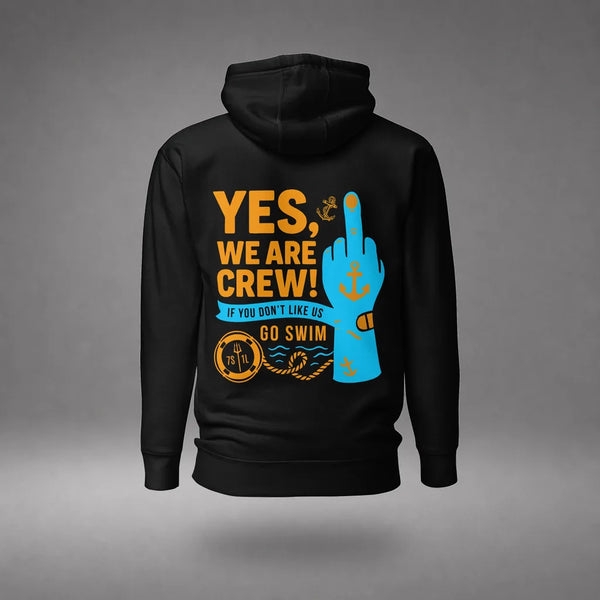
YES, WE ARE CREW.
Gear for the watchSeafarer T-Shirts · Crew Best SellersBuild your Sign On Set · Build your Sailor Set