
Martin Lex is the pen name of the 7S1L safety desk: SOLAS, lifesaving and firefighting gear, muster drills, emergency signals and safe work on board. Portrait is illustrative.
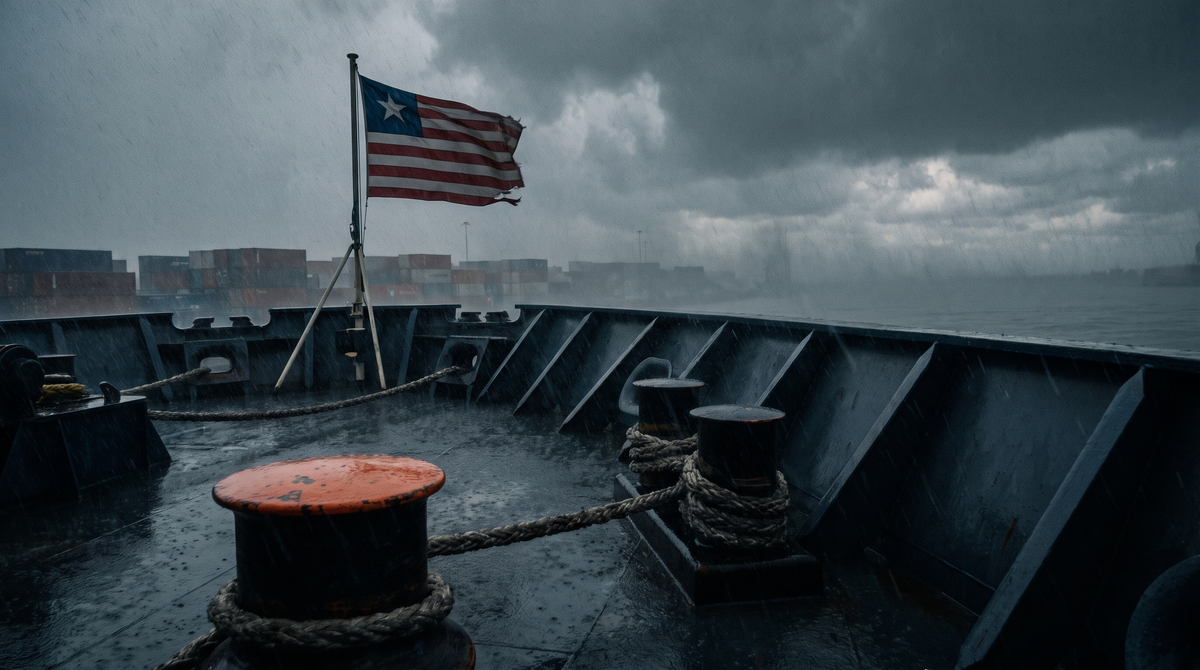
Since June 2023 Liberia has been the largest ship registry on earth: 424 million deadweight tons at the start of 2025 per UNCTAD, 17.4 percent of the world fleet. The register was set up in 1948 with help from a former US Secretary of State, and it has been run from the United States ever since. Today a private company, LISCR, manages it from Dulles, Virginia. Monrovia gets the fees. Your contract gets the law. That split is the heart of Liberia flag labor law: an American rulebook, administered from Virginia, flying a West African flag.
Before you sign a contract under the Liberian flag, know which laws apply. You can check your seafarer contract free in the MLC Checker Tool: select Liberia and it reads your SEA clause by clause against MLC 2006 and the verified Liberian flag facts.
Which law governs a Liberian SEA?
The Liberian Maritime Law, Title 21 of the Liberian Code, published as RLM-107. Chapter 10 covers shipping articles, wages, discharge and repatriation. Section 30 does something unusual: it adopts the non-statutory General Maritime Law of the United States as the law of Liberia. American concepts like maintenance and cure apply to your case, argued as Liberian law. Liberia was also the first state in the world to ratify the MLC, on June 7, 2006, and Marine Notice MLC-001 wires the convention into the register.
In practice, three layers sit over your signature. The statute fixes the floor. US General Maritime Law adds doctrines the statute never spells out: if an AB tears a shoulder rigging the gangway, maintenance and cure means the owner owes daily living costs and medical care up to maximum medical improvement. On top of both sits the MLC, with its minimum standards for hours of rest, food, accommodation and complaint handling.
Check the governing law clause in your SEA first. It should name Liberian law. A contract on a Liberian-flagged ship that quietly points somewhere else is a question for the crewing agent, in writing, before you fly. Ask two more things at the office: which CBA covers the vessel, and can you take a copy home. If the answer is a shrug, the shrug is the answer.
What happens to my pay if I get sick?
Read Section 336 slowly, because it decides real money. Full wages run only while you are sick or injured on board. From the day you are landed, the obligation drops to one third of base wages, for a maximum of 16 weeks. Board and lodging are covered up to 30 weeks, medical treatment until maximum cure and never less than 16 weeks. An oiler landed in a foreign port with a broken wrist lives on a third of base pay while it heals. If your CBA pays 100 percent sick wages, that CBA clause is worth more than most of your bonus lines. Check that the SEA names it.
At the kitchen table, put the SEA and the CBA side by side and find the sick pay clause. Many ITF-approved CBAs pay the full basic wage for a fixed period instead of the statutory third, and for a rating recovering ashore that gap is the difference between healing and borrowing. If the SEA does not name the CBA by its full title, ask the agent to write it in. A CBA that is not named in your contract is a CBA you will fight to enforce from a clinic bed in a port you did not choose.
Can the crew strike?
On board, effectively no. Section 358 makes any strike or picketing unlawful unless a majority of the crew votes by secret ballot, gives 30 days of written notice, and the conciliation and arbitration procedure of Section 359 has been followed to conclusion. By then the voyage is over. Your working lever under this flag is the complaint ladder, the ITF and port state control, not industrial action.
So learn the ladder before you need it. Every ship under the MLC carries an onboard complaint procedure: you raise the problem with your head of department or the master, and the procedure must list who to contact off the ship, including the flag administration. If the ship stalls, a port state control officer in the next berth can board and inspect. The full route for this flag, with the verified contacts and the paper trail that makes a complaint stick, is in the Liberia flag complaint guide. Read it before sign-on, not after the office stops answering.
What else sits in the fine print?
Claims arising out of the shipping articles expire after one year (Section 360). Annual leave vests only after 12 months of continuous service with the same vessel or employer (Section 333), so a nine month contract deserves a leave clause of its own in the SEA. The statute fixes no overtime percentage; the MLC notice says overtime should not be less than 1.25 times the basic hourly wage, so the number in your contract is the number that counts. On the protective side, your wages and clothing are exempt from court attachment (Section 332), and abandoning seamen is an offense under Section 351.
Three habits cover most of it. Diary the one year limit and keep signed copies of the articles, payslips and rest hour records from day one, because the clock under Section 360 runs with or without you. If your contract runs nine months, do not lean on Section 333: your paid leave must stand in the SEA itself, with a rate per month. And find the overtime number in your contract, then hold it against 1.25 times the basic hourly wage. The statute will not rescue a bad overtime clause. The number on the page is the deal.
Liberia flag labor law and MLC compliance
Liberia ratified the MLC before any other state, and MLC-001 sets out how the register applies the convention. At the gangway, the paper that matters is the Maritime Labour Certificate and its Declaration of Maritime Labour Compliance: ships of 500 GT and over on international voyages must carry both. DMLC Part I states the Liberian requirements. Part II states how the shipowner actually meets them, from recruitment and hours of rest to repatriation. The MLC requires these documents to be posted on board where the crew can read them. A master who cannot produce a current certificate is telling you something about the whole operation.
Certification is not comfort. A valid certificate means the systems passed inspection, not that your individual SEA is generous. The certificate protects the ship. The clauses protect you. That is why the reading happens before you sign, not after port state control finds a problem in Rotterdam.
Does the flag perform?
On port state control, yes. Liberia stands on the Paris MoU and Tokyo MoU White Lists, with roughly 6,300 Paris MoU inspections and 276 detentions across 2022 to 2024. A strong safety record and a thin labor floor can fly on the same mast. The verified administration contacts sit on our Liberia flag page. And how the other giant open registry answers the same questions, run as a state authority from Panama City rather than a company office in Virginia, is in the Panama flag labor law guide.
Where Liberia sits among open registries, second registers and national flags: the flag on the stern decides the law in your contract.
Before you sign: the Liberian flag checklist
Ten minutes with the documents at the kitchen table beats a dispute in a foreign port. Give the paperwork the same care as the sign-on set in your bag.
- Governing law: the SEA names Liberian law, Title 21. Anything else is a written question to the agent before you fly.
- CBA: named in full in the SEA, copy in hand, sick pay clause read against the one third floor of Section 336.
- Leave: a contract under 12 months carries its own paid leave clause with a rate, because Section 333 only vests leave at 12 months.
- Overtime: a written rate of at least 1.25 times the basic hourly wage, and a named system for recording hours.
- Repatriation: who pays, to where, and in which cases, in writing. Abandonment is an offense under Section 351, but you want a flight home, not a prosecution.
- Fees: you pay nothing for recruitment or placement. An agency that charges you for the job is breaking the rules explained in the manning agency fees guide.
- Deadlines: claims under the articles expire after one year (Section 360). Keep every signed page from day one.
The clauses that should stop you from signing under any flag are in the seafarer contract red flags guide.
The 90 second version
This flag in one video:
How the Liberia flag rates in port state control
Port state control keeps score on every flag. The regional inspection regimes publish each year which registers get detained most, and the ITF keeps its own list of flags of convenience. This is where Liberia stands on the current lists:
- Paris MoU (Europe and Canada): white list, rank 29 of 69, performance list valid July 1, 2026 to July 6, 2027.
- Tokyo MoU (Asia Pacific): high performance, inspections and detentions 2022 to 2024.
- ITF: listed as a flag of convenience, 2025 list.
- MLC 2006: party to the Convention.
These lists count detentions, not contracts. A white list flag can still sit under a bad SEA, and a black list flag tells you how much backing to expect from the administration when something goes wrong on board. The current rating of every flag we cover stands on the Liberia flag page, and the app report names MLC 2006 plus the flag at the top of every check, with the same rating next to it.
Source note
Liberian Maritime Law RLM-107, Marine Notice MLC-001, ILO NORMLEX ratification records, UNCTAD fleet data as of January 1, 2025, Paris MoU performance lists, and the ITF list of flags of convenience.
This article is editorial context for working crew, not legal advice. For a live dispute, use the complaint route above and get help from the ITF or a maritime lawyer.
FAQ
Is Liberia a flag of convenience?
Yes. The ITF lists Liberia as a flag of convenience because the register is open to shipowners from any country and is administered by a private company, LISCR, in the United States. Since June 2023 it is also the largest register in the world by tonnage.
What labor law applies on a Liberia-flagged ship?
The Liberian Maritime Law, Title 21 of the Liberian Code (RLM-107). Section 30 adds the General Maritime Law of the United States, and MLC 2006 applies through Marine Notice MLC-001. Your SEA and any named CBA sit on top of that floor.
Is Liberia flag labor law based on US law?
Partly. Title 21 is a Liberian statute, but Section 30 adopts the non-statutory General Maritime Law of the United States, so American doctrines such as maintenance and cure apply on Liberian ships, argued as Liberian law.
How much sick pay do seafarers get under the Liberian flag?
Full wages while sick or injured on board. After landing, Section 336 drops the obligation to one third of base wages for up to 16 weeks, with board and lodging up to 30 weeks and medical care until maximum cure, never less than 16 weeks. A CBA can pay more, and many ITF-approved agreements do.
Can seafarers strike on a Liberian ship?
Effectively not. Section 358 requires a majority secret ballot, 30 days of written notice and a completed conciliation and arbitration procedure before a lawful strike. The practical route is the onboard complaint procedure, the flag administration and port state control.
7SHORT1LONG® is a Seafarer Identity Brand. We build seafarer hoodies and tees for crew who read before they sign. The world's biggest flag is a contract, and contracts get read.
YES, WE ARE CREW.
Gear for the watchSeafarer T-Shirts · Crew Best SellersUnited States Sailor Set · Build your Sailor Set