
Martin Lex is the pen name of the 7S1L safety desk: SOLAS, lifesaving and firefighting gear, muster drills, emergency signals and safe work on board. Portrait is illustrative.
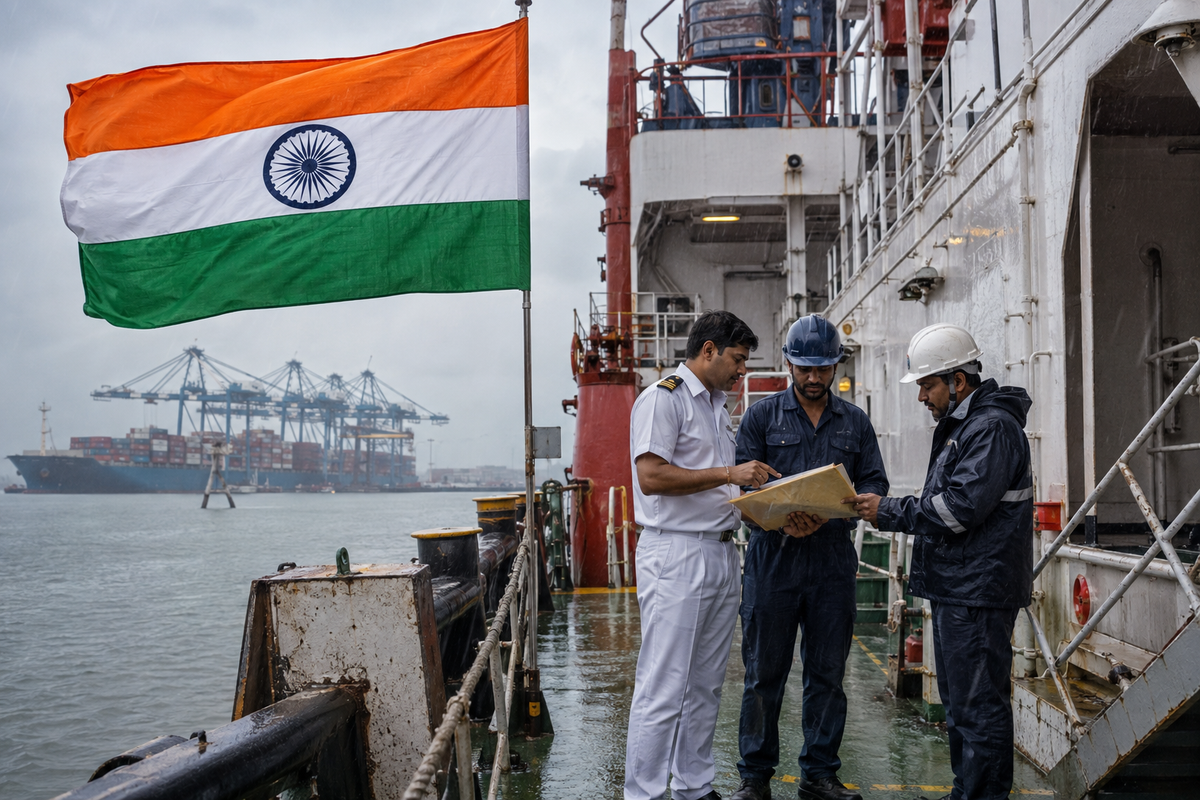
Second only to the Philippines, India puts more crew on the world fleet than almost any other country, and most of them sail under foreign flags. The Indian flag itself is a different animal from the open registers those crews usually sign with: a national register regulated by the Directorate General of Shipping in Mumbai, with maritime labour rules written in 2016 and a grievance desk that issues a reference number within 48 hours. That desk is the detail worth knowing. On a flag where the administration answers, a complaint is a paper trail, not a message in a bottle.
Before you sign a contract under the Indian flag, know which laws apply. You can check your seafarer contract free in the MLC Contract Check: pick India, and the report reads your SEA against MLC 2006 and the verified Indian facts.
The law under an Indian SEA
India registered its MLC 2006 ratification on October 9, 2015. The Convention was written into national law the following year as the Merchant Shipping (Maritime Labour) Rules 2016, made under the Merchant Shipping Act 1958, the statute that has governed Indian ships and Indian seafarers for decades. Two rules in that text matter at the desk before you sign.
A signed seafarers' employment agreement is mandatory. The Rules require a written SEA, signed by both sides, before you work. No SEA, no lawful employment on an Indian ship, and the recruitment and placement agency that put you on board is itself regulated by the DGS.
Seven days of notice, minimum. The Rules set a floor of seven days for notice to end the agreement, on either side. A contract that says three days, or that lets the owner end it on arrival at the next port with no notice, is below the Indian floor as well as the MLC one.
The Crew Branch and the 48-hour rule
Most flag states tell you to complain and leave it there. The DGS runs a seafarers' grievance redressal mechanism with a written promise: every grievance is registered and acknowledged within 48 hours, with a reference number. Grievances go to the Deputy Director General (Crew Branch) at the Directorate's office in Kanjurmarg, Mumbai, by e-mail or by post.
Why that matters: a shipowner who stalls on wages is betting that you will give up before anyone official notices. A DGS reference number changes the bet. It is dated, it names the ship and the company, and it is the first thing an ITF inspector or a port state control officer asks for when you say you already complained. File early, keep the acknowledgement, and attach the payslip and the rest hour record. The verified Crew Branch address stands on the India flag page of the checker.
What the MLC floor gives you on an Indian ship
Because India ratified and legislated, every Indian-flagged ship of 500 gross tons or more on international voyages carries a Maritime Labour Certificate and a Declaration of Maritime Labour Compliance. Both must be on board and available to you. Behind the certificate stand the Convention minimums that the 2016 Rules carry into Indian law:
- Wages paid at least monthly, with a monthly account of pay and deductions.
- At least 10 hours of rest in any 24-hour period and 77 hours in any seven days, recorded and countersigned.
- Paid annual leave of at least 2.5 calendar days per month of employment.
- Repatriation at the shipowner's cost, with a maximum period of service before it is due.
- Medical care and sick pay after illness or injury.
- No recruitment fees charged to you by the placement agency.
- A written on-board complaint procedure handed over with the SEA.
Indian ships commonly sail under a collective agreement negotiated with the national seafarer unions. If your SEA names one, the agreement sets the wage scale and the overtime rate above the floor; make sure it is attached, not just mentioned. How the basic wage relates to the ILO minimum is in our seafarer minimum wage guide.
How the Indian flag rates in port state control
India's inspection record is middling on both sides of the world. On the Paris MoU performance list valid July 1, 2026 to July 6, 2027, the flag stands on the grey list at rank 44 of 69. The Tokyo MoU rates it medium performance for 2022 to 2024. The ITF does not list India as a flag of convenience: Indian ships are, as a rule, Indian owned and Indian crewed under Indian law.
A grey list flag means a port state control officer in Europe weighs the flag into the ship's risk profile and boards more often than for a white list ship. That attention falls on the crew documents too: the SEA, the rest hour sheets, the payslips. On a national flag with a working grievance desk, those documents are also the evidence the DGS will ask for. Keep them.
The two-flag life of an Indian seafarer
An Indian third engineer on a Marshall Islands tanker has a Marshall Islands SEA, and the law under it is Marshall Islands law. Indian flag law does not follow him on board. What does follow him is the DGS regulation of the recruitment and placement agency that deployed him: a complaint about the agency, about fees or a broken promise at the desk, goes to Mumbai. A complaint about the ship goes to the flag, to port state control and to the ITF. Knowing which door is which saves weeks. How the biggest foreign registries treat an Indian crew member is in our guides to Marshall Islands flag labor law and Liberia flag labor law.
Indian flag in the contract: what I check before sign-on
- The SEA names India as the flag and the Merchant Shipping Act and the 2016 Rules as the governing law.
- Notice period at least seven days, on both sides.
- Basic wage, overtime and leave pay in separate lines, with the collective agreement attached if one is named.
- The repatriation clause names the shipowner as the payer and sets a maximum time on board.
- No placement fee was charged to you, in any form.
- You received the on-board complaint procedure with the SEA and you know the Crew Branch address.
The general warning signs, clause by clause, are in our guide to seafarer contract red flags. How India compares with every other register is in our guide to flags of convenience and your contract.
How the India flag rates in port state control
Port state control keeps score on every flag. The regional inspection regimes publish each year which registers get detained most, and the ITF keeps its own list of flags of convenience. This is where India stands on the current lists:
- Paris MoU (Europe and Canada): grey list, rank 44 of 69, performance list valid July 1, 2026 to July 6, 2027.
- Tokyo MoU (Asia Pacific): medium performance, inspections and detentions 2022 to 2024.
- ITF: not listed as a flag of convenience, 2025 list.
- MLC 2006: ratified 09 Oct 2015.
These lists count detentions, not contracts. A white list flag can still sit under a bad SEA, and a black list flag tells you how much backing to expect from the administration when something goes wrong on board. The current rating of every flag we cover stands on the India flag page, and the app report names MLC 2006 plus the flag at the top of every check, with the same rating next to it.
Source note
ILO NORMLEX ratification register for MLC 2006 (India, October 9, 2015); the Merchant Shipping Act 1958; the Merchant Shipping (Maritime Labour) Rules 2016; Directorate General of Shipping notice on the seafarers' grievance redressal mechanism; Paris MoU performance lists valid July 1, 2026 to July 6, 2027; Tokyo MoU Annual Report 2024, Table 8; ITF list of FOC registries 2025. Flag facts verified September 1, 2026. This article is editorial context for working seafarers, not legal advice.
FAQ
Has India ratified MLC 2006?
Yes. India registered its ratification on October 9, 2015 and implemented the Convention through the Merchant Shipping (Maritime Labour) Rules 2016 under the Merchant Shipping Act 1958.
Which law governs a seafarer contract on an Indian-flagged ship?
The Merchant Shipping Act 1958 and the Merchant Shipping (Maritime Labour) Rules 2016. The Rules require a signed seafarers' employment agreement and set a minimum notice period of seven days.
How do I file a grievance with the Directorate General of Shipping?
By e-mail or post to the Deputy Director General (Crew Branch) in Mumbai. The grievance redressal mechanism registers the complaint and issues an acknowledgement with a reference number within 48 hours.
How does the Indian flag rate in port state control?
On the Paris MoU performance list valid July 2026 to July 2027 India stands on the grey list, rank 44 of 69. The Tokyo MoU rates the flag medium performance for 2022 to 2024. The ITF does not list India as a flag of convenience.
I am an Indian seafarer on a foreign-flag ship. Does Indian flag law apply?
No. The flag state's law governs the ship and the SEA. The DGS still regulates the recruitment and placement agency that deployed you, so a complaint about the agency goes to Mumbai; a complaint about the ship goes to the flag, port state control and the ITF.
7SHORT1LONG® is a Seafarer Identity Brand. We build for the crews who keep the engine room running from Kandla to Rotterdam: ship department crew apparel that names the trade, and a sign on set for the day the contract starts.
YES, WE ARE CREW.
Gear for the watchSeafarer T-Shirts · Crew Best SellersIndian Sailor Set · Build your Sailor Set