Martin Lex is the pen name of the 7S1L safety desk: SOLAS, lifesaving and firefighting gear, muster drills, emergency signals and safe work on board. Portrait is illustrative.
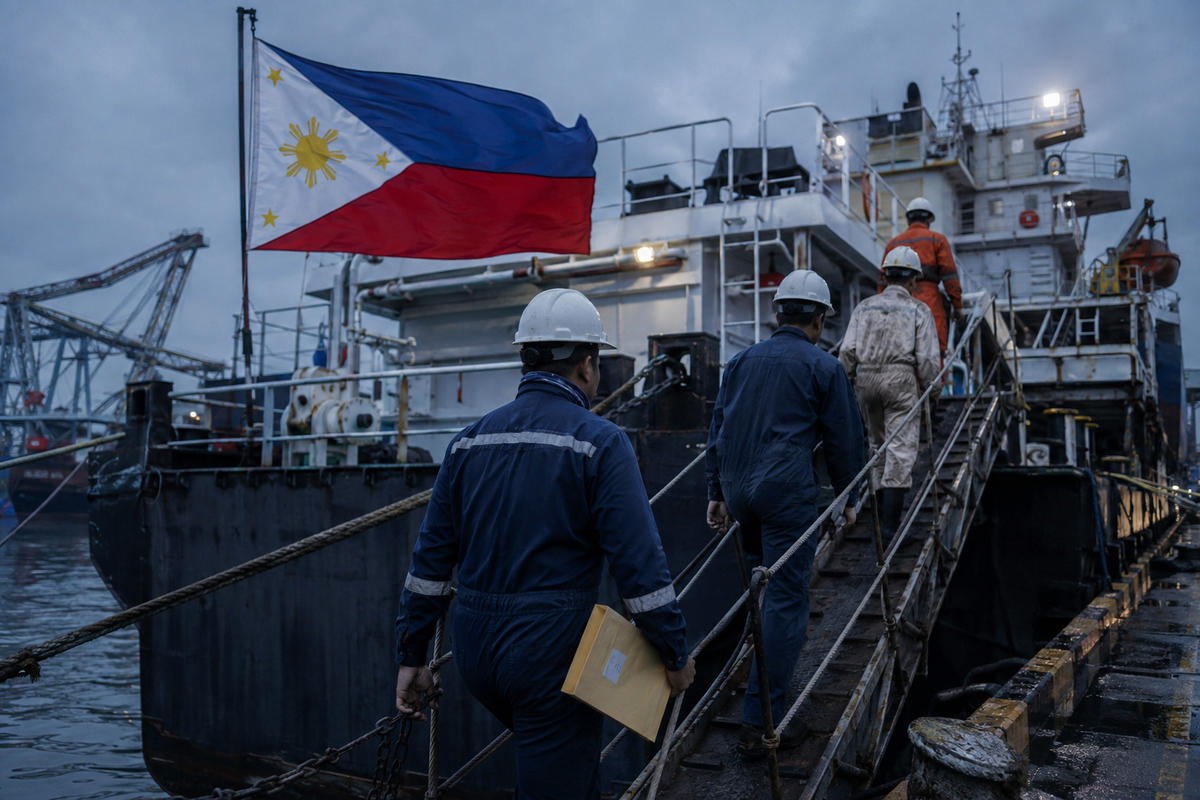
Ask any watch on any ship where the crew is from and the answer, more often than not, is the Philippines. The country supplies more seafarers than any other, and nearly all of them work under foreign flags. That is why the Philippine flag itself is a special case: a national register run by a state whose seafarers mostly sail elsewhere, and whose MLC paperwork for the ships it does flag is signed by the labor department, not the maritime authority. If you hold a Philippine passport and a foreign-flag contract, the flag on the stern decides which rules apply, and the Department of Migrant Workers stays your home-country route. If the ship is Philippine-flagged, this guide is for you.
Before you sign a contract under the Philippine flag, know which laws apply. You can run your seafarer contract through the free MLC Checker Tool: pick the Philippines, and the report reads your SEA against MLC 2006 and the verified Philippine facts.
Three agencies, one contract
Most flag states have one maritime administration that does everything. The Philippines splits the job three ways, and a seafarer who knows the split saves weeks when something goes wrong.
The Department of Labor and Employment (DOLE) is the competent authority for MLC 2006 on Philippine-registered ships. It issues the Declaration of Maritime Labour Compliance Part I, the document that spells out how the Philippines implemented each requirement of the Convention, under Department Order 130-13. On shore, DOLE runs a conciliation and mediation service that a seafarer on a Philippine-flagged ship can use for a wage or contract dispute.
The Maritime Industry Authority (MARINA) is the single maritime administration. It certifies the ship, issues the circulars on inspection and certification, and keeps the register. MARINA is where the ship's papers live; DOLE is where the crew's rights live.
The Department of Migrant Workers (DMW) is not a flag state body at all. It handles Filipino seafarers deployed on foreign-flag ships: the standard employment contract, the manning agency licences, the single-entry complaint that opens conciliation. If your ship flies the Philippine flag, the DMW is not your first door. If your ship flies Panama or Liberia, it is.
The two-flag life of a Filipino seafarer
Here is the confusion the manning agency desk rarely clears up. A Filipino AB on a Panama-flagged bulker has two sets of paper: the DMW standard employment contract, which the DMW SEC replaced the old POEA contract with in 2026, and the seafarer employment agreement under Panamanian law. The DMW SEC is home-country protection. It sets a floor for the Filipino seafarer that the manning agency and the principal answer for in Manila. The flag state law sits under the ship. Both apply, and when they differ, the one that gives you more usually wins, because the DMW contract says so and MLC 2006 says the flag must not fall below the Convention.
On a Philippine-flagged ship there is only one flag to read. The SEA is governed by Philippine law, DOLE signs the declaration, and the DMW steps aside. That is simpler, and it is rarer: most Filipino crew never sign under their own flag in a whole career. How the two-flag situation plays out under the biggest foreign registries is in our guides to Panama flag labor law and Liberia flag labor law.
How the Philippine flag rates in port state control
The flag's inspection record is middling in Europe and good in Asia. On the Paris MoU performance list valid July 1, 2026 to July 6, 2027, the Philippines stands on the grey list at rank 52 of 69 flags. The Tokyo MoU, which covers the ports most Philippine-flagged ships actually call at, rates the flag high performance for 2022 to 2024. The ITF does not list the Philippines as a flag of convenience: ships under this flag are owned, as a rule, by Philippine companies, and the crewing is domestic.
For you the grey list means one practical thing. A port state control officer in Rotterdam or Antwerp sees a grey list flag and weighs it into the risk profile of the ship. More inspections, more detentions, more attention to the crew documents, including your SEA, your rest hour records and your payslips. Keep them in order. The same rating stands on the Philippines flag page of the checker, next to the verified contacts.
What the MLC floor gives you on a Philippine-flagged ship
Because the Philippines ratified MLC 2006 and DOLE issues the DMLC Part I, every Philippine-flagged ship of 500 gross tons or more on international voyages must carry a Maritime Labour Certificate. Behind that certificate stand the Convention minimums, and they are the lines to check in the SEA before you sign:
- A written seafarer employment agreement, signed by you and the shipowner or the shipowner's representative, with a copy you keep.
- Wages paid at least monthly, with a monthly account of what was paid and what was deducted.
- At least 10 hours of rest in any 24-hour period and 77 hours in any seven-day period, recorded and countersigned.
- Paid annual leave of at least 2.5 calendar days per month of employment.
- Repatriation at the shipowner's cost, and a maximum period of service on board before repatriation is due.
- Medical care and sick pay after illness or injury, within the limits the flag sets.
- A written on-board complaint procedure, handed to you with the SEA.
Where the SEA names a collective agreement, the agreement is what lifts you above that floor. Where it names none, the floor is the offer. The general warning signs, clause by clause, are in our guide to seafarer contract red flags, and the basic wage line is covered in the seafarer minimum wage guide.
If something goes wrong on board
The route on a Philippine-flagged ship runs in the order MLC 2006 sets. First the on-board procedure: head of department, then the master, in writing, with a copy for you. Then DOLE, the competent authority, through its conciliation and mediation service, which is built for exactly this kind of dispute and does not require a lawyer. In a foreign port, port state control and the ITF inspector apply the Convention to the ship whatever its flag. Do not wait for the ship to come home to Manila: a complaint filed in Singapore or Busan with the rest hour sheet and the payslip attached is a complaint with evidence.
For Filipino crew on foreign flags the door is different. The DMW single-entry complaint opens conciliation with the manning agency and the principal in the Philippines, and it sits alongside the flag state route, not instead of it. Use both. The verified DOLE, MARINA and DMW contacts stand on the Philippines flag page of the checker.
Philippine flag in the contract: what I check before sign-on
- The SEA names the Philippine flag and Philippine law, and DOLE, not the DMW, as the competent authority. If the ship is Philippine-flagged and the contract is a DMW form, ask why.
- Basic wage, overtime and leave pay stand in separate lines.
- The rest hour rule is written in, 10 in 24 and 77 in 7, and the record is on board.
- The repatriation clause names the shipowner as the payer and sets a maximum time on board.
- The on-board complaint procedure came with the SEA, in writing.
- The Maritime Labour Certificate and the DMLC are on board and available to crew. Asking to see them is normal, not hostile.
How the Philippine flag compares with every other register is in our guide to flags of convenience and your contract. The step by step use of the checker itself is in How to Use the MLC Contract Check.
How the Philippines flag rates in port state control
Port state control keeps score on every flag. The regional inspection regimes publish each year which registers get detained most, and the ITF keeps its own list of flags of convenience. This is where Philippines stands on the current lists:
- Paris MoU (Europe and Canada): grey list, rank 52 of 69, performance list valid July 1, 2026 to July 6, 2027.
- Tokyo MoU (Asia Pacific): high performance, inspections and detentions 2022 to 2024.
- ITF: not listed as a flag of convenience, 2025 list.
- MLC 2006: ratified 20 Aug 2012.
These lists count detentions, not contracts. A white list flag can still sit under a bad SEA, and a black list flag tells you how much backing to expect from the administration when something goes wrong on board. The current rating of every flag we cover stands on the Philippines flag page, and the app report names MLC 2006 plus the flag at the top of every check, with the same rating next to it.
Source note
ILO NORMLEX ratification register for MLC 2006 (Philippines, August 20, 2012); Department of Labor and Employment Department Order 130-13; Maritime Industry Authority circulars on MLC certification; Department of Migrant Workers standard employment contract 2026; Paris MoU performance lists valid July 1, 2026 to July 6, 2027; Tokyo MoU Annual Report 2024, Table 8; ITF list of FOC registries 2025. Flag facts verified September 1, 2026. This article is editorial context for working seafarers, not legal advice.
FAQ
Has the Philippines ratified MLC 2006?
Yes. The Philippines registered its ratification on August 20, 2012. The Department of Labor and Employment issues the Declaration of Maritime Labour Compliance Part I for Philippine-registered ships under Department Order 130-13.
Which authority handles MLC matters on a Philippine-flagged ship?
Three share the work: the Department of Labor and Employment signs the DMLC Part I and runs conciliation and mediation on shore, the Maritime Industry Authority certifies the ship, and the Department of Migrant Workers handles Filipino seafarers deployed on foreign-flag ships.
I am Filipino but my ship flies another flag. Does Philippine flag law apply?
No. The flag on the stern decides the law under your SEA. Your DMW standard employment contract and the DMW complaint route still apply as your home-country protection, but the flag state's law governs the ship.
How does the Philippine flag rate in port state control?
On the Paris MoU performance list valid July 2026 to July 2027 the Philippines stands on the grey list, rank 52 of 69. The Tokyo MoU rates it high performance for 2022 to 2024. The ITF does not list it as a flag of convenience.
Where do I complain about a Philippine-flagged ship?
Start with the on-board procedure, then the Department of Labor and Employment through its conciliation and mediation service. In a foreign port, port state control and the ITF inspector apply MLC 2006 to the ship regardless of flag.
What replaced the POEA contract for Filipino seafarers?
The Department of Migrant Workers standard employment contract, the DMW SEC, replaced the POEA contract in 2026. It applies to Filipino seafarers deployed on foreign-flag ships and runs alongside the flag state's law, not instead of it.
7SHORT1LONG® is a Seafarer Identity Brand. The Filipino crew is the backbone of the world fleet, and the seafarer t-shirts and the sign on set were built for the day the contract starts, whatever the flag. Read the flag first. Then pack.
YES, WE ARE CREW.
Gear for the watchSeafarer T-Shirts · Crew Best SellersFilipino Sailor Set · Build your Sailor Set