Martin Lex is the pen name of the 7S1L safety desk: SOLAS, lifesaving and firefighting gear, muster drills, emergency signals and safe work on board. Portrait is illustrative.
Safety at sea is the discipline that keeps a ship predictable when conditions are not. It lives in watch handovers, toolbox talks, enclosed-space permits, mooring stations, engine-room rounds, fire doors, muster lists, and the way crew react when an alarm sounds.
For professional seafarers, safety is not a poster on a bulkhead. It is the difference between routine work and a bad day becoming worse.
This article explains what safety at sea actually means on a working ship: the culture behind it, the places where crews get hurt, and the one factor that quietly undermines everything else, fatigue.
What safety at sea includes
Safety at sea includes training, procedures, equipment, communication, maintenance, leadership, and crew attention. A lifeboat is only one part of it. The human part matters just as much.
A deck rating checking a line, an engineer logging machinery readings, a cruise crew member guiding guests during a drill, or a cadet asking the right question during a briefing all contribute to the safety system.
The legal framework behind that system is SOLAS, the convention that sets construction, fire protection, and life-saving standards for ships worldwide. We keep the treaty detail in our guide to what SOLAS is. This article stays on deck, with the crew.
Where safety becomes real
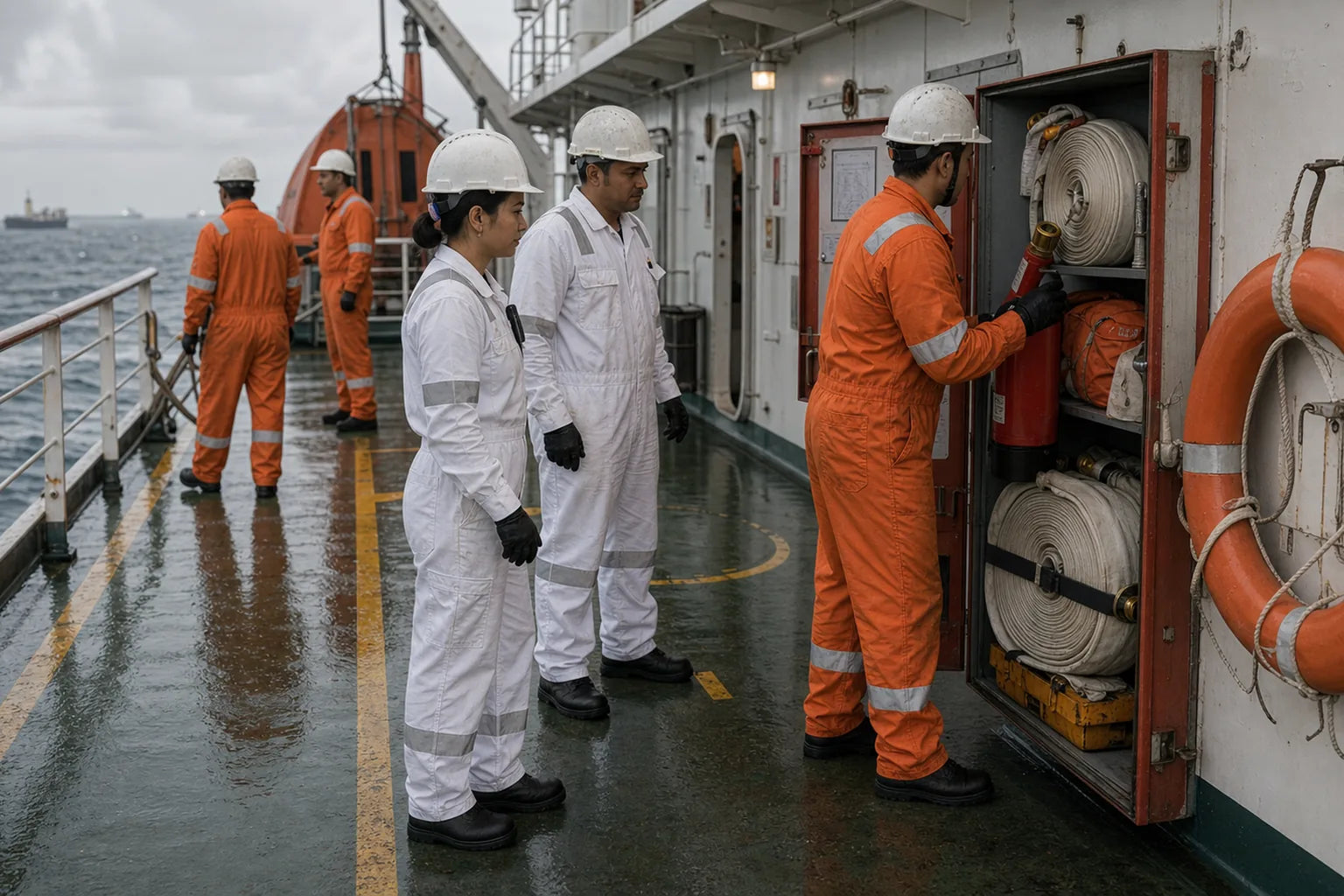
It becomes real at the gangway when access is controlled. It becomes real on the bridge when visibility drops. It becomes real in the engine room when a leak is noticed early. It becomes real during a fire drill when people move to the correct station without confusion.
Good safety culture is not loud. It is consistent. It shows up before the emergency.
What safety culture looks like in practice
Every ship carries a safety management system on paper. Culture is what happens when the paper meets a Tuesday afternoon job on deck. Four tools show up on almost every well-run vessel, whatever the flag.
Stop-work authority
Any crew member can halt a job they believe is unsafe. An AB who does not like the look of a sling can stop a lift. An oiler who spots a missing guard can stop a pump job. No permission needed, no reprisal afterward. Most companies have this written down. The real test is whether a rating actually uses it in front of the chief officer, and what happens to him when he does.
The toolbox talk
Five minutes at the job site before work starts. Who does what, what can go wrong, what stops the job. On a good ship the bosun runs it as a conversation, not a signature hunt. The talk that catches a wrong assumption before the first tool comes out is worth more than any poster in the mess room.
Near-miss reporting
A shackle drops from the crane and hits nobody. On a weak ship, that story dies on deck. On a strong ship it gets written up, because a system that only counts injuries learns nothing until someone is already hurt. Near-miss reports are how a ship finds its weak points while they are still free.
Permit to work
Hot work, working aloft, electrical isolation, enclosed spaces. High-risk jobs need a signed permit before anyone starts, and the permit forces the checks into a fixed order: isolate, test, ventilate, brief, then work. A permit is not bureaucracy. It is a checklist that has been paid for in lives.
0600, ballast tank inspection
What that looks like in practice. A bulk carrier at anchor, 0600. The chief officer, the bosun, and one AB stand at the manhole of a topside ballast tank due for inspection. The blowers have been running since the previous evening. The chief officer lowers the gas meter on a line and tests the atmosphere at three depths, top, middle, bottom. He wants the oxygen reading where normal air sits, close to 21 percent, and nothing on the toxic gas channels.
Only then does the permit get signed. The AB stays at the manhole as standby man with a radio and does not leave, whatever else happens on deck. Rescue equipment is rigged at the opening before the first boot goes down the ladder. Nobody trusts their nose. The tank looked harmless yesterday too.
That is safety at sea. Not a slogan. A sequence.
Where crews get hurt
Accident reports across flag states keep pointing at the same places on board.
Enclosed spaces. Cargo holds, ballast tanks, chain lockers, void spaces, CO2 rooms. An oxygen-depleted atmosphere looks and smells like air. InterManager, the trade association of ship managers, has tracked these casualties since 1999 and counts well over 100 seafarers killed in enclosed spaces, plus dozens of shore workers, and it argues that most incidents never reach the IMO casualty database at all. A grim pattern repeats in the reports: many of the dead are rescuers who went in after a collapsed shipmate without testing or breathing apparatus.
Mooring decks. A line under load stores enormous energy. When it parts, it snaps back faster than anyone can react, which is why modern practice treats the whole mooring area as a danger zone rather than painting safe spots on deck. Ratings die at mooring stations doing a job they have done a hundred times before.
Slips, trips, and falls. Wet decks, ladder rungs, hatch coamings, moving between deck levels in the dark. Unspectacular, constant, and one of the most common ways seafarers get injured on any ship type.
The engine room. Hot surfaces, fuel and hydraulic oil under pressure, rotating machinery, steam. An engineer answering an unattended machinery alarm alone at 0300 is doing one of the more exposed jobs on board.
The categories differ by ship type, and daily risk on a tanker is not the same as on a cruise ship. The pattern does not change: routine work, familiar space, one skipped step.
 Free crew appSeafarer Contract CheckCheck your contract clause by clause against MLC 2006 and flag state regulations. The check is free. On iPhone, Android or in the browser.
Fatigue is a safety factor
A tired crew defeats every procedure on the ship. The Maritime Labour Convention, 2006 sets the floor: at least 10 hours of rest in any 24-hour period and 77 hours in any 7-day period, with rest divided into no more than two blocks, one of them at least six hours long. Port calls, cargo watches, inspections, and drills all eat into those hours, and a 6-on-6-off watch schedule leaves no margin at all.
Fatigue is not weakness. It is a physical state that slows reaction and narrows attention, on the bridge as a lookout and in the engine room at the workbench. Rest hours are recorded on board precisely because they are a safety barrier, not a comfort. The longer strain of contract life, sleep, isolation, and pressure is covered in our guide to mental health for seafarers.
Your rest hour terms start in your employment agreement, before you ever climb the gangway. The free MLC Contract Check reads a contract clause by clause against MLC 2006 in about a minute, in your browser, no account. Checking before sign-on is itself a safety habit.
Common safety areas on board
Shipboard safety usually touches navigation, fire prevention, life-saving appliances, communication systems, enclosed spaces, mooring operations, working aloft, hot work, cargo handling, pollution prevention, and fatigue management. The rules behind these areas are written and updated at the IMO.
Each area has procedures because the ship is a working environment. Steel, weather, machinery, cargo, confined spaces, and time pressure do not forgive vague attention.
The signal behind the name
Seven short blasts and one long: the General Emergency Alarm under SOLAS. Stop, muster, wait for orders. It is not the order to abandon ship, and a crew member who confuses the two moves in the wrong direction under pressure. What the alarm sounds like, and what happens on board after it, is covered on the cruise ship emergency alarm page, including an original recording from a crew drill. The full background of the signal is in what 7 short and 1 long means on a ship.
How this connects to 7SHORT1LONG
7SHORT1LONG® takes its name from that signal. It is a reminder that crew safety depends on people knowing what to do before the alarm sounds, not after.
That is why drill language runs through the safety at sea collection: a man overboard t-shirt, a fire drill t-shirt, a maritime safety drill hoodie. Designs for people who have stood a muster station in the rain and know the difference between a drill and a Tuesday.
7S1L is a Seafarer Identity Brand. Official procedures always come from the vessel, the company, the flag state, and the maritime authorities.
Source note
For official safety convention context, see the International Maritime Organization overview of SOLAS. Rest hour minimums are set in the Maritime Labour Convention, 2006 of the International Labour Organization. Enclosed space casualty figures come from InterManager, which has recorded these incidents since 1999. This article is editorial context for crew and readers, not legal advice and not an operational procedure. Your vessel's safety management system and your company's instructions always take precedence.
FAQ
What is safety at sea?
Safety at sea is the system of training, equipment, procedures, maintenance, and crew behavior used to prevent incidents and respond to emergencies on ships.
What does 7 short blasts and 1 long blast mean?
It is the General Emergency Alarm under SOLAS. It means go to your muster station and wait for orders. It is not the order to abandon ship.
Who is responsible for safety on board?
Everyone has a role. The master carries overall responsibility, but officers, engineers, ratings, hotel crew, cadets, and contractors all affect safety through their actions.
What is stop-work authority on a ship?
Stop-work authority is the right of any crew member to halt a job they believe is unsafe, without asking permission first and without reprisal. It is written into most shipboard safety management systems.
Why are enclosed spaces so dangerous on ships?
Because an oxygen-depleted or toxic atmosphere looks and smells like normal air. InterManager has counted well over 100 seafarer deaths in enclosed spaces since 1999, and many of the victims were rescuers who entered without testing the atmosphere or wearing breathing apparatus.
How many hours of rest do seafarers get under MLC 2006?
MLC 2006 requires at least 10 hours of rest in any 24-hour period and 77 hours in any 7-day period. Rest may be split into no more than two blocks, and one block must be at least six hours long.
YES, WE ARE CREW.
Gear for the watchSafety at Sea Collection · Seafarer T-ShirtsBuild your Sign On Set · Build your Sailor Set