Martin Lex is the pen name of the 7S1L safety desk: SOLAS, lifesaving and firefighting gear, muster drills, emergency signals and safe work on board. Portrait is illustrative.
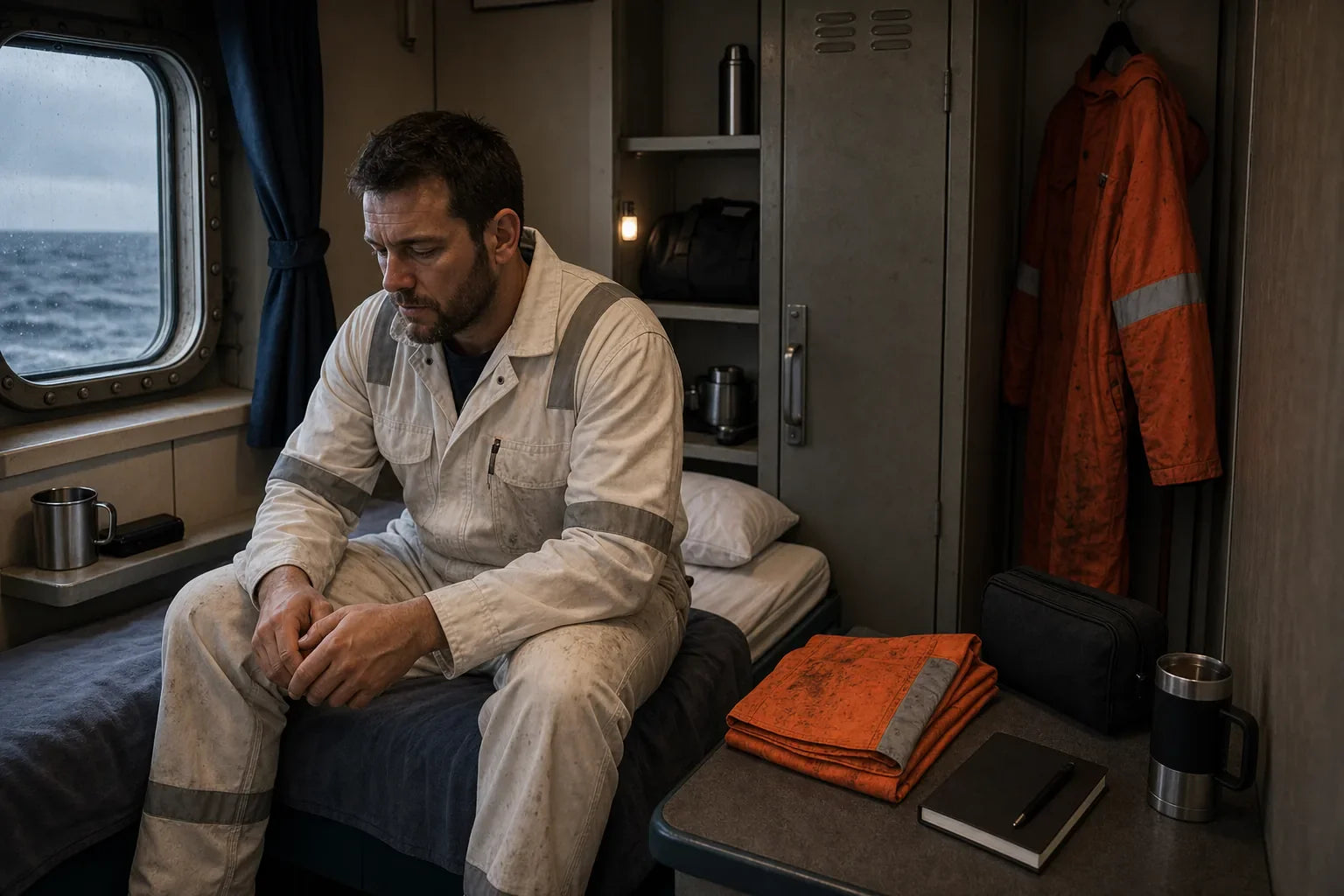
Mental health at sea is not weakness. Seafarer mental health is shaped by the working reality of long contracts, broken sleep, missed family moments, heavy weather, shared cabins, port pressure, and the responsibility of keeping a ship moving.
This article is not medical advice. If a crew member is in immediate danger, talking about self-harm, unable to function safely, or facing a crisis on board, use the vessel's emergency chain, contact the master or designated officer, and seek professional medical support immediately.
Why seafarer mental health needs plain language
A seafarer can be surrounded by people and still feel alone. The mess room can be full, the engine room can be loud, the bridge can be busy, and the cabin can still feel very far from home.
Long contracts, watch schedules, fatigue, cultural distance, limited shore leave, poor connectivity, and pressure from home build quietly. Crew learn to keep working because the ship needs them. That does not mean the pressure is small.
Most articles about this subject are written for shipping companies. This one is written for the people standing the watch. If you want the wider picture of the job itself, read our honest look at life at sea and working at sea jobs first. This page stays on one question: what the pressure does to a person, and what actually helps.
What the research on seafarer mental health shows
This is not a niche concern, and it is documented. A study by Yale University, commissioned by the ITF Seafarers' Trust and published in 2019, surveyed 1,572 serving seafarers across ranks, vessel types, and flags. Within the two weeks before the survey, 25 percent showed symptoms of depression, 17 percent reported anxiety, and 20 percent had thought about suicide or self-harm. The same study found something every safety officer should read twice: depression and anxiety were linked to a higher likelihood of injury and illness on board. The full report is public on the ITF Seafarers' Trust website.
The trend lines are not improving on their own. The Mission to Seafarers publishes the quarterly Seafarers Happiness Index, built from crew survey responses. In the Q2 2026 report overall happiness fell to 6.87 out of 10, and shore leave scored 5.72, the lowest category by a clear margin. Crew described time ashore sacrificed to short port stays, terminal restrictions, and workload. ISWAN, the charity behind the SeafarerHelp helpline, has reported record quarterly levels of mental health related contacts, including calls from seafarers in acute distress.
One honest caveat. Exact percentages vary between studies, fleets, ranks, and trade routes, and self-reported surveys have limits. The pattern does not vary: a meaningful share of working crew carries depression, anxiety, or worse through their contracts, mostly in silence.
What stress can look like on board
Poor sleep. Anger. Withdrawal. Mistakes during routine tasks. Loss of appetite. Low mood. Constant worry. Feeling numb.
It can also show up as silence. The person stops joining mess room conversation. Stops calling home. Stops caring about small routines.
On a ship, those changes matter. A tired deck officer, a distracted engineer, an isolated cadet, an overloaded steward, or an exhausted rating becomes less safe long before anyone asks for help.
The pressure points, one by one
Rest hours and fatigue
Fatigue is the most measurable pressure on this list because the law defines it. Under MLC 2006 Standard A2.3, a seafarer must get at least 10 hours of rest in any 24 hour period and at least 77 hours in any 7 day period. Rest may be split into no more than two periods, one of which must be at least 6 hours long. The ILO publishes the standard in full.
Every watchkeeper knows the gap between the record sheet and the body. A 6 on 6 off rotation technically fits the numbers. Add cargo operations, port arrivals at 0300, drills, inspections, and pilot stations, and the rest becomes fragments. Fragmented sleep is not the same as sleep. Chronic fatigue flattens mood, shortens tempers, and makes small problems feel unsolvable. If your rest hour records are being adjusted to look compliant, that is a working conditions problem, and it belongs to the formal route further down this page.
Contract length and extensions
A contract has an end date for a reason. The human mind paces itself toward that date. When the office asks for "one more month" at day 240, the extension costs more than the calendar suggests, because the finish line the seafarer was running toward just moved.
Know what your contract actually says before you sign it. Duration, extension terms, and rest hour clauses are exactly the kind of text that gets skimmed at the manning agency office. The free MLC Contract Check reads a contract clause by clause against MLC 2006 in about a minute, in the browser, with no account. Pair it with our guide to seafarer employment agreement red flags. A contract you understand is one less thing grinding at you mid-ocean.
Distance from family
The hardest calls are the ones you miss. A child's first day of school happens in a port with no signal. A parent gets sick and the next WiFi package costs half a day's pay. Connectivity on many ships has improved, and the Seafarers Happiness Index has repeatedly linked better internet to better crew morale, but access is still uneven between companies and vessel types.
What helps is preparation, not hope. Sort out data plans, messaging apps that work on weak connections, and a calling routine before you fly out. We keep a practical list in apps for seafarers. A fixed call schedule, even a short one, beats random attempts that fail and leave both sides frustrated.
Food, exercise, and the body
Mood follows the body more than most crew want to admit. Months of fried galley food, no daylight for engine room staff, and a gym that is a single broken treadmill add up. You cannot control the provisions budget. You can control a few things: plate choices when options exist, water instead of the fourth coffee on watch, and 20 minutes of movement most days, even if that is stairs and a resistance band in the cabin.
Shared cabins and no off switch
Ashore, a bad day at work ends when you go home. At sea, you live inside your workplace. On many vessels, especially cruise ships, you share the cabin too. There is no room where you are not crew. That constant low-level exposure, no true privacy and no true off switch, is one of the least discussed loads on seafarer mental health. Even small territory helps: a curtain closed around the bunk, headphones, an agreed quiet hour with the cabin mate.
 Free crew appSeafarer Contract CheckCheck your contract clause by clause against MLC 2006 and flag state regulations. The check is free. On iPhone, Android or in the browser.
What crew can do early
Small action matters before a crisis. Tell one trusted person on board. Speak with the master, chief officer, chief engineer, HR contact, medical officer, chaplain, welfare visitor, or another crew member you trust.
Save the helpline contact before you need it. When the connection drops mid-contract, you cannot look it up.
For shore support, organizations such as SeafarerHelp by ISWAN, The Mission to Seafarers, Stella Maris, Deutsche Seemannsmission, and local seafarer centers are starting points in most ports.
Small things that help on board
None of this is therapy, and none of it fixes a clinical condition. It is experience from working ships, the kind of habits older crew pass to cadets, and it keeps ordinary pressure from compounding.
Keep a routine that is yours. Ten minutes with coffee before watch. A fixed washing day. A series you only watch at sea. Routines mark time, and marked time passes better than a blur of identical days.
Protect sleep like cargo. In a watch system you cannot choose when to sleep, but you can choose how. Dark cabin, eye mask, earplugs, no phone scrolling in the bunk after a night watch. Treat the 6 hour block as non-negotiable and defend it, including from yourself.
Use the mess room. Eating alone in the cabin for a week is a warning sign in disguise. Card games, birthday cakes for crewmates, basketball on the aft deck when the weather allows: these sound like small things until you have been 90 days out, and then they are the things.
Change out of the boiler suit when the day ends. It sounds trivial. It is not. Off-watch clothes tell your body the working day is over, the same way shore clothes mark a port day. Something soft and warm from your own bag, a seafarer hoodie or whatever feels like yours, does more for the evening than staying in work gear ever will.
And say the quiet thing early. "I am not sleeping well." "The extension is getting to me." Spoken at the mess table, sentences like these cost little. Held in for three months, they get heavy.
How to check on a crewmate
You do not need training to ask. You need two minutes and a door.
Pick a private moment, not the full mess room. Name what you saw, without drama: "You have been quiet since Singapore. Everything okay at home?" Then stop talking and let the silence work. Most people answer the second question, not the first, so ask twice.
Do not rush to fix anything. Do not turn it into a joke, even a kind one. Listening is the job. If what you hear worries you, especially any mention of self-harm, do not carry it alone: bring in the master, the medical officer, or the designated person, and stay honest with your crewmate about doing so. A bosun who asks one direct question in the paint locker can matter more than any poster campaign.
The formal route: who is responsible
Every ship has a structure for this, whether the crew uses it or not.
On board, the medical officer (on most cargo ships an officer with medical training, on cruise ships a doctor) is the first formal stop, alongside the master, who carries overall responsibility for crew welfare. Under the ISM Code, every company must name a Designated Person Ashore (DPA) whom any crew member can contact directly about safety concerns, and untreated distress in a watchkeeper is a safety concern.
Many companies run an Employee Assistance Program (EAP) or a contracted telehealth service. The details live in your employment agreement or the crew handbook. Read them at sign-on, not in a crisis. Port chaplains and welfare visitors from Mission to Seafarers, Stella Maris, and Deutsche Seemannsmission board ships in most major ports, and a conversation with them stays outside the company chain entirely. Your union or the ITF can step in when the problem behind the distress is contractual: unpaid wages, refused sign-off, rest hour violations.
Helplines to save before you sail
Store these in your phone and write them in the back of a notebook, because the phone may have no signal when it matters.
SeafarerHelp by ISWAN is free, confidential, multilingual, and available 24 hours a day, 365 days a year, for seafarers and their families. Phone +44 20 7323 2737, WhatsApp +44 7909 470732, plus live chat and email through the website. You reach a trained human, not a chatbot.
The Mission to Seafarers runs a Chat to a Chaplain service: an online messenger staffed by chaplains around the clock, open to crew of any faith or none. Stella Maris chaplains and local seafarer centers cover most major ports for face to face support during a port call.
If you are in immediate danger or someone on board is, this list is not the tool. Use the ship's emergency procedures and the master.
What good shipmates do
A good crew does not mock fatigue, loneliness, or fear. It notices when someone changes. It checks on the cadet after a bad watch. It lets the galley crew be human. It gives the engine team room to speak after a hard job. It does not turn every problem into a joke.
7SHORT1LONG® is built around crew identity. That identity has to include the hard parts: long contracts, pressure, silence, and the need for support without shame.
What this brand can and cannot do
A shirt cannot replace a chaplain, doctor, counselor, union rep, welfare worker, company contact, or trusted officer. A brand cannot fix mental health at sea.
What 7S1L can do is use its voice responsibly: speak about crew pressure without drama, point toward real support, and refuse to turn seafarer struggle into motivational marketing. Welfare organizations that want to work with us can find the door on our crew welfare cooperation page.
Source note
This article is editorial context written for crew, not medical advice and not legal advice. For diagnosis or treatment, speak to a medical professional. Sources used here: the ITF Seafarers' Trust and Yale University Seafarer Mental Health Study (2019); the Mission to Seafarers Seafarers Happiness Index (Q2 2026); ISWAN helpline reporting and the SeafarerHelp service pages (contact details checked August 2026); and ILO guidance on MLC 2006 Standard A2.3 rest hours. If a helpline number has changed since publication, the current details are always on seafarerhelp.org.
FAQ
Is it normal for seafarers to struggle mentally?
Yes. Long contracts, fatigue, isolation, and distance from home affect mental health. In a 2019 Yale University study for the ITF Seafarers' Trust, 25 percent of surveyed seafarers showed symptoms of depression. The important thing is to seek support early and not hide serious distress.
Where can seafarers look for support?
Start with the vessel's chain of command, medical contact, company support, welfare visitors, seafarer centers, chaplains, or services such as SeafarerHelp.
Are there free 24/7 helplines for seafarers?
Yes. SeafarerHelp by ISWAN is free, confidential, and multilingual, reachable 24 hours a day by phone (+44 20 7323 2737), WhatsApp (+44 7909 470732), live chat, and email. The Mission to Seafarers also offers a round the clock Chat to a Chaplain service online.
How many hours of rest are seafarers entitled to?
Under MLC 2006 Standard A2.3, at least 10 hours of rest in any 24 hour period and 77 hours in any 7 day period. Rest may be split into no more than two periods, one of which must be at least 6 hours.
What should I do in an emergency?
If someone may harm themselves or others, treat it as an emergency. Contact the master, designated officer, medical support, or local emergency services through the ship's procedures immediately.
YES, WE ARE CREW.
Gear for the watchCrew Welfare at 7S1L · Seafarer HoodiesBuild your Sign On Set · Build your Sailor Set