Martin Lex is the pen name of the 7S1L safety desk: SOLAS, lifesaving and firefighting gear, muster drills, emergency signals and safe work on board. Portrait is illustrative.
Ship types read like textbook categories until you sign on. On board, the type shapes the work, the rhythm, the pressure, and the identity of the crew.
A container ship, tanker, bulk carrier, gas carrier, cruise ship, ferry, tug, or offshore vessel can all be called a vessel. The working life inside each one is different: cargo routines, watch pressure, port stays, safety risks, machinery spaces, passenger demands, and the way crew talk about their ship.
Vessel type also changes things nobody puts in the brochure. Contract length. Wage level. How much shore leave you realistically get. How many people you eat dinner with. Whether the WiFi works.
Container ships
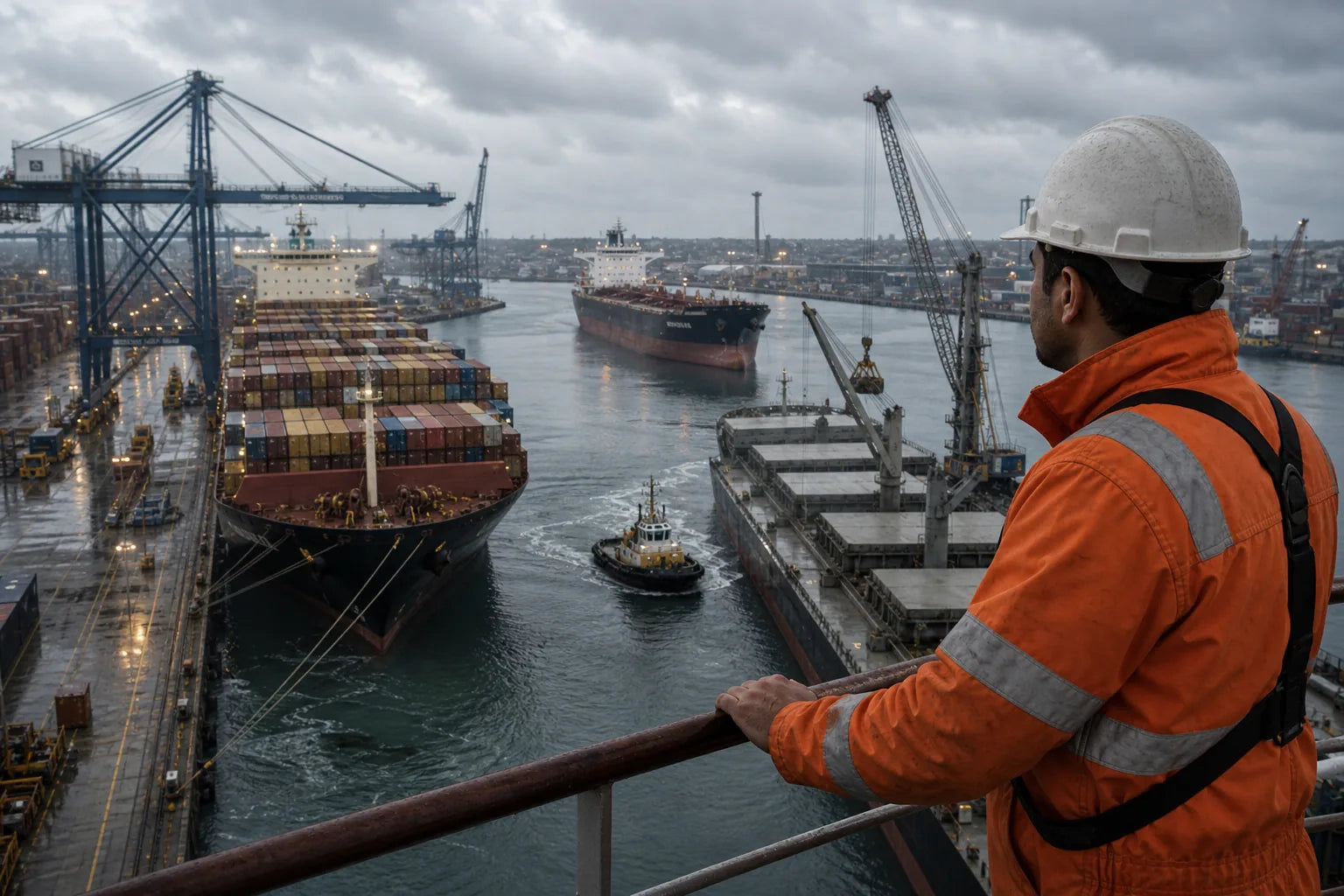
Container ships move standardized boxes between terminals. For crew, the work is shaped by tight port schedules, cargo plans, lashings, reefer checks, navigation watches, inspections, and fast turnarounds alongside.
The ship may look clean from a distance. The routine is exacting. One bad handover, missed alarm, or cargo issue becomes expensive quickly.
The port call is the thing to understand. A container terminal can turn a ship around in twelve hours. That is twelve hours of cargo operations, not twelve hours of shore leave. The chief officer builds the stability condition while the cranes are still working. The AB on gangway watch sees the terminal, the stevedores, and the fence. Rarely the town behind it.
Liner schedules cut both ways. The ship follows a published rotation, so crew can often tell their families which week they will be off which coast. On a tramp bulk carrier, nobody can promise that.
General cargo and multipurpose ships
General cargo ships and multipurpose vessels carry whatever the market offers: steel coils, timber, bagged cargo, machinery, project pieces, sometimes containers on top. Many carry their own cranes, which means the ship can work ports that have no shore gear at all.
For crew, this is the most varied cargo work in the merchant fleet. Every cargo needs its own securing plan, its own dunnage, its own lashing arrangement. The bosun and the deck ratings spend real hours on it. A load of steel coils is a different day than a load of sawn timber.
These ships are usually smaller and older than deep-sea liners, and they trade into smaller ports where the gangway sometimes lands a short walk from town. Crews are small. The upside is variety and closer ports. The downside is more physical cargo work and tonnage that has seen better decades.
Bulk carriers
Bulk carriers carry loose cargo: grain, coal, ore, cement, fertilizer. Crew life revolves around cargo holds, hatch covers, ballast, dust, cargo residues, loading rates, and port stays that can be physically demanding.
Bulk carrier crews know the feeling of a vessel changing trim, the noise of cargo gear, and the long cleaning jobs that come when the ship changes cargo. Hold cleaning between coal and grain is its own chapter of seafaring life.
The trade-off runs the other way from containers. Long ocean passages, small crews, and port stays that sometimes last days instead of hours. What that actually looks like below deck, from hold inspections to anchor waits, is covered in the dedicated bulk carrier article linked above.
Tankers
Tankers carry liquid cargo: crude oil, refined products, chemicals. Life on board is shaped by cargo safety, enclosed spaces, gas detection, deck lines, pumps, inert gas systems, and strict terminal procedures.
On tankers, discipline is visible in small details. A shortcut on deck or in the cargo control room carries serious risk.
Tanker work is often better paid than equivalent ranks on dry cargo. It is also more procedurally loaded, and terminals rarely let crew ashore. The full picture of tanker ship life, from cargo watch to terminal pressure, deserves its own article and has one.
Gas carriers (LNG and LPG)
Gas carriers move liquefied natural gas or liquefied petroleum gas at very low temperatures or under pressure. The cargo systems are the most technically demanding in the merchant fleet.
Crew on gas carriers need additional certification beyond standard tanker endorsements. Under the STCW Convention, officers and ratings with cargo duties on liquefied gas tankers need specific basic and advanced training for that ship type. That barrier keeps the pool small and the wages high. It also means the certificates you earn on a gas carrier change what you can do for the rest of your career.
Modern LNG ships are among the newest and best-maintained vessels afloat. That is a real quality-of-life difference for the crew living inside them.
Reefer ships
Dedicated reefer ships carry refrigerated cargo in insulated holds: fruit, fish, meat. They are fast ships built for seasonal trades, and the classic run is still bananas from Central America or West Africa to Europe.
Most refrigerated cargo has moved into reefer containers on container ships, so the specialized reefer fleet has been shrinking for years. The ships that remain run hard. For the engine department, the refrigeration plant is a second engine room: compressors, temperature logs, and cargo that spoils if a watchkeeper misses a rising trend. A cargo claim on a reefer is measured in whole holds, not single boxes.
Port stays follow the fruit. Loading can take a day or two in a small tropical port, discharge in Europe is faster, and the schedule is tight because the cargo is aging in the hold either way.
Ro-Ro ships and car carriers (PCTC)
Ro-Ro ships and pure car and truck carriers move cargo that rolls on board over ramps: trucks, trailers, new cars, machinery. A big PCTC is a floating multi-story parking structure with a small crew living on top of it.
The work is lashing chains, deck ventilation, ramp operations, and turnarounds measured in hours. Cars come on board with fuel in the tank and batteries connected, which is why fire patrols and deck ventilation are taken seriously. Two car carrier fires in recent years, the Felicity Ace in 2022 and the Fremantle Highway in 2023, put vehicle deck fire risk in front of the whole industry.
These ships are tall and light, which means they feel the wind at the berth and roll in ways that surprise crew coming from tankers or bulkers. Port calls are frequent but short. An AB on a car carrier can visit six countries in two weeks and see six terminals.
Heavy lift and project cargo ships
Heavy lift ships carry the cargo nothing else can: transformers, wind turbine components, port cranes, yachts, sometimes other vessels. Their own cranes lift hundreds of tons, and semi-submersible types ballast down to float cargo on and off.
For crew, the rhythm is unlike any liner trade. A single lift can take a full day of ballast operations, rigging checks, and slow, deliberate crane work, with the chief officer and the bosun watching every centimeter. Then weeks of passage with the cargo welded and lashed to the deck.
The fleet is small and the crews are specialists. Voyages are irregular tramp trading: you find out the next port when the office does. Crew who like engineering problems and hate routine tend to stay in this sector for good.
 Free crew appSeafarer Contract CheckCheck your contract clause by clause against MLC 2006 and flag state regulations. The check is free. On iPhone, Android or in the browser.
Cruise ships
Cruise ships are passenger vessels. They are also workplaces for large multinational crews. Bridge teams, engineers, deck ratings, hotel crew, galley staff, cleaners, security, entertainment teams, and medical staff all work inside one moving operation.
For guests, the ship feels like a holiday. For crew, it is a dense working environment with drills, turnarounds, cabin inspections, service pressure, and constant public-facing work.
Cruise contracts are usually shorter than deep-sea cargo contracts, and the ship is rarely far from a port. The trade is a longer working day and almost no privacy. If you are weighing the two worlds against each other, the direct comparison of cruise ship life vs cargo ship life goes deeper than this overview can.
Ferries and short-sea vessels
Ferries and short-sea vessels run repeated routes. Their crews work around fast port calls, passenger safety, vehicle decks, ramps, mooring routines, weather, and time pressure.
Repetition does not mean easy. It means small errors repeat quickly if the safety culture is weak. Ferry crews also live a different contract pattern: many work in rotations of days or weeks rather than months, and some sleep at home between shifts. For seafarers with families, that single fact outweighs everything else on this page.
Offshore vessels and tugs
Offshore support vessels, anchor handlers, crew boats, and tugs work close to platforms, wind farms, ports, and other vessels. The work involves towing, positioning, supply runs, personnel transfer, heavy weather, and high concentration during close-quarters operations.
These vessels are smaller than ocean-going cargo ships. The crew skill required is serious. Offshore rotations are often shorter and more regular than deep-sea contracts, which is a large part of why experienced officers move into the sector.
Crew size by ship type: reading the numbers honestly
Every ship carries a minimum safe manning document, required under SOLAS, which states the smallest crew the flag state accepts for that vessel. Real crews sit at or slightly above that line, because every extra berth is a cost the operator can count.
Honest orientation, without pretending these are fixed numbers: a deep-sea container ship, bulk carrier, or tanker typically sails with a crew of roughly 20 to 25 people. A harbor tug may run with a handful. A large PCTC carries a crew about the size of a bulk carrier crew while managing a cargo space several decks tall. The biggest cruise ships carry crews counted in the thousands, most of them hotel and service departments.
What the number means in daily life is simple. On a 22-person ship, the mess room is one table conversation, everyone stands extra duties, and one sick crew member changes the watch plan. Small crew, big ship, no slack.
What ship types mean for your contract and your career
Ship type decides more of your contract than most juniors expect. Tanker and gas endorsements carry wage premiums because the certificates take time and money to earn. Cruise contracts tend to be shorter but with longer working days. Deep-sea dry cargo usually means longer contracts and longer flights home. Shore leave chances differ so much by type and terminal that we wrote a separate guide to shore leave.
Switching types mid-career is normal, but it has a price. Deck and engine certificates carry across dry cargo types without much friction. Moving into tankers or gas means new STCW endorsements plus documented sea time on the type, because operators track officer experience for oil major vetting. A chief officer with ten years on bulkers starts a tanker career further down the list than his rank suggests. Plan the switch early, not at year fifteen.
One thing does not change with the ship type: the contract you sign before the flight. Whatever vessel is on the first page, run the agreement through the free MLC Contract Check before sign-on. It checks your contract clause by clause against MLC 2006 in about a minute, in the browser, no account.
How cadets end up on their ship types
Cadets rarely choose their first ship type. The company or the crewing agency assigns berths from the fleet it actually operates, and the cadet takes the slot that exists. A cadet sponsored by a tanker operator does tanker time. A cadet placed by an agency serving container lines learns lashings and terminal turnarounds.
That first assignment matters more than it feels at the time. Companies prefer to hire junior officers with sea time on their own vessel type, so the cadetship quietly sets the direction of the first jobs. It is not a life sentence. It is a starting lane. A cadet who wants gas carriers later should say so early, collect the tanker basics first, and watch which companies train their own juniors up the certification ladder.
Whether that cadet ends up on deck or below is the other half of the story, and the deck vs engine divide runs through every ship type on this page.
Why vessel type matters to 7SHORT1LONG
7SHORT1LONG® speaks to crew identity, and vessel type is part of that identity. Tanker crew, container crew, bulk carrier crew, gas crew, cruise crew, offshore crew, and port workers all share the sea. They do not all live the same workday.
That is why ship-type designs should never feel like generic clip art. A vessel on a shirt carries the reality of the people who know that ship from the inside. The ship type t-shirts in the 7S1L collection are drawn around working vessels, not harbor postcards: a guardian angel container ship t-shirt for the crew who live by the terminal clock, a Poseidon bulk carrier design for the crew who know hold cleaning by hand.
Source note
Regulatory facts in this article rest on public sources: the STCW Convention (training and certification requirements, including tanker and liquefied gas tanker training) and the SOLAS Convention (safe manning) at the IMO, plus the ITF Seafarers wages resources for wage scales and collective agreements. Crew size figures are orientation values, not guarantees: the safe manning document of the individual ship is the only binding number. This article is editorial context for working seafarers, not legal advice.
FAQ
What are the main ship types?
Container ships, bulk carriers, tankers, gas carriers, cruise ships, ferries, offshore vessels, tugs, general cargo ships, and research vessels.
Which ship type pays the most?
Gas carriers and chemical tankers generally sit at the top for equivalent ranks, because the certification requirements are higher and the pool of qualified crew is smaller. Wage scales vary by flag, company, and collective agreement, so check the ITF wage scales for your vessel rather than trusting a forum post.
Which ship type gives the most shore leave?
Bulk carriers and general cargo ships tend to have longer port stays than container ships or tankers. Shore leave still depends on the terminal, the port state, security level, and whether the company permits it.
Why do ship types matter for crew?
Each type creates different routines, risks, departments, port schedules, and cargo work. It also affects contract length, wage level, crew size, and how much shore leave you realistically get.
Can you switch ship types during your career?
Yes, and many seafarers do. Certificates carry across dry cargo types easily, while tankers and gas carriers require additional STCW endorsements and documented sea time on the type before operators will rank you fully.
Does 7SHORT1LONG make vessel-specific designs?
Yes. Vessel-specific designs represent working ship identity, not generic nautical decoration.
YES, WE ARE CREW.
Gear for the watchShip Type T-Shirts · Ship DepartmentBuild your Sign On Set · Build your Sailor Set