Martin Lex is the pen name of the 7S1L safety desk: SOLAS, lifesaving and firefighting gear, muster drills, emergency signals and safe work on board. Portrait is illustrative.
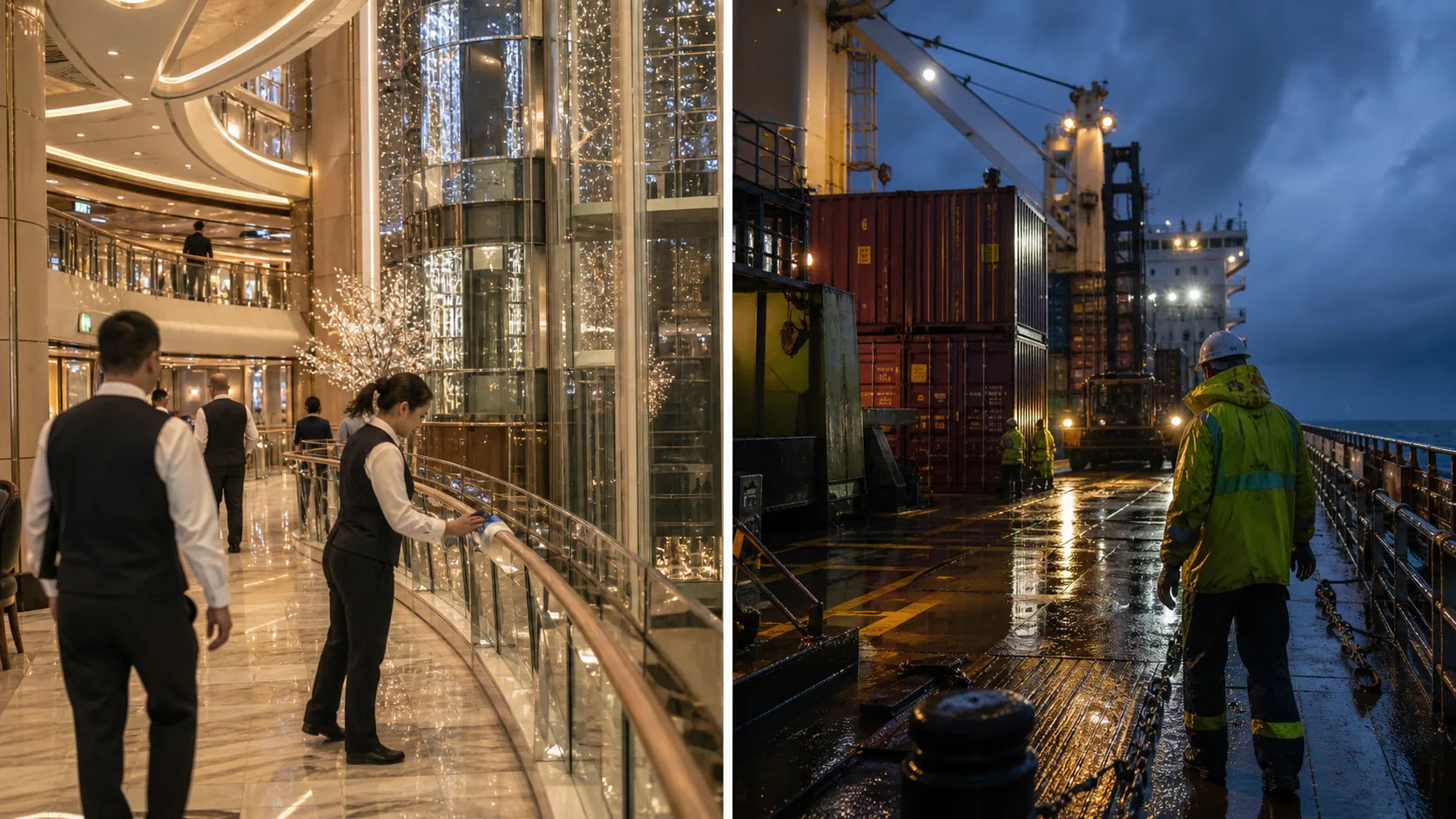
Cruise ship life and cargo ship life are both real ship life. They share watches, drills, contracts, cabins, crew mess rooms, port pressure, fatigue, and the strange rhythm of living where you work. But they are not the same life.
A cruise ship is also a hotel operation. It carries guests, restaurants, housekeeping, entertainment, excursions, retail, medical teams, security, deck, engine, galley, and a large crew working in front-of-house and back-of-house spaces. A cargo ship is usually smaller in crew size and heavier in operational focus: cargo, maintenance, watches, weather, terminals, machinery, and route pressure.
One world is not more real than the other. They are different pressure systems inside the same ocean. This comparison walks through contracts, pay, cabins, internet, drills, and shore leave on both sides.
Cruise ship life: ship work inside a hotel operation
Cruise ship crew work in a floating city that never fully goes quiet. Guest services, housekeeping, food and beverage, galley, bar, entertainment, excursions, deck, engine, security, laundry, medical, and hotel administration all live inside the same steel hull.
That changes the feeling of the contract. A cabin steward may start before guests leave for breakfast and still be handling turndown later in the day. A waiter may carry a smile through a long service while thinking about the next drill, the next port, or the next call home. A security team may stand at the gangway in heat, rain, or wind while guests see only the start of their shore excursion.
Cruise ship life has more public contact. That can be rewarding, but it also means less emotional privacy. Crew must manage guest questions, guest complaints, shipboard rules, safety announcements, uniform standards, and department pressure while still living in crew areas below or behind the guest experience.
The ship is visible. The work behind it is not.
Cargo ship life: fewer people, heavier operational isolation
Cargo ship crew usually work with fewer people around them. On a container ship, tanker, or bulk carrier, the crew list may feel small compared with a cruise ship. That can make the ship quieter, but not easier.
The deck team stands watches, handles maintenance, prepares for port arrival, checks lashing, works cargo-related routines, and deals with weather. The engine department lives with machinery, heat, alarms, rounds, planned maintenance, and the kind of noise that follows a person back to the cabin. The galley still matters. The mess room still matters. A good cook can change the mood of a long passage.
Cargo ship life has less guest contact, but more isolation. There may be fewer people to talk to, fewer departments, fewer distractions, and fewer chances to step away from the same faces, same alleyways, same watch rhythm, and same horizon.
Contract lengths and rotations: who goes home when
The clearest difference between the two worlds sits in the contract. A chief officer on a European-managed container ship may fly home after three or four months. An AB or an oiler on the same ship often sails six to nine. On the cruise side, a waiter or cabin steward commonly signs for six to eight months in one stretch, then takes a vacation that is usually unpaid before the next ship. Exact terms vary by company and rank. The contract in your hand is what counts, not the pattern.
There is one hard floor under all of it. The Maritime Labour Convention, 2006 sets the maximum period of service on board before a seafarer is entitled to repatriation at less than 12 months. A cruise line and a bulk carrier operator are bound by the same line in the same convention. A contract that quietly stretches past that point is a problem on any ship type.
The rotation rhythm feels different too. Senior cargo officers in well-run companies can get close to month-for-month leave. Cruise hotel crew rarely see anything like that ratio. The trade is a long block on board against a shorter block at home, repeated for years. Before any sign-on, read the employment agreement line by line. Cruise ship crew contracts under the MLC have their own traps, and the free MLC Contract Check runs any contract clause by clause against MLC 2006 in about a minute, in the browser, with no account.
Cruise ship life vs cargo ship life: how the pay is built
Cargo pay is built for predictability. A rating's wage account typically stacks basic pay, fixed overtime, and leave pay into one consolidated monthly figure, and ITF collective agreements are negotiated on exactly that structure. The reference floor is public: from 1 January 2026 the ILO minimum basic monthly wage for an able seafarer stands at 690 US dollars, agreed by the ILO Joint Maritime Commission subcommittee. Totals under ITF-negotiated scales sit well above that basic figure, because the consolidated wage adds overtime and leave pay on top.
Cruise pay splits into two systems on one ship. Marine crew, meaning deck and engine, are paid much like their cargo counterparts: a fixed monthly wage tied to rank. Hotel positions work differently. A waiter, bar server, or cabin steward often has a modest guaranteed base, and the larger share of monthly income comes from the service charge pool or gratuities. A strong season on a full ship and a slow repositioning cruise do not pay the same month.
Neither system is automatically better. Cargo pay is the same in February as in July. Cruise hotel pay carries upside and variance in the same envelope. What matters is that the guaranteed portion, the currency, and the payment schedule are written into the contract before departure, not explained verbally at the crew office.
Cabins and privacy: a door of your own
Here the cargo side wins, and it wins by regulation. MLC 2006 requires an individual sleeping room for each seafarer on ships other than passenger ships, with exemptions possible on smaller vessels. On a modern container ship or tanker, a single cabin with its own shower and toilet is the standard. An oiler coming off the 0400 watch closes a door and the ship is gone.
Passenger ships are the exception written into that same rule. Junior cruise crew usually share: two to a cabin, bunk beds, a curtain for privacy, and a roommate chosen by the crew office, not by you. A good roommate on an opposite shift can make a contract easy. A bad one can make eight months long. Officers, staff ranks, and senior hotel positions get single cabins as they move up, which is one quiet reason promotion matters so much on the hotel side.
After ten hours in a galley or a laundry, the difference between your own door and a shared bunk is not a detail. It is the shape of your recovery.
Food and the mess room
On a cargo ship, one cook, sometimes with a messman, feeds the whole crew. The menu bends toward the nationality mix on board, provisions come aboard weeks apart, and the cook's skill decides more about crew morale than most office departments would believe. The mess table is the social event of the day. Fifteen minutes of rice, stew, and complaints about the schedule.
A cruise ship runs a crew mess like a canteen: multiple stations, long opening hours, a dedicated crew galley behind it, and separate messes for officers and staff. Variety is real. So is the trade: eating fast between split shifts, in a room with hundreds of people, on a schedule the restaurant above you dictates.
Social life: a three-man mess table or a crew bar with a thousand colleagues
Cargo ship evenings are quiet. After dinner the alleyways empty, and the same few faces sit at the mess table for the whole contract. On a twenty-person ship, three of those people share your watch, your coffee break, and your smoke deck. Friendships go deep or the silence gets heavy. Karaoke nights, basketball in an empty hold, a birthday cake from the cook: small things carry real weight out there.
A large cruise ship carries a crew that can run above a thousand names, from dozens of countries. There is a crew bar, a crew gym, a crew deck, parties, football tournaments, and a social scene with its own rules and its own drama. You can find your people faster. You can also stand in a full crew bar and feel just as alone as an AB mid-Pacific. Different loneliness, both real.
Internet and calling home
Connectivity used to be the sharpest dividing line, and it is moving fast. The MLC amendments that entered into force on 23 December 2024 tell shipowners to provide seafarers with social connectivity, including internet access where available, at reasonable cost. That is direction, not a guarantee of free unlimited data, and enforcement runs through flag states and port state control.
On the water it looks like this: many cargo operators have installed low-earth-orbit satellite terminals in the last few years, and on those ships a video call from mid-ocean is normal now. Other ships still ration data by the megabyte. Cruise crew usually buy wifi packages at crew rates, with speed that depends on itinerary and on how many thousand people are sharing the pipe. On both sides, ask about internet policy before you sign.
 Free crew appSeafarer Contract CheckCheck your contract clause by clause against MLC 2006 and flag state regulations. The check is free. On iPhone, Android or in the browser.
Shifts, watches, and drills
Cargo ships run on watches. The classic deck pattern is four hours on, eight hours off, around the clock, sea and anchor. Day workers like the bosun's team run maintenance hours, and the engine room may run unmanned at night with a duty engineer carrying the alarm. Port calls break the rhythm and rebuild it. The body learns the 0400 alarm whether it wants to or not.
Cruise hotel departments run on shifts instead: breakfast service, a break, lunch, a break, dinner and late service, seven days a week. The split shift means the day starts early and ends late even when the total hours are legal. Both worlds sit under the same MLC rest hour rules: minimum ten hours of rest in any 24-hour period and 77 hours in any seven days, recorded and signed.
Drills separate the two worlds most visibly. On a cargo ship with around twenty crew, everyone holds several emergency duties at once: fire team, boat preparation, first aid, communications. On a cruise ship, SOLAS drills cover the crew and the guests. Running an assembly for a ship with 5,000 guests is a logistics operation: crowd management training, stairway guides, muster station teams, and a cabin steward who is suddenly responsible for moving strangers calmly toward a station. Same convention. Completely different scale.
Shore leave: four hours in the same port or a van from the terminal
Cruise ships call ports almost daily, which sounds like the better deal. The reality is in-port manning rules, duty schedules, and workload. A steward may get two or three hours ashore, in the same port the ship visits every single week. Crew learn which cafe near the pier has the fastest wifi, because that is where the contract's free time actually happens.
Cargo crew see fewer ports and harder access. Terminals sit far from town, gate passes take time, and cargo work does not pause for sightseeing. Sometimes the ship sails before anyone steps ashore at all. The people who soften this are the welfare organizations: Mission to Seafarers, Stella Maris, and the seafarer centers whose vans wait at the terminal gate. What shore leave legally is, and why it keeps shrinking, is its own topic: our guide to shore leave covers it.
Tanker life: cargo safety and terminal pressure
Tanker ship life is shaped by cargo risk. Oil, product, chemical, LNG, and LPG tankers each have their own technical world, but the shared culture is careful work. Cargo watches, terminal rules, checklists, gas detection, enclosed-space awareness, firefighting readiness, and communication with shore personnel make tanker life feel disciplined.
On a tanker, a mistake can become serious quickly. Deck crew may spend long hours around manifolds, lines, valves, PPE, safety zones, and cargo control routines. Officers carry paperwork and operational responsibility that does not end when the ship is alongside. Engineers keep the machinery ready while the ship is tied to a terminal where delays cost money and attention cannot drift.
Tanker life can be professionally strong. It can also be mentally heavy. The ship may be quiet, but the pressure is not.
Container ship life: schedules, port rotation, and fast cargo operations
Container ship crew often live under the clock. Port rotation can be fast. Cargo operations may run through the night. The deck team checks lashing, watches weather, prepares for pilotage, and works around container stacks, cranes, twistlocks, and terminal schedules.
For the bridge team, traffic, port approaches, pilot boarding, route planning, and watchkeeping can stack tightly. For the engine team, the ship has to be ready for arrival, departure, maneuvering, sea speed, and whatever the schedule demands next.
Container ships are the visible spine of global trade. The crew life behind that trade is less visible: short port calls, limited shore leave, operational pressure, and a ship that may leave before the body catches up with the last arrival.
Bulk carrier life: holds, dust, waiting, and long port days
Bulk carrier life has its own pace. It can mean cargo holds, hatch covers, dust, grabs, shore cranes, ballast, draft surveys, weather delays, and long port days where the ship is not really at rest.
The work can feel physical and patient at the same time. Crew may wait on cargo, wait on weather, wait on documents, wait on berth, then suddenly move into a hard operational window. Cleaning holds, preparing for the next cargo, checking access, and managing dust or residue are part of the ship's rhythm.
Compared with cruise ships, bulk carriers are less public. Compared with container ships, they can feel slower. But slow does not mean easy. It often means the pressure sits in the background until the next inspection, cargo change, or weather shift brings it forward.
What all ship life has in common
Every vessel type has its own culture, but some parts of ship life are shared. A crew member learns the sound of the ship at night. The cabin becomes both private space and workplace recovery room. The mess room becomes a social barometer. Shore leave depends on port, workload, security, fatigue, transport, and time.
Drills also cut across vessel types. SOLAS frames the international ship safety world, while STCW sets training and certification standards for seafarers. That does not make every ship feel the same. It means each ship carries a safety structure underneath its daily routine.
Different ships, different routes. Same demand: know your duty before the ship needs you.
Switching sides: careers between the two worlds
The bridge between the worlds is the certificate. STCW licenses travel with the seafarer, so deck and engine officers move from cargo fleets to cruise marine departments and back. A second engineer from a product tanker can stand a watch in a cruise ship engine control room. The license is the same, and cruise lines actively recruit marine officers from cargo backgrounds.
The hotel ladder does not cross over the same way. A head waiter's rank means nothing on a chemical tanker. Hotel careers climb inside the cruise world, restaurant to management, or transfer ashore into hospitality, where the shipboard discipline reads as a strength. Some crew also switch for life reasons: cruise itineraries mean coastal phone signal and a predictable schedule, while cargo officer rotations can mean fewer total months away per year. If you are still choosing a direction, start with the vessel itself: our overview of ship types explained for crew maps what each ship actually demands.
Which ship type fits which crew member?
A person who handles public contact well may fit cruise ship life. That does not mean the work is soft. It means the person can carry professionalism through guest pressure, department hierarchy, shared cabins, uniform standards, and long service days.
A person who wants a smaller crew and more operational focus may prefer cargo ships. That does not mean the work is simple. It means the person accepts isolation, machinery, cargo operations, watches, paperwork, weather, port state control, and the slower weight of long contracts.
Some crew move between worlds. Some never want to. Both choices make sense. The sea does not produce one type of worker. It produces departments, habits, loyalties, rivalries, routines, and the quiet pride of people who know what their ship demands. That pride follows the ship type: a bar server after a Caribbean season wears a cruise ship seafarer tattoo t-shirt for a different reason than an AB reaching for a container ship seafarer tattoo t-shirt after nine months on box ships. Same trade. Different ship. The full range of ship type t-shirts covers both sides.
Source note
This article is editorial context for crew and future crew, not legal advice. The binding text is always your signed employment agreement and the conventions your flag state has ratified. Facts referenced above:
- IMO: International Convention for the Safety of Life at Sea (SOLAS)
- IMO: STCW Convention
- ILO: Subcommittee on Wages of Seafarers agreement (minimum basic wage for an able seafarer: 690 USD from 1 January 2026)
- ILO: 2022 amendments to the MLC, 2006, in force 23 December 2024 (social connectivity)
- ITF Seafarers: Wages (collective agreements and consolidated wage scales)
FAQ
Is cruise ship life the same as cargo ship life?
No. Both are ship life, but cruise ships combine marine operations with hotel and guest-service work. Cargo ships usually have smaller crews and stronger focus on cargo, watches, maintenance, and port operations.
Is working on a cruise ship harder than working on a cargo ship?
It depends on the department, company, route, contract, and person. Cruise ships often bring more guest-facing pressure and shared cabins. Cargo ships often bring more isolation and operational focus.
Do cruise ship crew earn more than cargo ship crew?
It depends on rank and department. Cargo wages are usually consolidated fixed amounts under ITF-style agreements, with an ILO minimum basic wage of 690 USD per month for an able seafarer from 2026. Cruise hotel income often combines a lower base with service charge or gratuities, so it varies month to month.
What is different about tanker ship life?
Tanker life is shaped by cargo safety, terminal rules, checklists, gas awareness, firefighting readiness, and careful cargo operations. The ship may feel quiet, but the risk culture is constant.
Do cruise ship crew get more shore leave?
Not always. Cruise ships call many ports, but shore leave depends on department workload, in-port manning rules, ship schedule, security, fatigue, and company policy.
Which ship type is best for new seafarers?
There is no single best ship type. A new seafarer should look at training, department, contract terms, safety culture, crew support, route, and what kind of pressure they handle well.
YES, WE ARE CREW.
Gear for the watchShip Type T-Shirts · Ship DepartmentBuild your Sign On Set · Build your Sailor Set