
Martin Lex is the pen name of the 7S1L safety desk: SOLAS, lifesaving and firefighting gear, muster drills, emergency signals and safe work on board. Portrait is illustrative.
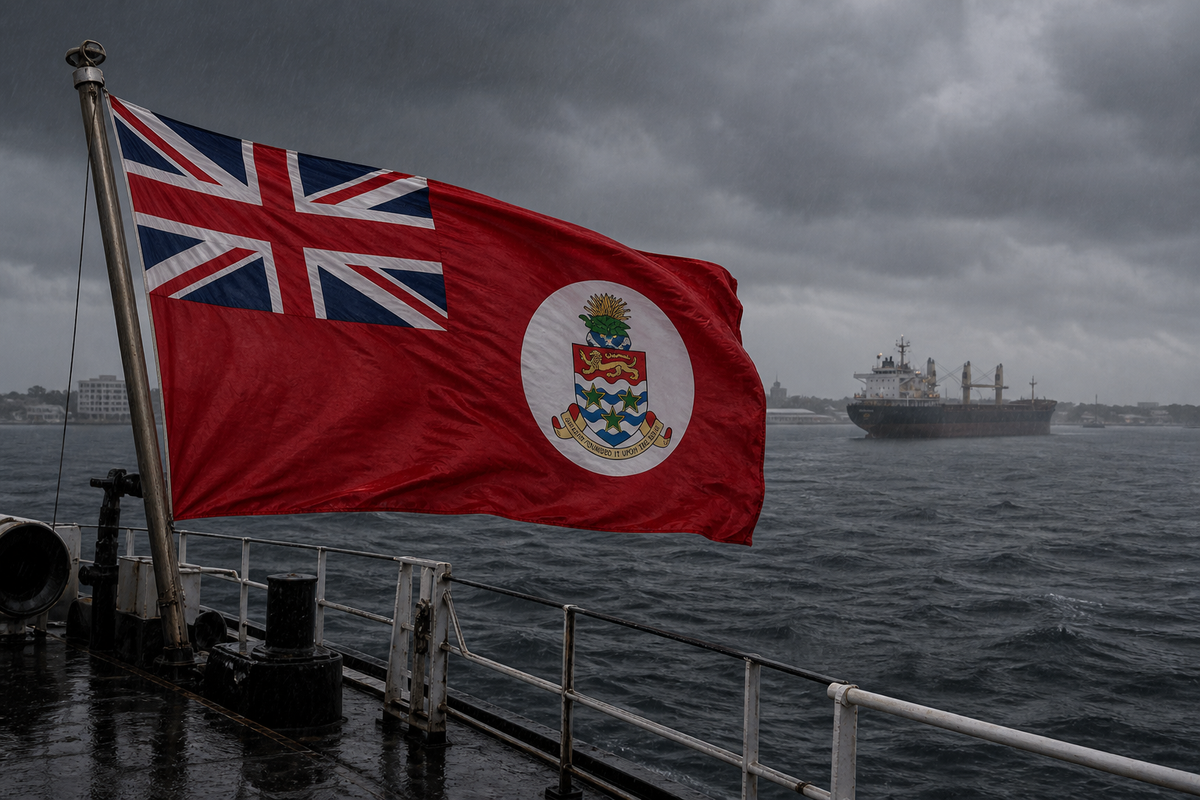
The Cayman Islands flag pulled off something unusual in 2026: first place on the Paris MoU performance list, ahead of every national European flag, while standing on the ITF's flag of convenience list at the same time. Both labels are earned. The inspections are excellent. The employment law under your contract is still thin by design, and if you crew yachts, this register writes your rules more often than any other: about 85 percent of Cayman-registered vessels are yachts, including roughly a fifth of the world's 40 meter plus fleet. That mix is Cayman Islands flag labor law in one sentence: excellent oversight, thin statute, heavy contract.
Most merchant crew expect a labor code behind the flag. Here there is none waiting onshore for internationally sailing crew. There is the MLC floor, the flag's own shipping legislation, and one clause in your SEA that decides nearly everything else: the governing law clause. Here is what that means at the gangway, for a deckhand joining in Antibes or a chief stew signing her third season.
Before you sign a contract under the Cayman flag, know which laws apply. You can check your seafarer contract free in the Seafarer Contract Checker against MLC 2006 and the verified Cayman Islands flag facts.
The 2024 act changed yacht life
The Merchant Shipping Act 2024, in force since March 2024, extended the written SEA requirement from commercial vessels to every Cayman-flagged vessel, privately registered yachts included. A master who sails with any crew member aboard and no SEA now faces criminal prosecution and a significant fine. Nautilus warned captains about this in plain terms. For deckhands and stews who spent years on handshake terms, this is the single best thing the flag has done for you: the paper must now exist. Make sure yours does before the lines come in.
What does that mean on the dock? If you pick up day work in Antibes or Palma and the boat asks you to stay for a delivery passage, you are crew, and the master needs a signed SEA with your name on it before departure. Ask for it. A captain who shrugs at that question in 2026 is telling you how the rest of the season will run. For longer engagements, put the question to the crewing agent early: is the SEA based on the MACI model, and when do I get my copy? Two sentences in an email, and they can save you a legal argument later.
The private yacht side matters most. Commercial yachts already carried SEAs through their MLC paperwork. Private program crew often did not, and wage disputes on private boats used to die quietly because there was no paper to argue from. Since March 2024 that excuse is gone: on a private 50 meter without SEAs, the master is the one exposed. Use that leverage politely.
What the paper must say, and the clause that rules them all
The act prescribes minimum SEA content: wages and payment method, monthly wage accounts, permitted deductions, repatriation and medical expenses, leave, notice period, the agreed place of return, and the governing law. That last item is the sleeper. Cayman imports no onshore employment protection regime for internationally sailing crew, so the law your SEA names is the law you get, on top of the MLC floor carried by the 2014 employment and wages regulations. The registry publishes a model Cayman SEA; if your owner uses something else, compare it against the model line by line. A contract naming an unfamiliar governing law deserves questions before signature, not after a dispute off Antibes.
Read that list the way a port state control officer would. Wages: amount, currency, payment interval, plus the monthly wage accounts the 2014 regulations require. Deductions: everything the owner may take from your pay must be listed, and open ended deductions for damages or uniform costs deserve a question before signature. Repatriation: the agreed place of return decides whether the owner flies you home to Manila or Cape Town, or drops you at the airport nearest the shipyard. Notice period: on yachts the season ends fast, and this clause decides whether you leave with wages in hand or with a promise.
The governing law clause deserves its own slow read. Many Cayman SEAs name Cayman Islands law, some name English law, and both are workable because they sit on top of the MLC floor. A SEA naming a governing law with no connection to the boat, the owner, or the operation is a warning sign, and it belongs on the same list as the patterns in our SEA red flags guide. Contract length is the other quiet clause: yacht SEAs often run open ended with a notice period instead of a fixed term. What counts as a normal contract length at sea, and what counts as too long, is covered in our guide on contract duration.
Cayman Islands flag labor law and MLC compliance
The MLC 2006 reached the Cayman Islands through London. The United Kingdom ratified the convention on August 7, 2013 and extended it to the Cayman Islands, where it entered into force on August 7, 2014. The flag implements it through its merchant shipping legislation, including the 2014 employment and wages regulations your SEA already sits on. So the MLC floor under a Cayman contract is real and enforceable, whatever the governing law clause says above it.
The register itself is a Red Ensign Group Category 1 register, which means it may register vessels of unlimited tonnage and type, alongside the UK, the Isle of Man, Bermuda and Gibraltar. Oversight runs through the UK Maritime and Coastguard Agency. The Maritime Authority of the Cayman Islands (MACI) has operated as a statutory body since 2005, and the shipping registry in George Town dates back to 1903. Commercial yachts under the flag are surveyed against the REG Yacht Code, the Red Ensign Group's large yacht standard, and the Cayman registry runs the code's secretariat.
If something goes wrong aboard, the MLC route works the same as on any flag. Use the on-board complaint procedure first, then the flag state, then port state control or an ITF inspector in the next port. Keep your SEA copy and your wage accounts; they carry the case. If your next boat flies the other big yacht register, the process there is covered step by step in our guide to MLC complaints under the Marshall Islands flag.
 Free crew appSeafarer Contract CheckCheck your contract clause by clause against MLC 2006 and flag state regulations. The check is free. On iPhone, Android or in the browser.
Before you sign: a yacht crew checklist
Confirm the SEA exists, on paper, signed, with your copy in hand. Read the governing law clause and the deductions clause. Check the repatriation clause names a place of return you would actually want. The verified administration contacts are on our Cayman Islands flag page, the yacht-specific SEA questions are in Yacht Crew Contracts: The SEA Questions to Ask Before You Step Aboard, and the full register landscape is in our flags of convenience guide. Then run this list before you initial anything:
- SEA on paper, signed by you and by the owner or employer, your copy in hand before the lines come in.
- Governing law clause read and understood. If it names neither Cayman Islands nor English law, ask why, and get the answer in writing.
- Deductions clause closed, not open ended. Every permitted deduction listed, with a number next to it.
- Repatriation clause naming a place of return you chose, with the flights on the owner.
- Wage clause with amount, currency and payment date, plus the monthly wage account the regulations require.
- Notice period and leave terms that survive an early end of season.
- The on-board complaint procedure, and the name of the person who handles it.
Sign-on day is easier when your papers travel like your kit. The printed SEA copy goes in the same bag as the sign-on set and the spare seafarer hoodie for the delivery passage. One folder, one bag.
The 90 second version
This flag in one video:
How the Cayman Islands flag rates in port state control
Port state control keeps score on every flag. The regional inspection regimes publish each year which registers get detained most, and the ITF keeps its own list of flags of convenience. This is where Cayman Islands stands on the current lists:
- Paris MoU (Europe and Canada): white list, rank 1 of 69, performance list valid July 1, 2026 to July 6, 2027.
- Tokyo MoU (Asia Pacific): high performance, inspections and detentions 2022 to 2024.
- ITF: listed as a flag of convenience, 2025 list.
- MLC 2006: party to the Convention.
These lists count detentions, not contracts. A white list flag can still sit under a bad SEA, and a black list flag tells you how much backing to expect from the administration when something goes wrong on board. The current rating of every flag we cover stands on the Cayman Islands flag page, and the app report names MLC 2006 plus the flag at the top of every check, with the same rating next to it.
Source note
Merchant Shipping Act 2024, MACI model SEA, Nautilus on the new SEA rules, Paris MoU 2025 performance lists, and ITF FOC list. On the MLC extension and the register: Maples on the MLC entering into force for the Cayman Islands, Red Ensign Group: Cayman Islands Category 1, and MACI: About us.
This article is editorial context for crew, not legal advice. For a live dispute under a Cayman SEA, talk to the ITF, to Nautilus, or to a lawyer in the jurisdiction your contract names.
FAQ
Is the Cayman Islands flag a flag of convenience?
Yes, by the ITF definition: the Cayman Islands stands on the ITF list of declared flags of convenience. At the same time it ranked first on the Paris MoU performance list in 2026, so FOC listing and inspection quality are two separate questions.
What labor law applies on a Cayman-flagged yacht?
Cayman Islands flag labor law means the MLC 2006 floor, the flag's merchant shipping legislation, and above that the law named in the governing law clause of your SEA. Cayman imports no onshore employment protection regime for internationally sailing crew, so that clause carries real weight.
Does MLC 2006 apply to Cayman-registered ships?
Yes. The United Kingdom ratified MLC 2006 and extended it to the Cayman Islands, in force there since August 7, 2014. The flag implements it through its merchant shipping legislation, including the 2014 employment and wages regulations.
Do private yacht crew need a written SEA under the Cayman flag?
Yes, since March 2024. The Merchant Shipping Act 2024 requires a written SEA for every crew member on every Cayman-flagged vessel, privately registered yachts included, and a master who sails without them risks prosecution and a fine.
How do I complain about conditions on a Cayman-flagged ship?
Start with the on-board complaint procedure your SEA must reference, then go to the flag state (MACI), then to port state control or an ITF inspector in the next port. Keep your SEA copy and wage accounts; they carry the case.
7SHORT1LONG® is a Seafarer Identity Brand. Best inspected flag afloat, and your contract still does the heavy lifting.
YES, WE ARE CREW.
Gear for the watchSeafarer T-Shirts · Crew Best SellersBuild your Sign On Set · Build your Sailor Set