
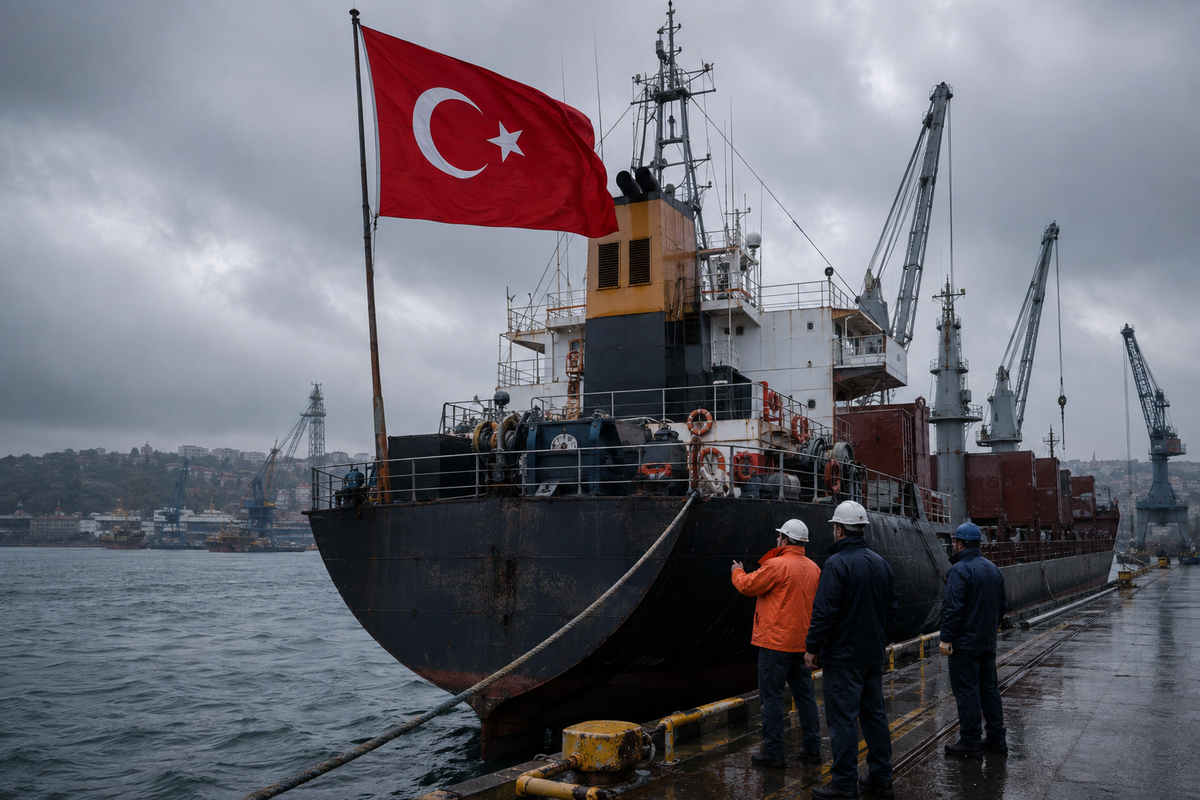
Türkiye has coastline on four seas, shipyards on two of them, and a crew pool that fills officer positions across the Mediterranean and beyond. Its flag is a national register with a good inspection record: around 600 Paris MoU inspections in three years and a place on the white list, plus high performance in the Tokyo MoU region. What the flag does not have is a long history with the Convention, or a door marked complaint. Türkiye ratified MLC 2006 in 2017, years after the big registers, and the Directorate General of Maritime Affairs in Ankara publishes a switchboard number, not a seafarer inbox. A Turkish SEA is backed by a serious administration and a real national labour law; reaching that administration from a ship is the part that takes planning.
Before you sign a contract under the Turkish flag, know which laws apply. You can run your seafarer contract through the free Seafarer Contract Checker: pick Türkiye, and the report reads your SEA against MLC 2006 and the verified Turkish facts.
Ratified in 2017, in force a year later
The Convention entered into force worldwide in 2013. Türkiye joined four years later: the ratification law was published in Official Gazette No. 30018 of March 25, 2017, and under the Convention's own rule the treaty took effect for Turkish-flagged ships twelve months after the ratification was registered with the ILO. Until then, Turkish ships in foreign ports were held to the Convention by port state control anyway, under the no more favourable treatment rule. Since 2018 the flag certifies them itself.
For a seafarer the late date has one practical effect: the flag's MLC practice is younger than its inspection record. The Directorate General has been surveying ships for decades; it has been issuing Maritime Labour Certificates for less than ten years. Ask to see the certificate and the Declaration of Maritime Labour Compliance on board, and read the declaration, because it is the flag's statement of what your SEA has to contain.
The Directorate General in Ankara
The competent authority is the Directorate General of Maritime Affairs, Denizcilik Genel Müdürlüğü, under the Ministry of Transport and Infrastructure, at its offices in Çankaya, Ankara. It publishes a telephone number and a website. It does not publish a dedicated MLC complaint address. A complaint that the master and the shipowner do not resolve goes through the ministry's general channel, in writing, with a dated copy kept by you, and with the ITF copied in. In a Turkish port the harbour master's office is the practical first door. The verified contacts stand on the Türkiye flag page of the checker.
What the MLC floor gives you on a Turkish ship
Every Turkish-flagged ship of 500 gross tons or more on international voyages carries a Maritime Labour Certificate and a DMLC. The lines in the SEA that have to match them:
- A written SEA signed by you and the shipowner or the owner's representative, with a copy you keep.
- Wages at least monthly, with a monthly account of pay and deductions, and the currency stated.
- At least 10 hours of rest in any 24-hour period and 77 hours in any seven days, recorded and countersigned.
- Paid annual leave of at least 2.5 calendar days per month of employment.
- Repatriation at the shipowner's cost, with a maximum period of service before it is due.
- Medical care and sick pay after illness or injury.
- A written on-board complaint procedure handed over with the SEA.
Turkish ships with Turkish crews commonly sail under national employment terms and, on unionised ships, a collective agreement. If the SEA names one, it sets the wage scale and the overtime rate above the floor; make sure it is attached. How the basic wage relates to the ILO minimum is in our seafarer minimum wage guide. The clauses that usually go wrong are in our guide to seafarer contract red flags.
White list in Europe, high performance in Asia
On the Paris MoU performance list valid July 1, 2026 to July 6, 2027, Türkiye stands on the white list at rank 32 of 69, on around 600 inspections in three years. The Tokyo MoU rates the flag high performance for 2022 to 2024. The ITF does not list Türkiye as a flag of convenience: Turkish ships are, as a rule, Turkish owned and Turkish crewed under Turkish law.
A white list flag is boarded less often than the average in European ports, which is good for the ship and means fewer outside eyes on your payslip. On this flag the paper you keep yourself, the SEA, the rest hour sheets and the monthly wage statements, is the main check on the owner between inspections. A good flag rating is a statement about detentions, not about your contract.
 Free crew appSeafarer Contract CheckCheck your contract clause by clause against MLC 2006 and flag state regulations. The check is free. On iPhone, Android or in the browser.
The two-flag life of a Turkish seafarer
Turkish officers and ratings are a large group on foreign flags, above all on Maltese, Panamanian, Liberian and Marshall Islands ships owned by Turkish companies. On those ships the law under the SEA is the flag state's law, not Turkish law, and the Ankara directorate is not the competent authority. The flag on the stern decides which guide applies: Malta flag labor law for the EU register most Turkish owners use, Panama flag labor law and Marshall Islands flag labor law for the open registers.
Turkish flag in the contract: what I check before sign-on
- The SEA names Türkiye as the flag and Turkish law as the governing law, with a collective agreement attached if one is named.
- Basic wage, overtime and leave pay in separate lines, with the currency stated.
- The rest hour rule is written in and the record is on board.
- The repatriation clause names the shipowner as the payer and sets a maximum time on board.
- The on-board complaint procedure came with the SEA, and you have the ministry's number and the ITF contact for your next port written down.
- The Maritime Labour Certificate and the DMLC are on board and available to crew.
How Türkiye compares with every other register is in our guide to flags of convenience and your contract. The step by step use of the checker is in How to Use the MLC Contract Check.
How the Türkiye flag rates in port state control
Port state control keeps score on every flag. The regional inspection regimes publish each year which registers get detained most, and the ITF keeps its own list of flags of convenience. This is where Türkiye stands on the current lists:
- Paris MoU (Europe and Canada): white list, rank 32 of 69, performance list valid July 1, 2026 to July 6, 2027.
- Tokyo MoU (Asia Pacific): high performance, inspections and detentions 2022 to 2024.
- ITF: not listed as a flag of convenience, 2025 list.
- MLC 2006: ratified 2017 (Official Gazette 25 Mar 2017).
These lists count detentions, not contracts. A white list flag can still sit under a bad SEA, and a black list flag tells you how much backing to expect from the administration when something goes wrong on board. The current rating of every flag we cover stands on the Türkiye flag page, and the app report names MLC 2006 plus the flag at the top of every check, with the same rating next to it.
Source note
Official Gazette of the Republic of Türkiye No. 30018 of March 25, 2017 (ratification law); ILO NORMLEX ratification register for MLC 2006; Directorate General of Maritime Affairs, Ministry of Transport and Infrastructure, contact pages (denizcilik.uab.gov.tr); Paris MoU performance lists valid July 1, 2026 to July 6, 2027; Tokyo MoU Annual Report 2024, Table 8; ITF list of FOC registries 2025. Flag facts checked against these sources on September 1, 2026. This article is editorial context for working seafarers, not legal advice.
FAQ
Has Türkiye ratified MLC 2006?
Yes. The ratification law was published in Official Gazette No. 30018 of March 25, 2017, and the Convention took effect for Turkish-flagged ships twelve months after the ratification was registered with the ILO.
Which authority handles MLC matters on a Turkish-flagged ship?
The Directorate General of Maritime Affairs, Denizcilik Genel Müdürlüğü, under the Ministry of Transport and Infrastructure in Ankara. It publishes a telephone number but no dedicated MLC complaint address.
How does the Turkish flag rate in port state control?
On the Paris MoU performance list valid July 2026 to July 2027 Türkiye stands on the white list, rank 32 of 69, on around 600 inspections in three years. The Tokyo MoU rates the flag high performance for 2022 to 2024. The ITF does not list it as a flag of convenience.
Where do I complain about conditions on a Turkish-flagged ship?
After the on-board procedure, through the ministry's general channel, or to the ITF inspector in port. In a foreign port, port state control applies MLC 2006 to the ship regardless of flag.
I am Turkish on a foreign-flag ship. Does Turkish law apply?
No. The flag on the stern decides the law under your SEA. Turkish crew are a large group on Maltese, Panamanian, Liberian and Marshall Islands ships, and each of those flags has its own guide.
7SHORT1LONG® is a Seafarer Identity Brand. From the Bosphorus to the Bay of Biscay, the watch is the same. The seafarer t-shirts name the trade, and the sign on set is for the day the SEA gets signed.
YES, WE ARE CREW.


Gear for the watchSeafarer T-Shirts · Crew Best Sellers· Seafarer iPhone CasesBuild your Sign On Set · Build your Sailor Set


