
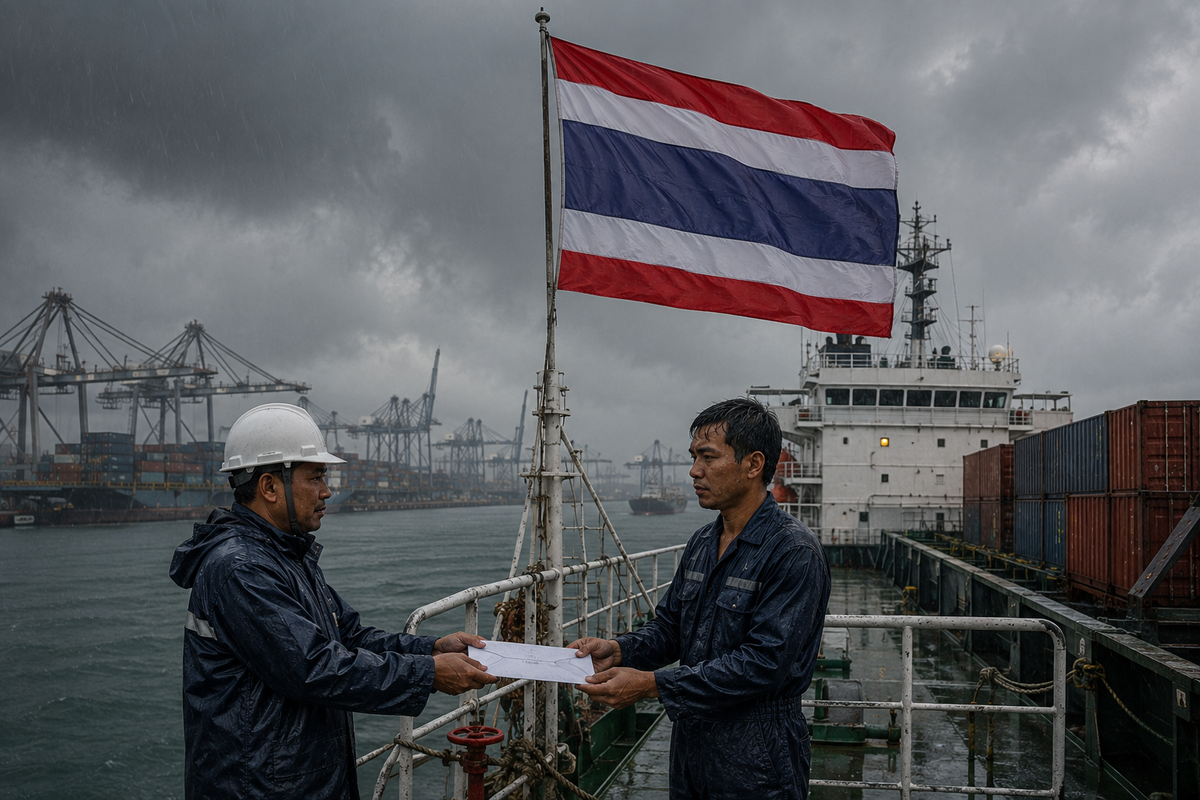
Thailand did the paperwork in an unusual order. The Maritime Labour Act B.E. 2558 was passed in 2015 and came into force on March 29, 2016, and only then, on June 7, 2016, did Thailand register its ratification of MLC 2006 with the ILO. Most flags ratify first and legislate later, sometimes years later. Thailand had the domestic statute on the shelf before the treaty bound it, which means a Thai SEA has been backed by a national law with the Convention's content for as long as the flag has been certified. The complaint side is just as concrete: the Seafarer Standards Division of the Marine Department in Bangkok takes complaints on a prescribed form.
Before you sign a contract under the Thai flag, know which laws apply. You can check your seafarer contract free in the MLC Contract Check: pick Thailand, and the report reads your SEA against MLC 2006 and the verified Thai facts.
The Maritime Labour Act B.E. 2558
The Act is the domestic law behind the Convention. Its scope is the first thing to check, because it is narrower than the flag: it applies to Thai commercial ships of 500 gross tons and over on international or near-coastal voyages. A seafarer on a Thai ship of that size and trade is covered by the Act in full. A seafarer on a smaller Thai vessel, or on a purely domestic trade, is outside it, and outside the certification regime, though the Convention still follows the ship into any foreign port through port state control.
Within its scope, the Act carries the Convention's minimums into Thai law: the written agreement, the monthly wage account, the rest hours, the leave, the repatriation, the medical care, the on-board complaint procedure. It is the text a Thai court or the Marine Department applies to a Thai SEA, and the text the Declaration of Maritime Labour Compliance Part I on board refers to.
The Seafarer Standards Division
The competent authority is the Marine Department, Krom Chao Tha, under the Ministry of Transport, at Yotha Road in Bangkok's old riverside district. Complaints under the Act are handled by the Seafarer Standards Division, and they are filed on the Department's own form. That sounds bureaucratic; it is a gift. A prescribed form means the Division has a process, a file number and a record, and a complaint filed on it is a document a port state control officer or an ITF inspector can see and cite. Ask the Division for the form before you need it. The verified addresses and the hotline stand on the Thailand flag page of the checker.
What the Act gives you on a Thai ship
Every Thai-flagged ship within the Act's scope carries a Maritime Labour Certificate and a DMLC. The lines in the SEA that have to match them:
- A written SEA signed by you and the shipowner or the owner's representative, with a copy you keep.
- Wages at least monthly, with a monthly account of pay and deductions.
- At least 10 hours of rest in any 24-hour period and 77 hours in any seven days, recorded and countersigned.
- Paid annual leave of at least 2.5 calendar days per month of employment.
- Repatriation at the shipowner's cost, with a maximum period of service before it is due.
- Medical care and sick pay after illness or injury.
- A written on-board complaint procedure handed over with the SEA.
How the basic wage relates to the ILO minimum is in our seafarer minimum wage guide. The clauses that usually go wrong, on any flag, are in our guide to seafarer contract red flags.
High performance in Asia, grey list in Europe
Thai ships trade mostly in their own region, and the ratings follow. The Tokyo MoU rates Thailand high performance for 2022 to 2024, on almost 700 inspections in three years. On the Paris MoU performance list valid July 1, 2026 to July 6, 2027, the flag stands on the grey list at rank 49 of 69, on far fewer inspections. The ITF does not list Thailand as a flag of convenience.
For a seafarer the split means this: on an Asian run a Thai ship is boarded less often than the average, and the paper you keep yourself, the SEA, the rest hour sheets, the wage statements, is the main outside check on the owner. On a rare European call the ship is boarded as a grey list ship and the crew documents are read. Either way the Act is behind you, and the Division's form is the way to invoke it.
 Free crew appSeafarer Contract CheckCheck your contract clause by clause against MLC 2006 and flag state regulations. The check is free. On iPhone, Android or in the browser.
The two-flag life of a Thai seafarer
Thai crew also sail under foreign flags, and there the Maritime Labour Act does not follow them. A Thai second engineer on a Singapore-flagged tanker has a Singapore SEA and Singapore law behind it. The flag on the stern decides which guide applies: Singapore flag labor law for the region's biggest national register, Panama flag labor law for the biggest open one.
Thai flag in the contract: what I check before sign-on
- The ship is within the Act's scope: 500 GT and over, international or near-coastal voyage. If not, ask what law the SEA names instead.
- The SEA names Thailand as the flag and the Maritime Labour Act as the governing law.
- Basic wage, overtime and leave pay in separate lines.
- The rest hour rule is written in and the record is on board.
- The repatriation clause names the shipowner as the payer and sets a maximum time on board.
- The on-board complaint procedure came with the SEA, and you have the Seafarer Standards Division's form.
How Thailand compares with every other register is in our guide to flags of convenience and your contract. For the other Asian flags with their own national law, read our guides to Vietnam flag labor law and Indonesia flag labor law.
How the Thailand flag rates in port state control
Port state control keeps score on every flag. The regional inspection regimes publish each year which registers get detained most, and the ITF keeps its own list of flags of convenience. This is where Thailand stands on the current lists:
- Paris MoU (Europe and Canada): grey list, rank 49 of 69, performance list valid July 1, 2026 to July 6, 2027.
- Tokyo MoU (Asia Pacific): high performance, inspections and detentions 2022 to 2024.
- ITF: not listed as a flag of convenience, 2025 list.
- MLC 2006: ratified 07 Jun 2016.
These lists count detentions, not contracts. A white list flag can still sit under a bad SEA, and a black list flag tells you how much backing to expect from the administration when something goes wrong on board. The current rating of every flag we cover stands on the Thailand flag page, and the app report names MLC 2006 plus the flag at the top of every check, with the same rating next to it.
Source note
ILO NORMLEX ratification register for MLC 2006 (Thailand, June 7, 2016); the Maritime Labour Act B.E. 2558 (2015), in force March 29, 2016; Marine Department, Ministry of Transport, contact pages (md.go.th); Paris MoU performance lists valid July 1, 2026 to July 6, 2027; Tokyo MoU Annual Report 2024, Table 8; ITF list of FOC registries 2025. Flag facts verified September 1, 2026. This article is editorial context for working seafarers, not legal advice.
FAQ
Has Thailand ratified MLC 2006?
Yes. Thailand registered its ratification on June 7, 2016. The domestic law is the Maritime Labour Act B.E. 2558 (2015), in force since March 29, 2016.
Which ships does the Thai Maritime Labour Act apply to?
Thai commercial ships of 500 gross tons and over on international or near-coastal voyages. Smaller ships and domestic trades fall outside the Act, though the Convention still applies to the ship in a foreign port through port state control.
Where do I complain about conditions on a Thai-flagged ship?
After the on-board procedure, to the Seafarer Standards Division of the Marine Department in Bangkok, on the Department's prescribed complaint form. In a foreign port, port state control and the ITF inspector apply MLC 2006 to the ship regardless of flag.
How does the Thai flag rate in port state control?
The Tokyo MoU rates Thailand high performance for 2022 to 2024, on almost 700 inspections. On the Paris MoU performance list valid July 2026 to July 2027 the flag stands on the grey list, rank 49 of 69. The ITF does not list Thailand as a flag of convenience.
Is Thailand a flag of convenience?
No. The ITF does not list Thailand. Thai-flagged ships are, as a rule, Thai owned and Thai crewed under the Maritime Labour Act.
7SHORT1LONG® is a Seafarer Identity Brand. A statute on the shelf, a form in the drawer, a crew on the ship. The seafarer t-shirts name the trade, and the sign on set is for the day the SEA gets signed.
YES, WE ARE CREW.


Gear for the watchSeafarer T-Shirts · Crew Best Sellers· Seafarer HoodiesBuild your Sign On Set · Build your Sailor Set


