
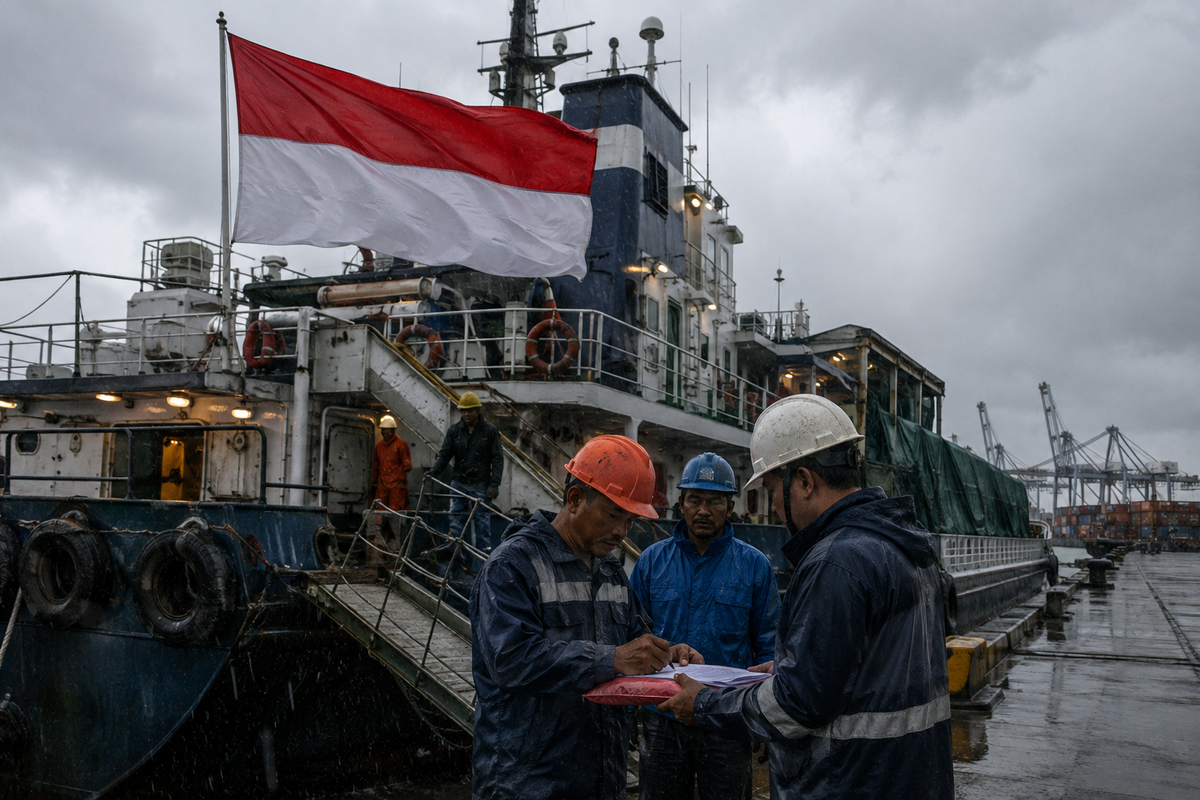
Indonesia is an archipelago of thousands of islands and a maritime labor market to match: it sends tens of thousands of seafarers onto foreign ships every year, and it flags a large domestic and regional fleet of its own. The two roles meet in one document. The Perjanjian Kerja Laut, the sea employment agreement, is the instrument Indonesian law builds everything on, and since the ratification law of 2016 no seafarer may be placed on board without one. Whether the ship flies the Indonesian flag or a foreign one, that piece of paper is the first thing to ask about.
Before you sign a contract under the Indonesian flag, know which laws apply. You can check your seafarer contract free in the Seafarer Contract Checker: pick Indonesia, and the report reads your SEA against MLC 2006 and the verified Indonesian facts.
Ratified by statute, registered in 2017
Indonesia did what many flags skip: it passed a law to ratify. Law No. 15 of 2016 on the ratification of the Maritime Labour Convention, 2006 went through parliament first, and the ratification was registered with the ILO on June 12, 2017. From that date the Convention binds Indonesian-flagged ships, and the Directorate of Shipping and Seafarers under the Directorate General of Sea Transportation in Jakarta is the office that certifies them.
The Directorate publishes a working e-mail address, a general address for the Directorate General and a national contact centre. What it does not publish is an MLC-specific complaint inbox. A complaint about conditions on an Indonesian ship goes to the seafarers directorate through the general channel, or in person to the port's maritime office. Write it down, date it, keep a copy, and copy the ITF. The verified addresses stand on the Indonesia flag page of the checker.
The Perjanjian Kerja Laut
The PKL is the Indonesian answer to the seafarer employment agreement the Convention requires, and Indonesian law treats it as a condition of employment, not an afterthought. No PKL, no lawful placement. That has three practical consequences for a seafarer at the desk.
It has to exist before you board. A manning agency that puts you on a flight with a promise and a handshake has already broken the rule. Ask for the signed PKL, take a copy, and check the ship name, the rank, the wage and the duration against what you were told.
It is the document a claim is built on. A wage dispute, an injury case, a repatriation fight: the Indonesian authorities, the insurer and the ITF will all ask for the PKL first. A PKL that names a lower wage than the one you were promised is the wage you will be paid in a dispute.
It follows you onto foreign flags. An Indonesian oiler on a Panama-flagged bulker has a PKL because Indonesian placement rules require one, and a Panamanian SEA because the flag requires one. The law under the ship is Panama's. The PKL is the home-country paper trail. Both should say the same thing about wage and duration; when they do not, ask why before you sign, not after. What Panamanian law actually grants is in our guide to Panama flag labor law.
What the MLC floor gives you on an Indonesian ship
Because Indonesia ratified, every Indonesian-flagged ship of 500 gross tons or more on international voyages carries a Maritime Labour Certificate and a Declaration of Maritime Labour Compliance. The declaration tells you how Indonesia implemented each rule, and the PKL has to match it:
- A written agreement, signed by you and the shipowner or the owner's representative, with a copy you keep.
- Wages at least monthly, with a monthly account of pay and deductions.
- At least 10 hours of rest in any 24-hour period and 77 hours in any seven days, recorded and countersigned.
- Paid annual leave of at least 2.5 calendar days per month of employment.
- Repatriation at the shipowner's cost, with a maximum period of service before it is due.
- Medical care and sick pay after illness or injury.
- No recruitment fees charged to you.
- A written on-board complaint procedure handed over with the agreement.
The lines that usually go wrong, clause by clause, are in our guide to seafarer contract red flags. How the basic wage relates to the ILO floor is in the seafarer minimum wage guide.
 Free crew appSeafarer Contract CheckCheck your contract clause by clause against MLC 2006 and flag state regulations. The check is free. On iPhone, Android or in the browser.
High performance in Asia, unranked in Europe
Indonesia's ships trade mostly in their own region, and the inspection record reflects it. The Tokyo MoU rates the flag high performance for 2022 to 2024, on almost 750 inspections in three years. In Europe there were too few inspections for the flag to appear on the Paris MoU performance list at all, so the checker shows it as unranked there rather than as good or bad. The ITF does not list Indonesia as a flag of convenience: the ships are Indonesian owned and Indonesian crewed under Indonesian law.
A high performance rating is good news for the ship and no guarantee for the contract. It means port state control in Singapore or Busan boards Indonesian ships less often than the average, which also means fewer outside eyes on your payslip. On this flag the PKL and your own copies of the rest hour sheets do the work an inspector might otherwise do.
Indonesian flag in the contract: what I check before sign-on
- The PKL exists, is signed, and matches the ship, the rank, the wage and the duration you were promised.
- Basic wage, overtime and leave pay in separate lines.
- The rest hour rule is written in and the record is kept on board.
- The repatriation clause names the shipowner as the payer and sets a maximum time on board.
- No placement fee was charged to you, in any form.
- The on-board complaint procedure came with the agreement, and you know the Jakarta address.
How Indonesia compares with every other register is in our guide to flags of convenience and your contract. For the other big crew-supplying flags with their own national law, read our guides to Philippine flag labor law and India flag labor law.
How the Indonesia flag rates in port state control
Port state control keeps score on every flag. The regional inspection regimes publish each year which registers get detained most, and the ITF keeps its own list of flags of convenience. This is where Indonesia stands on the current lists:
- Paris MoU (Europe and Canada): not ranked (too few inspections), performance list valid July 1, 2026 to July 6, 2027.
- Tokyo MoU (Asia Pacific): high performance, inspections and detentions 2022 to 2024.
- ITF: not listed as a flag of convenience, 2025 list.
- MLC 2006: ratified 12 Jun 2017.
These lists count detentions, not contracts. A white list flag can still sit under a bad SEA, and a black list flag tells you how much backing to expect from the administration when something goes wrong on board. The current rating of every flag we cover stands on the Indonesia flag page, and the app report names MLC 2006 plus the flag at the top of every check, with the same rating next to it.
Source note
ILO NORMLEX ratification register for MLC 2006 (Indonesia, June 12, 2017); Law No. 15 of 2016 on the ratification of the Maritime Labour Convention, 2006; Directorate General of Sea Transportation, Ministry of Transportation, contact pages; Paris MoU performance lists valid July 1, 2026 to July 6, 2027; Tokyo MoU Annual Report 2024, Table 8; ITF list of FOC registries 2025. Flag facts checked against these sources on September 1, 2026. This article is editorial context for working seafarers, not legal advice.
FAQ
Has Indonesia ratified MLC 2006?
Yes. Indonesia passed Law No. 15 of 2016 on the ratification of the Convention and registered the ratification with the ILO on June 12, 2017.
What is a Perjanjian Kerja Laut?
The Indonesian sea employment agreement, the PKL. It is the core instrument of Indonesian seafarer law: no seafarer may be placed on board without one, and it is the document a complaint, a wage claim or an insurance case is built on.
Which authority handles MLC matters on an Indonesian-flagged ship?
The Directorate of Shipping and Seafarers under the Directorate General of Sea Transportation, Ministry of Transportation, in Jakarta. It publishes a working address and a contact centre, but no MLC-specific complaint inbox.
How does the Indonesian flag rate in port state control?
The Tokyo MoU rates Indonesia high performance for 2022 to 2024, on almost 750 inspections. The flag has too few inspections in Europe to appear on the Paris MoU list. The ITF does not list Indonesia as a flag of convenience.
I am Indonesian on a foreign-flag ship. Does the PKL still apply?
The PKL still has to exist, because Indonesian placement rules require it, but the law under the ship is the flag state's law. Read that flag's page for your contract; the PKL is your home-country paper trail.
7SHORT1LONG® is a Seafarer Identity Brand. From Tanjung Priok to the Gulf, Indonesian crew keep the engine rooms and the galleys running. The ship department crew apparel names the trade, and the sign on set is for the day the PKL is signed.
YES, WE ARE CREW.


Gear for the watchSeafarer T-Shirts · Crew Best Sellers· Seafarer iPhone CasesIndonesian Sailor Set · Build your Sailor Set


