
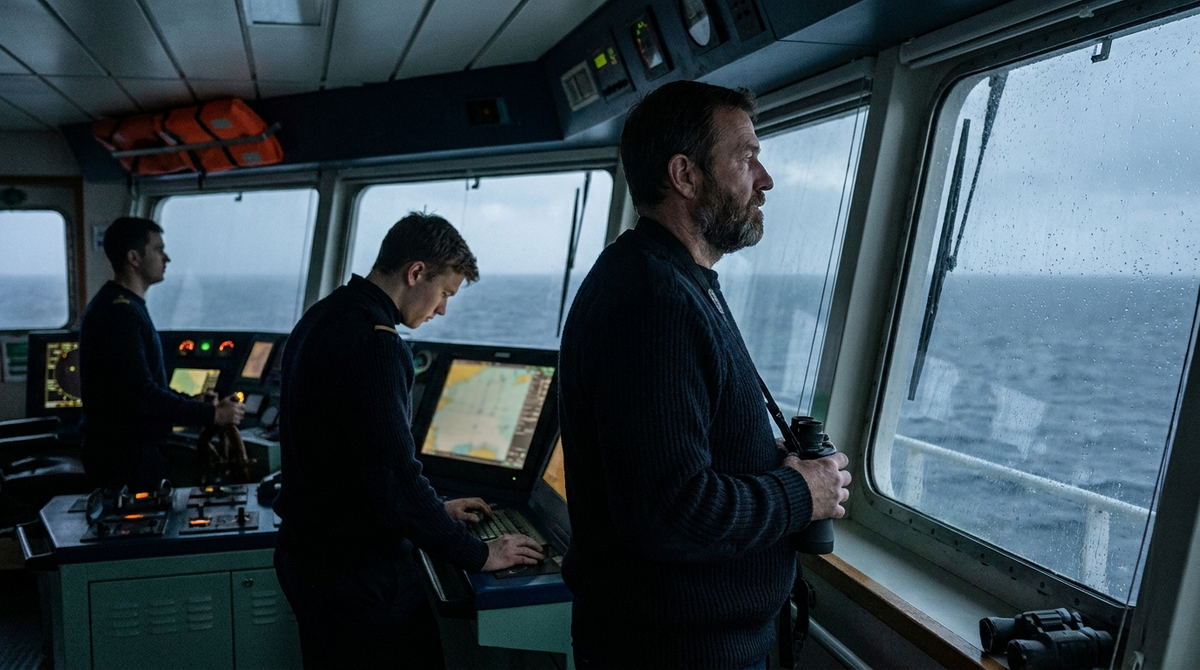
A ship is a floating org chart, and everyone on board can draw it from memory. Who calls the bridge, who answers to the bosun, who signs the oil record book, who runs the galley when the cook is sick. Ashore, merchant ship ranks confuse people. On board, they are the operating system.
The confusion has a reason. Half of these titles are legal categories written into an international convention. The other half are spoken names that outlived sailing ships and steam plants, and the two lists never lined up. A second officer and a second engineer are not the same seniority. Captain is not a rank. Ordinary seafarer is a job description, not an insult.
Here is the ladder, department by department, the way it actually works on a working merchant ship.
Deck department: from ordinary seafarer to master
The master, called captain ashore and the old man in the mess, carries final responsibility for ship, cargo and crew. Everything under that is delegated authority. The master signs the official log book, signs each completed page of the Oil Record Book under MARPOL Annex I, decides whether the ship sails in the weather that is coming, and is the one person on board whose signature nobody else can substitute.
Under the master: the chief officer (chief mate), who runs cargo operations, stability and the deck crew's working day. On a tanker that means the loading plan and the pressure figures. On a container ship it means arguing with the terminal about the stowage. By long convention he keeps the 4 to 8 watch. The second officer is usually the navigator: passage plan, chart corrections, the 12 to 4. The third officer carries safety equipment, lifeboats, fire gear and the drill inventory, and holds the 8 to 12.
Those watch pairings are shipboard convention, not international law. What STCW actually fixes is rest, not the clock. An officer of the watch or a rating forming part of a watch must be given at least 10 hours of rest in any 24 hour period and 77 hours in any 7 day period, in no more than two blocks, one of them at least 6 hours long (STCW Code, section A-VIII/1).
The ratings side carries the physical ship. The bosun leads the deck gang: he takes the chief officer's plan and turns it into a work list, decides who chips, who paints, who rigs the pilot ladder in the dark. He is not an officer and does not want to be. On a cold foredeck a bosun neck gaiter is working kit, and it reads as a rank badge to anyone who has worked for one.
ABs (able seafarers) steer, stand lookout, handle mooring lines, chip, paint and rig. Since the 2010 Manila amendments the AB grade has its own certificate under STCW Regulation II/5, with a separate one for engine ratings under III/5. OSs (ordinary seafarers) are learning the trade, usually with a watchkeeping rating certificate under II/4 and a lot of hours behind a needle gun. A deck cadet is an officer in training, somewhere between student, workhorse and future third mate.
Engine department: from wiper to chief engineer
The chief engineer answers for everything that turns, burns or pumps, and for the fuel and lube oil figures the master signs off. The second engineer runs the engine room day to day, builds the maintenance plan, and is usually the hardest working rank on board. Third and fourth engineers hold their own machinery: generators, purifiers, boilers, auxiliaries, the fresh water system nobody thinks about until it stops. Each completed operation in the Oil Record Book is signed by the officer in charge of that operation, which is why a fourth engineer learns very early that a bunkering entry is a legal document.
Electro-technical officers (ETOs) carry the ship's electronics, automation and high voltage systems. The rank got its own STCW certificate under Regulation III/6 in the same 2010 package, with an electro-technical rating grade under III/7. On older ships the work sat with the second engineer and a good motorman, and on some fleets it still does.
Below the officer line: oilers and motormen on watch or on day work, wipers cleaning and learning, and on many ships a fitter in the workshop cutting and welding what cannot be ordered until the next port. Some fleets still carry a donkeyman, a rank whose name outlived the auxiliary boiler it came from. An engine cadet sits where the deck cadet sits, one deck lower and several degrees warmer.
The two chains run in parallel and meet at the mess room table, which is where most of the friction happens. That relationship has its own entry: deck vs engine. It is also the reason the deck vs engine t-shirt reads as a joke to crew and as gibberish to everyone else.
Galley and hotel
On a cargo ship, the cook may be the most important morale officer on board, with a mess room to prove it daily. He works with a messman or steward, orders provisions for a 30 day passage, and hears more about the ship's mood than the master does. Bad food on day 40 of a contract is not a small problem, and every master knows it.
On a cruise ship, the hotel department dwarfs everything else. Hotel director, food and beverage, executive chef and galley brigade, housekeeping, guest services, entertainment, retail, spa, security. The hierarchy there is deeper than the deck and engine ladders combined, and it uses hospitality titles rather than STCW ones. All of them are seafarers with full contract rights, as we covered in the hotel department post. Ship type changes the shape of the whole crew list, which is worth reading next to ship types explained for crew.
How the ladder is climbed
Rank follows certificates, and certificates follow sea time. The STCW Convention, adopted at the IMO, sets the international framework: watchkeeping licenses, management level tickets, medical certificates, revalidation every five years.
The numbers are real and they are long. For a deck officer of the watch under Regulation II/1, a candidate needs either 12 months of approved seagoing service inside an approved training programme with structured onboard training, or 36 months of approved seagoing service. For master on ships of 500 gross tonnage or more under II/2, the requirement is a further 36 months of approved service as officer in charge of a navigational watch, reduced to 24 months if at least 12 of them were served as chief mate. On the engine side, III/2 puts chief engineer and second engineer on ships of 3,000 kW propulsion power or more on the same kind of ladder.
Between each step sit written exams, orals and simulator assessments set by the flag state, paid for in study months ashore with no wage coming in. That is the part nobody posts about. It is also why rank is respected on board in a way that job titles ashore are not: everyone in the mess knows exactly what the ticket cost.
 Free crew appSeafarer Contract CheckCheck your contract clause by clause against MLC 2006 and flag state regulations. The check is free. On iPhone, Android or in the browser.
Stripes, and what they do not mean
Four stripes for the master, three for the chief officer, two for the second, one for the third, with the chief engineer wearing four alongside the master. Worth knowing what that system is not. No IMO instrument regulates merchant navy insignia. Stripes are company and national convention, inherited from naval and passenger line practice, and they vary: some fleets give the ETO three, some two, some none at all.
On cargo ships the uniform mostly lives in the wardrobe until inspectors, pilots or an agent come aboard. On passenger ships it is worn daily, because guests read stripes the way crew read a watch list. Either way the stripes describe the certificate, not the person.
What crew actually call each other
Almost nobody uses the full rank in speech. The chief engineer is Chief. The chief officer is Mate or Chief Officer depending on the fleet, which is a live source of confusion when both are in the same conversation. The second engineer is Second, the bosun is Bosun, and the master is Captain or Cap, never Master, because Master is what the crew list says and Captain is what a human being says.
Sparks is the oldest survivor. It was the radio officer, a rank that effectively ended when the GMDSS was fully implemented on 1 February 1999 and the Morse requirement went with it. The radio work moved to GMDSS qualified deck officers. The name stayed, and on some ships it now belongs to whoever fixes the wifi.
Where people get merchant ship ranks wrong
Captain versus master. Same person. Master is the legal rank on the crew list and in the flag state's certificates. Captain is the spoken title and the courtesy address.
Officer versus rating. This is the real dividing line, not seniority in years. Officers hold certificates of competency at operational or management level and carry legal responsibility for a watch or a system. Ratings hold certificates of proficiency and carry the ship physically. An AB with 25 years at sea knows more about mooring than a third officer with 25 months, and both facts are true at once.
Second officer versus second engineer. Different departments, different ladders, and they are not equals. The second engineer is number two in his department. The second officer is number three in his.
And the word crew. Ashore it often means the ratings. On board it means everyone who signed on, master included, which is the only definition that has ever mattered to 7SHORT1LONG®. Gear sorted by the world you work in: the Ship Department collection carries the signal for deck, engine and galley.
Your rank is a contract term
Rank is not just a place in the mess room. It is a legal particular. MLC 2006, Standard A2.1, paragraph 4, lists what a seafarer's employment agreement must contain, and item (d) is the capacity in which the seafarer is to be employed. If the SEA says AB and the ship works you as bosun, the paperwork and the reality have separated, and the paperwork is what an inspector, a flag state or a court will read.
Wages follow the same logic. The published international floor exists only for the AB rank (USD 690 basic in 2026); every other rank scales through the CBA wage tables named in your contract. So check the rank line before you sign, not after. You can run your own agreement through the MLC Contract Check free, clause by clause, in about a minute.
What the ranks feel like from inside, rather than on a crew list, is a separate story: life at sea.
Source note
Certification, sea service and rest hour figures in this article come from the IMO STCW Convention and the STCW Code (regulations II/1, II/2, II/4, II/5, III/2, III/5, III/6, III/7 and section A-VIII/1). Contract particulars come from the ILO Maritime Labour Convention, 2006, Standard A2.1. Wage figures come from ITF Seafarers. The Oil Record Book signing rule is MARPOL Annex I. The GMDSS implementation date is from IMO radiocommunications. This article is editorial context for crew, not legal advice.
FAQ
What are the ranks on a merchant ship?
Deck: master, chief officer, second officer, third officer, deck cadet, bosun, AB, OS. Engine: chief engineer, second, third and fourth engineers, ETO, engine cadet, fitter, oiler or motorman, wiper. Plus cook and steward on cargo ships, and a full hotel department on passenger ships.
What is the difference between captain and master?
Same person. Master is the legal rank on a merchant ship, used on the crew list and in flag state certificates. Captain is the spoken title. The master carries final responsibility for vessel, cargo and crew.
What is the difference between an officer and a rating?
Officers hold certificates of competency and carry legal responsibility for a watch or a system. Ratings hold certificates of proficiency and do the physical work of the ship: steering, lookout, mooring, maintenance, engine room support. Both are seafarers with the same MLC contract rights.
How long does it take to become a master?
Typically well over a decade. STCW Regulation II/1 requires 12 months of approved training service or 36 months of seagoing service for a deck watchkeeping certificate, and II/2 requires a further 36 months as officer of the watch for master on ships of 500 gross tonnage or more, reducible to 24 months with at least 12 as chief mate. Exams and revalidations sit between each step.
What do the stripes on a ship officer's uniform mean?
Four stripes for the master and chief engineer, three for the chief officer, two for the second, one for the third is the common pattern. No IMO rule sets it. Insignia are company and national convention, so they vary between fleets.
Does my rank have to be written in my contract?
Yes. MLC 2006, Standard A2.1, paragraph 4(d) requires the seafarer's employment agreement to state the capacity in which the seafarer is to be employed. If the SEA and the actual job do not match, the SEA is what counts in an inspection or a dispute.
Wiper or master, the rank sets the watch, the pay scale and the signature line. It does not set who belongs. Every rank on the ladder is crew first, and that is the whole 7S1L position.
YES, WE ARE CREW.


Gear for the watchShip Type T-Shirts · Ship Department· Seafarer HoodiesBuild your Sign On Set · Build your Sailor Set


