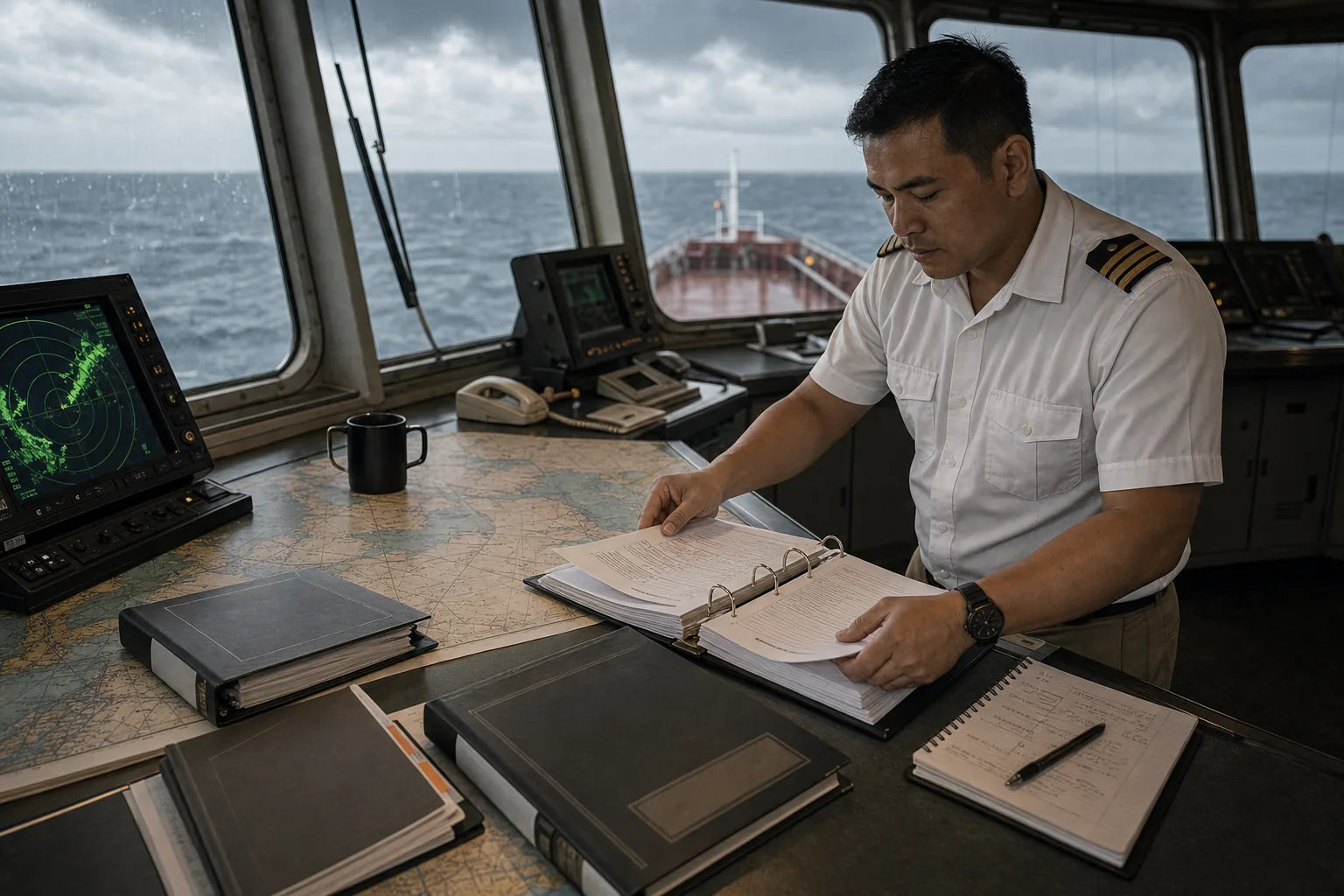
Martin Lex is the pen name of the 7S1L safety desk: SOLAS, lifesaving and firefighting gear, muster drills, emergency signals and safe work on board. Portrait is illustrative.
What is the IMO? Ask ten seafarers and you will get ten versions of the same answer: the people behind the rules. The International Maritime Organization, or IMO, is the United Nations agency behind many of the international rules that shape shipboard life. Crew may not talk about the IMO every watch, but they live with its work through drills, certificates, bridge procedures, engine-room safety, pollution controls, and training standards.
For a seafarer, the IMO is not a distant office in London. It is the system behind SOLAS, MARPOL, STCW, ISPS, voyage planning, emergency readiness, and the paperwork checked when a vessel enters port.
This article explains what the IMO actually is, how it makes rules, which conventions matter most on board, and how its paperwork ends up in the hands of a Port State Control officer walking up your gangway.
What is the IMO, exactly
The IMO is a specialized agency of the United Nations, headquartered at 4 Albert Embankment in London, on the south bank of the Thames. It currently has 176 Member States and three Associate Members. Almost every flag you have sailed under, and almost every port you have called at, belongs to it.
The organization is older than most of the ships it regulates. The convention creating it was adopted in Geneva in 1948, entered into force in 1958, and the body first met in 1959. For its first decades it was called IMCO, the Inter-Governmental Maritime Consultative Organization. The name changed to IMO in 1982. If you find IMCO on an old certificate frame in a ship's office, that is why.
What the IMO is not: a shipping company, a union, or an inspection service. It has no ships, no inspectors, and no police. It is a forum where governments negotiate common rules for international shipping, supported by a secretariat of roughly 300 staff under a Secretary-General. Since January 2024 that post is held by Arsenio Dominguez of Panama.
What the IMO does
The IMO develops global standards for international shipping. Those standards let ships from different flags, companies, and ports work under a common safety and environmental framework.
On board, that framework becomes practical: bridge watchkeeping, fire drills, lifeboat equipment, oil record books, garbage management, security levels, crew certification, and the way a ship prepares for inspection.
How the IMO works: Assembly, Council, committees
The structure matters because it explains why maritime rules change slowly, and why they stick once they change.
The Assembly is the top level. All Member States sit in it, and it meets in regular session once every two years. It approves the work program, votes the budget, and elects the Council.
The Council is the executive organ between Assembly sessions. Forty Member States sit on it, elected in three categories: ten states with the largest interest in providing shipping, ten with the largest interest in seaborne trade, and twenty elected for geographic balance. The Council supervises the work and appoints the Secretary-General.
The real technical work happens in the committees. Two of them produce most of the rules a watchkeeper ever meets:
The Maritime Safety Committee (MSC) owns safety: construction, life-saving appliances, navigation, manning, fire protection. When SOLAS changes, it changes here.
The Marine Environment Protection Committee (MEPC) owns pollution prevention: oil, garbage, sewage, air emissions, ballast water. When a new MARPOL requirement lands in the engine room, an MEPC session put it there.
Three more committees cover legal matters, technical cooperation, and facilitation (the fight against port paperwork). Below the committees sit seven sub-committees where specialists grind through the detail. Their abbreviations read like a crew change manifest: HTW for training and watchkeeping, NCSR for navigation and search and rescue, PPR for pollution prevention, SDC for ship design, SSE for ship systems and equipment, CCC for cargoes and containers, III for implementation.
A chief officer does not need to follow the sessions. But it helps to know that the checklist that changed on your last vessel was not invented by your DPA. It came down this chain.
How a rule is made: the tacit acceptance procedure
Most major IMO rules start with something going wrong. A casualty, an investigation report, a study, or a proposal from a Member State lands at a sub-committee. Specialists draft. The committee, usually MSC or MEPC, debates and adopts. So far, normal diplomacy.
The clever part is what happens next. Under the classic treaty model, an amendment only entered into force once enough governments actively ratified it. That model failed at sea: none of the amendments adopted to the 1960 SOLAS Convention between 1966 and 1973 ever collected enough acceptances to take effect. Rules were agreed and then died in filing cabinets while the ships kept sailing.
SOLAS 1974 flipped the logic with the tacit acceptance procedure. An amendment to the technical annexes enters into force on a set date unless enough parties actively object before that date. For SOLAS, an amendment is deemed accepted two years after it is communicated to governments, unless more than one third of contracting governments, or states holding 50 percent of world merchant tonnage, file objections. In practice most amendments now enter into force within 18 to 24 months of adoption.
Silence means yes. That single mechanism is why your ECDIS carriage requirement, your enclosed-space entry drill, and your low-sulphur fuel changeover all arrived on board with dates attached, instead of waiting a decade for ratifications.
After entry into force, the flag state writes the rule into its national law, class societies fold it into their rules, the company writes it into the safety management system, and the crew meets it as a revised procedure, a new certificate, or one more item on the pre-arrival checklist. By the time it reaches the mess room notice board, few remember it started as a proposal in a London committee room.
The main IMO-linked names crew hear
SOLAS is safety of life at sea: construction, life-saving appliances, fire protection, navigation safety, and emergency readiness.
MARPOL is pollution prevention. Crew meet it through oil, garbage, sewage, air-emission, and cargo-related procedures.
STCW is standards of training, certification, and watchkeeping. It is tied directly to professional competence and safety duties, and it is the reason your certificates have expiry dates.
ISPS is ship and port facility security. It matters at the gangway, in restricted areas, and during port calls under different security levels.
MLC 2006 is the Maritime Labour Convention. It sits with the International Labour Organization rather than the IMO, but crew meet it in the same place: contracts, wages, rest hours, repatriation, and living conditions on board. The distinction matters when something goes wrong: safety deficiencies trace back to IMO instruments, while wage and contract problems run through ILO machinery and the flag state. The ILO minimum wage figures for seafarers come from that side of the house too. Before you sign your next contract, you can run it clause by clause through the free MLC Contract Check: it takes about a minute in the browser, needs no account, and your data stays on your device.
 Free crew appSeafarer Contract CheckCheck your contract clause by clause against MLC 2006 and flag state regulations. The check is free. On iPhone, Android or in the browser.
A short timeline of the conventions
The dates tell their own story. Nearly every major instrument follows a disaster.
1948. The convention establishing the organization is adopted in Geneva. It enters into force in 1958, and the first meeting is held in 1959.
1974. The current SOLAS Convention is adopted, carrying a lineage that began with the first SOLAS of 1914, written after the Titanic. SOLAS 1974 entered into force in 1980 and has been amended continuously ever since, which is exactly what tacit acceptance was built for.
1973 and 1978. MARPOL is adopted in 1973 and modified by the 1978 Protocol after a string of tanker accidents. The combined instrument, MARPOL 73/78, entered into force in 1983. Every oil record book entry an engineer signs sits on this foundation.
1978. STCW is adopted, the first convention to set binding international standards for training and watchkeeping instead of leaving them to each flag. It entered into force in 1984. The 2010 Manila amendments rewrote large parts of it, with effect from 2012: rest hour records, refresher training, and the certificate structure most current crew trained under.
2002. After the September 11 attacks, the ISPS Code is adopted in December 2002 and enters into force on 1 July 2004 as part of SOLAS chapter XI-2. Gangway access control, restricted areas, and security levels date from here.
2006. The Maritime Labour Convention is adopted at the ILO, not the IMO, and enters into force in 2013. It completes the picture: the IMO covers the ship, the MLC covers the people.
The IMO number welded to the hull
There is one place where the IMO follows a ship physically for life. Look at the stern, the superstructure, or the hull side of almost any merchant vessel and you will find it: the letters IMO followed by seven digits.
That is the ship's identification number under the IMO ship identification number scheme. It is assigned when the ship is built, and it never changes. The name can change, the flag can change, the owner can change, the paint scheme can change. The number stays until the hull is scrapped. Marking it permanently and visibly became mandatory on 1 January 1996 under SOLAS regulation XI-1/3.
For crew, the number is mostly a detail you copy onto forms. For Port State Control, insurers, and anyone tracking a vessel with a history of name changes, it is the one identity a ship cannot shed. Welders cut it into the steel for a reason.
Why crew should care
You do not need to memorize every IMO instrument to understand why it matters. A deck officer using ECDIS, an engineer maintaining pollution-prevention equipment, a rating standing gangway watch, or a cadet preparing for STCW training all meet IMO-linked rules in daily work.
Good regulation does not remove seamanship. It gives the ship a baseline, so the crew can work with clearer expectations across ports, flags, and companies. That baseline is also the backbone of everything covered in our overview of safety at sea.
What the IMO does not do
The IMO does not inspect your ship. It does not issue your certificates. It does not pay your wages or enforce your contract.
Enforcement runs through flag states, port state control, class societies, and the company. When a Port State Control officer walks up the gangway in Rotterdam, that is the IMO framework arriving in person, held by someone else's hand.
How IMO rules come up the gangway
Port State Control is where the whole system gets teeth. Regional agreements like the Paris MoU in Europe and the Tokyo MoU in Asia coordinate national inspectors who board foreign ships and check them against the IMO conventions their flag has ratified.
The inspection is familiar to anyone who has done a port call. The officer checks certificates first: safety equipment, safety construction, load line, pollution prevention, the crew's STCW documents. Then the walk-through. Lifeboat davits, fire dampers, the oily water separator, the muster list by the mess room, expiry dates on hydrostatic releases. If clear grounds appear, the inspection goes deeper.
Findings become deficiencies. Serious deficiencies become detentions, and a detention means the ship does not sail until the flag state and class confirm the problem is fixed. For the AB repainting a lifebuoy stencil the day before arrival, for the third engineer testing the 15 ppm alarm, for the master signing the pre-arrival checklist: this is the IMO, translated into a Tuesday in port.
It is worth saying plainly that the system protects crew as much as it audits them. A functioning free-fall lifeboat, a fire pump that starts, rest hour records that are honest: PSC pressure on these things has kept people alive. The inspector is not the enemy. A ship that would fail the inspection is.
The 7SHORT1LONG connection
7SHORT1LONG® is named after a shipboard emergency signal: seven short blasts, one long. That signal has meaning only because professional crews work inside a safety culture of muster lists, drills, alarms, roles, and responsibility. The full story of the signal is its own article. The same alarm pattern is printed on the seafarer emergency signal t-shirt, and the wider safety at sea collection carries the drills, boats, and equipment that IMO rules put on board.
7S1L is a Seafarer Identity Brand. Official rules come from the vessel, the company, the flag state, the port state, and the maritime authorities.
Source note
For official convention context, start with the International Maritime Organization pages on SOLAS and STCW. Membership figures (176 Member States, three Associate Members) are from the IMO membership page, the organizational structure from the IMO structure page, and the ship number rules from the IMO identification number scheme page, all checked in August 2026. This article is editorial context for crew, not legal advice. For questions about your certificates, your contract, or an inspection, the flag state, the company, and organizations like the ITF are the right addresses.
FAQ
What is the IMO and what does IMO stand for?
IMO stands for International Maritime Organization, a specialized agency of the United Nations headquartered in London. It sets global safety, training, security, and pollution standards for international shipping.
How many member states does the IMO have?
The IMO has 176 Member States and three Associate Members, per the organization's own membership page as of August 2026.
Does the IMO inspect ships directly?
No. The IMO develops international standards. Enforcement is handled by flag states, port states, companies, class societies, and maritime authorities.
What is an IMO number on a ship?
It is a unique identification number, the letters IMO plus seven digits, assigned when a ship is built. It stays with the hull for life regardless of name, flag, or owner changes, and permanent visible marking has been mandatory since 1996 under SOLAS.
Is the MLC an IMO convention?
No. The Maritime Labour Convention 2006 comes from the International Labour Organization, not the IMO. It covers contracts, wages, rest hours, and living conditions.
Why does the IMO matter to crew?
Its instruments shape the safety, training, pollution-prevention, and security systems that crew work with on board every day.
YES, WE ARE CREW.
Gear for the watchSafety at Sea Collection · Seafarer T-ShirtsBuild your Sign On Set · Build your Sailor Set