Martin Lex is the pen name of the 7S1L safety desk: SOLAS, lifesaving and firefighting gear, muster drills, emergency signals and safe work on board. Portrait is illustrative.
Ask a bosun what SOLAS is and you will get a practical answer before a legal one. SOLAS means the International Convention for the Safety of Life at Sea. For crew, it is not an abstract regulation. It shows up at muster stations, lifeboat drills, fire doors, bridge equipment, radio checks, emergency lighting, and the way a ship prepares people to survive when something goes wrong.
A deck officer, engineer, rating, cruise crew member, cadet, steward, or port worker meets it through procedures, drills, signs, alarms, certificates, inspections, and the daily habit of keeping the vessel ready.
This is the full crew guide: what the convention says, where it came from, what its chapters mean on a working day, how drills and musters put it into muscle memory, and what happens when a Port State Control officer walks up the gangway to check it.
What is SOLAS? The short answer
SOLAS sets minimum international safety standards for the construction, equipment, and operation of ships. The International Maritime Organization calls it the most important of all international treaties concerning the safety of merchant ships. The current version was adopted on 1 November 1974 and entered into force on 25 May 1980.
That matters because ships move across flags, ports, terminals, weather systems, and jurisdictions. Crew need a common safety language when the ship is at sea, alongside, under inspection, or preparing for emergency response.
The convention applies to merchant ships on international voyages. The flag state certifies its own ships against it. Port states check foreign ships that call at their berths. A Filipino AB on a Panama-flag bulk carrier and a Croatian officer on a Bahamas-flag cruise ship work under the same core rules. That is the point.
From the Titanic to the 1974 convention
SOLAS exists because ships sank and the lessons were written down afterward. The first version was adopted in 1914, in response to the Titanic disaster of 1912, when a ship went down with lifeboat capacity for only about half of the people on board. New versions followed in 1929, 1948, and 1960. Each one carried the weight of casualties that came before it.
The 1974 convention changed how the rules stay current. It introduced the tacit acceptance procedure: an amendment enters into force on a set date unless enough parties object before that date. Before 1974, updates could stall for years while governments ratified them one by one. After 1974, the convention could keep pace with new ship types, new equipment, and new accidents. That is why a treaty adopted in 1974 still governs a newbuild leaving the yard this year, and why the chapter list has kept growing, most recently with rules for ships in polar waters and ships carrying industrial personnel.
Where crew actually meet SOLAS
Most seafarers do not experience SOLAS as a document. They experience it as a muster list posted in the alleyway. A lifeboat drill before departure. A fire team assignment. A watertight door. A GMDSS radio check. A lifejacket inspection. An alarm pattern that cuts through ship noise.
That is the crew-facing truth. Safety rules become real only when people know their station, know their role, and can move through the ship under pressure. How that readiness connects to the wider habit of working safely on board, from toolbox talks to fatigue management, is covered in our guide to safety at sea.
The chapters that shape a working day
SOLAS runs to fifteen chapters today. Five of them define most of the safety work a crew member actually touches. Some chapters also carry special rules for particular vessels: tankers, passenger ships, bulk carriers. What those ship types mean for the people who crew them is its own guide. Here is what each chapter looks like from inside the ship, not from a lawyer's desk.
Fire protection: Chapter II-2
Fire is the emergency crews drill for most, because a ship on fire has nowhere to pull over. Chapter II-2 is behind the fire doors that must never be wedged open, the fire plan in its container at the gangway, the fixed CO2 system covering the engine room, the galley extinguishers, and the SCBA sets waiting in the fire lockers.
For an oiler, this chapter is the reason hot work needs a permit and the reason oily rags do not stay in a corner. For the fire team, it is the reason the monthly drill covers a different scenario each time: engine room, galley, accommodation, cargo space. Smoke behaves the same whether the drill was taken seriously or not.
Life-saving appliances: Chapter III
This chapter covers lifejackets, lifeboats, life rafts, immersion suits, EPIRBs, rescue boats, launching arrangements, alarms, and communication systems. On board, these items are checked, logged, maintained, and drilled.
For deck officers and ratings, this means inspections, lowering routines, inventory, maintenance, and making sure equipment is ready before anyone needs it. Chapter III is also where the drill schedule lives: every crew member takes part in at least one abandon ship drill and one fire drill every month, and a ship that has changed a large part of its crew drills within 24 hours of leaving port. Anyone who has joined a vessel in a hot terminal and been mustered the same evening has felt that rule directly.
Radio and distress: Chapter IV and GMDSS
Chapter IV covers radiocommunications and carries the Global Maritime Distress and Safety System, phased in during the 1990s. GMDSS means a ship can send a distress alert that reaches shore rescue centers and other vessels automatically: DSC calls on VHF and MF/HF, satellite equipment, the EPIRB that floats free and transmits if the ship goes down, the SARTs that make a life raft visible on radar.
Crew meet this chapter as the daily and weekly radio tests logged by the GMDSS-certified officer, the battery checks, and the printed distress procedures next to the radio installation. Quiet work. It only matters once, and then it matters completely.
Safety of navigation: Chapter V
Chapter V is the bridge chapter: radar, AIS, ECDIS, voyage planning, the voyage data recorder, bridge visibility, and the duty to respond to distress signals. It applies in some form to a wider range of ships than most other chapters.
For the officer of the watch, this chapter is the passage plan checked before departure, the lookout kept in fog, the position fixed and logged. For the helmsman, it is the standing orders on the bridge. Watchkeeping standards themselves come from a separate convention, STCW, but Chapter V decides much of what the bridge must be equipped to do.
Safety management: Chapter IX and the ISM Code
Chapter IX makes the ISM Code mandatory. The ISM Code turns safety into daily procedure: permits, risk assessments, near-miss reporting, maintenance systems, bunkering procedures, enclosed-space entry, hot work, cargo operations, and emergency response plans.
That paperwork can feel heavy. The purpose is clear. Make the ship predictable before conditions become dangerous. A chief officer signing an enclosed-space permit at 0600 is executing SOLAS whether or not anyone says the word.
Security has its own place in the convention too. Chapter XI-2 carries the ISPS Code, with its security levels, restricted areas, and gangway control. That system deserves its own explanation, and it has one in our guide to ship security.
 Free crew appSeafarer Contract CheckCheck your contract clause by clause against MLC 2006 and flag state regulations. The check is free. On iPhone, Android or in the browser.
Muster stations and drills
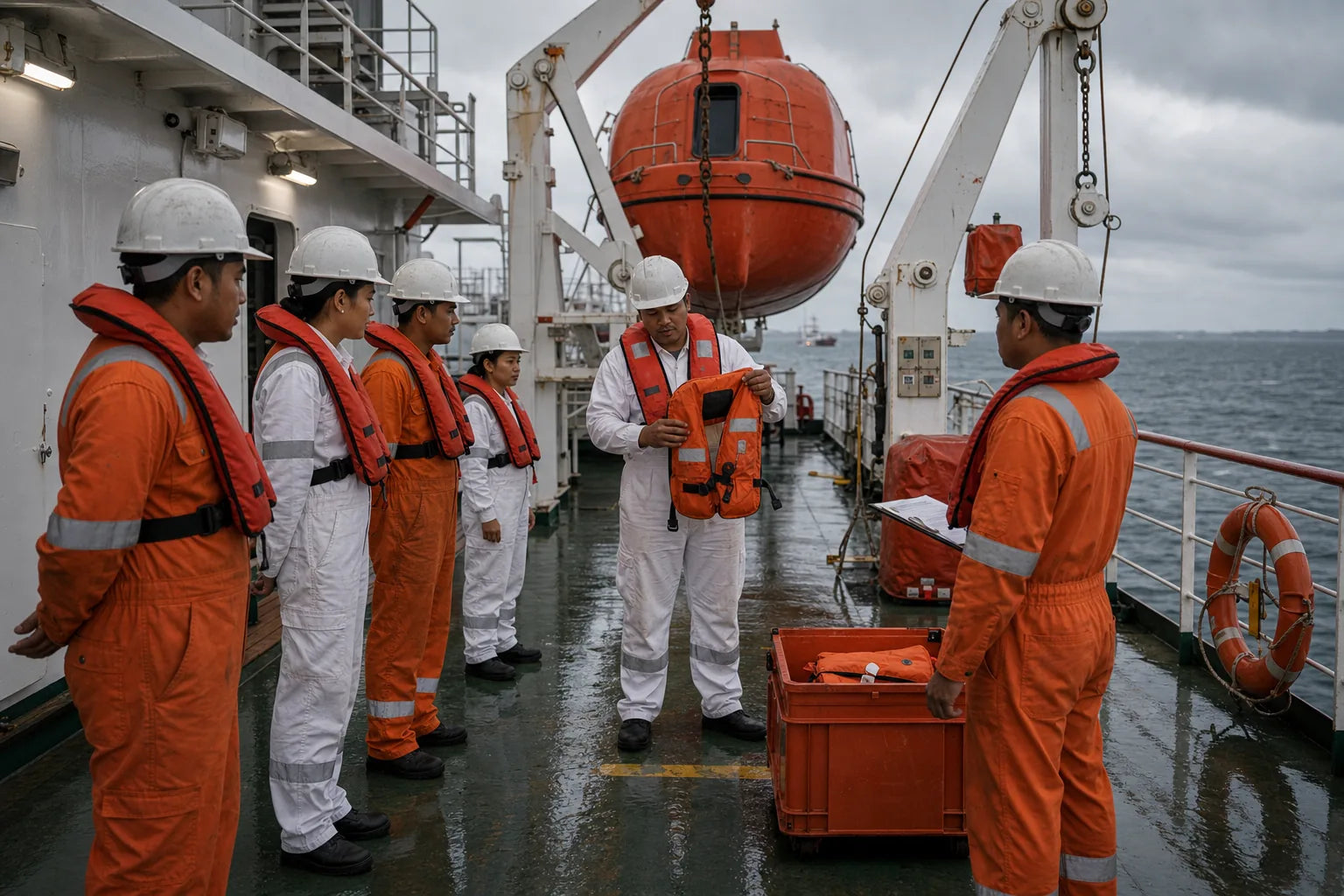
Muster drills build memory before the emergency. A crew member needs to know the route from cabin to station, the role on the muster list, the equipment involved, and the officer responsible for the station.
Fire drills, abandon ship drills, man-overboard preparation, and rescue boat routines are not theatre. They are practice for the moment when darkness, smoke, weather, passengers, fatigue, or panic can make simple actions difficult.
The muster list on the bulkhead tells every person on board which station is theirs and what their job is when the alarm sounds: who closes watertight doors, who brings the crowd control team to the stairways, who preps the rescue boat, who takes the count at the station. A steward on a cruise ship may guide passengers. A fitter may be on the fire team. Nobody stands around asking what to do. That is what the drills buy.
The general emergency signal
Seven or more short blasts followed by one long blast, sounded on the ship's whistle and the general alarm bells, is the general emergency alarm under SOLAS. Every crew member on a SOLAS vessel knows it.
It does not mean abandon ship. This is the single most common misunderstanding ashore, and crew never make it. The alarm means: stop what you are doing, take your lifejacket, go to your muster station, report, and wait for orders. Abandon ship is a separate order. It comes from the master, and it comes verbally.
The full breakdown of the signal, what each phase of a real emergency sounds like, and why the pattern is built the way it is, lives in its own article: what 7 short and 1 long means on a ship. An original recording is on the cruise ship emergency alarm page.
Port State Control: when SOLAS walks up the gangway
A flag state certifies its ships. But the check that most crews remember happens in port, when a Port State Control officer boards a foreign ship at the berth. Regional agreements such as the Paris MoU and the Tokyo MoU coordinate these inspections so that substandard ships have fewer places to hide.
The inspector looks at certificates first: safety equipment, safety construction, radio, safety management. Then the ship itself. Fire doors that close. Lifeboat engines that start. Emergency lighting that works. The inspector can ask a rating where their muster station is, or have the crew run a fire drill on the spot. Serious deficiencies can hold the ship at the berth until they are fixed. A detention costs the operator real money, which is exactly why the system works.
PSC inspections cover labor standards too, under the Maritime Labour Convention. But the officer checks the ship, not your personal deal. Your contract is your own responsibility, and the time to read it is before sign-on, not at the gangway. The free MLC Contract Check reviews a contract clause by clause against MLC 2006 in about a minute, in the browser, with no account.
SOLAS is one rulebook of four
New cadets sometimes lump every regulation into one pile. It helps to keep the big instruments separate, because each one answers a different question.
SOLAS answers: is the ship safe, equipped, and ready for an emergency. MARPOL answers: does the ship pollute. It is the reason for the oil record book and the garbage management plan. STCW answers: is the person qualified. It stands behind every certificate in a seafarer's file. MLC 2006 answers: is the crew treated and paid fairly. It covers contracts, wages, food, accommodation, hours of rest, and repatriation.
On a working ship the four overlap constantly. A chief officer runs a lifeboat drill under SOLAS, logs rest hours under STCW and MLC, and signs the garbage log under MARPOL. Different books. One job.
Why this connects to 7SHORT1LONG
7SHORT1LONG® takes its name from the general emergency alarm, not from decoration. The name points toward awareness, muster, discipline, and the shared language of people who work at sea. It is professional crew language on a shirt.
7S1L honors safety culture as crew identity. We do not replace training. We do not issue procedures. We do not sell fake authority. We use the signal to recognize the people who know what it means: seafarers, cruise crew, cargo crew, offshore workers, deck officers, engineers, ratings, cadets, and port workers.
That is why the seafarer emergency signal t-shirt and the SOLAS emergency signal snapback cap carry the alarm pattern itself, and why the safety at sea collection is built around real shipboard subjects: lifeboats, fire drills, man overboard, EPIRB. Crew recognize their own equipment. Guests see a design. That difference is the brand.
Source note
For the official convention overview, adoption history, and chapter structure, see the International Maritime Organization page on SOLAS, the Safety of Life at Sea Convention. The convention dates in this article (adopted 1 November 1974, entered into force 25 May 1980, first version 1914 after the Titanic, later versions 1929, 1948, and 1960) follow that page. This article is editorial context for crew identity, not legal advice or shipboard training. Procedures on board always come from the vessel, the company, the flag state, and the relevant authorities.
FAQ
What does SOLAS stand for?
SOLAS stands for the International Convention for the Safety of Life at Sea. It is an IMO treaty that sets minimum safety standards for the construction, equipment, and operation of merchant ships.
When did SOLAS come into force?
The current SOLAS Convention was adopted on 1 November 1974 and entered into force on 25 May 1980. The first version dates to 1914, adopted in response to the Titanic disaster, with earlier revisions in 1929, 1948, and 1960.
What is the general emergency signal under SOLAS?
Seven or more short blasts followed by one long blast on the ship's whistle and general alarm bells. It means go to your muster station and wait for orders. It is not the order to abandon ship.
Which safety areas do SOLAS regulations cover?
Construction standards, fire protection, life-saving appliances, radio communications, navigation safety, cargo rules, security, and management systems such as the ISM Code. Crew meet them as drills, inspections, and maintenance routines.
Does SOLAS apply to all ships?
SOLAS applies to merchant ships on international voyages, with exceptions for categories such as warships, small cargo ships, fishing vessels, and pleasure yachts not in trade. Chapter V on navigation safety applies in some form to a wider range of vessels.
Is 7SHORT1LONG a safety authority?
No. 7S1L is a Seafarer Identity Brand. The name is taken from a shipboard emergency signal, but official training, procedures, and regulations always come from the vessel, the company, the flag state, and the relevant authorities.
YES, WE ARE CREW.
Gear for the watchSafety at Sea Collection · Seafarer T-ShirtsBuild your Sign On Set · Build your Sailor Set