Martin Lex is the pen name of the 7S1L safety desk: SOLAS, lifesaving and firefighting gear, muster drills, emergency signals and safe work on board. Portrait is illustrative.
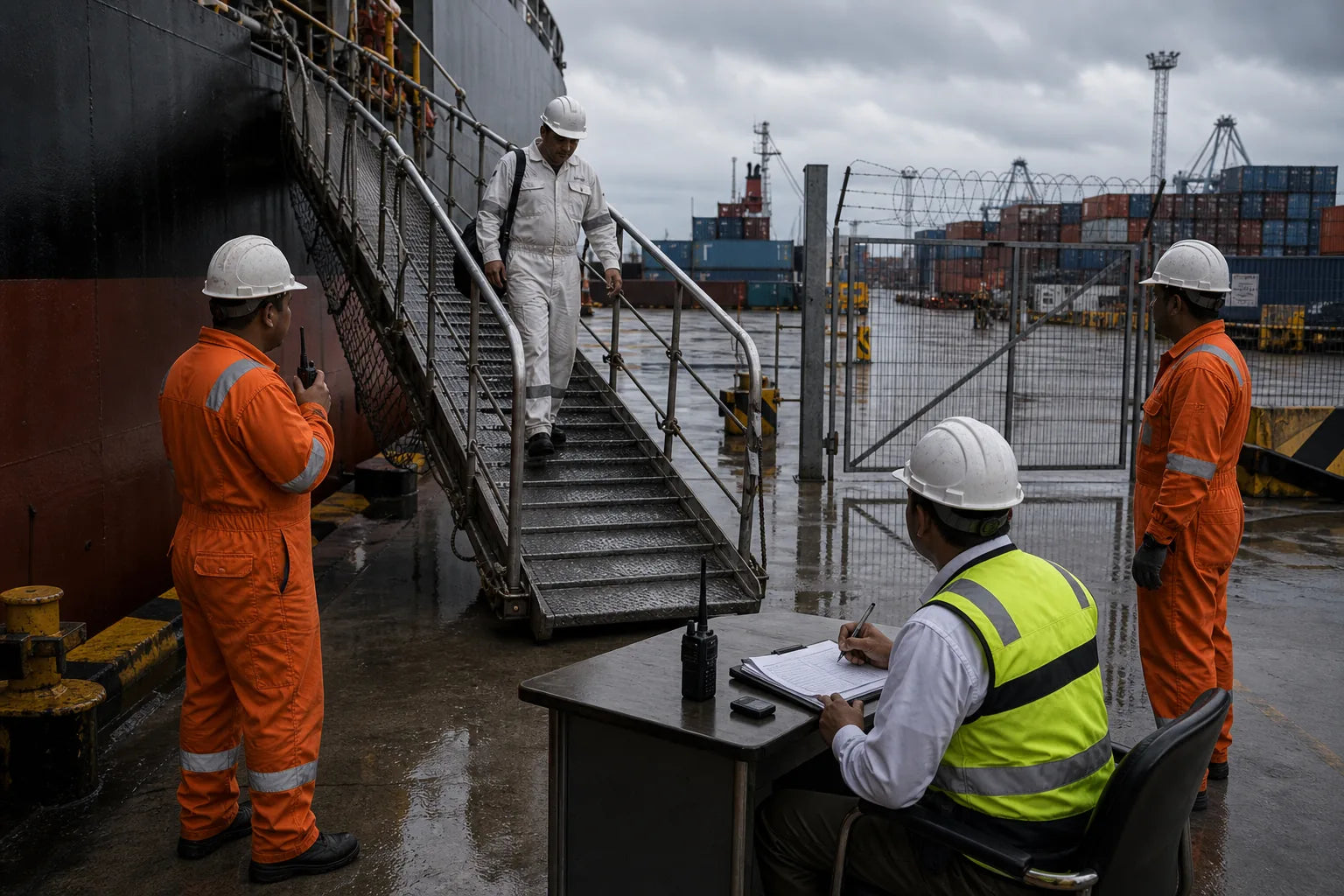
Ship security starts at the gangway. Who comes on board. Who leaves. Which contractor has permission. Which area is restricted. Which bag, vehicle, launch, or visitor does not feel right.
Piracy gets the headlines. Daily security for crew looks smaller: access control, port calls, cargo areas, passenger spaces, engine rooms, bridge access, and the quiet habit of reporting something early.
What ship security means
Ship security is the system used to protect the vessel, crew, passengers, cargo, and port operation from unlawful acts, unauthorized access, smuggling, sabotage, cyber risk, and other threats.
On a working ship, that system includes the Ship Security Plan, security levels, drills, gangway procedures, restricted areas, ID checks, visitor logs, lighting, cameras, communications, and crew instructions.
The ISPS context
The International Ship and Port Facility Security Code, usually called the ISPS Code, entered into force on 1 July 2004 as an amendment to SOLAS. The requirements sit in SOLAS Chapter XI-2. The IMO adopted the package in December 2002, in the security push that followed the 2001 attacks, and it created a common security framework for ships and port facilities worldwide.
Crew meet ISPS through security levels, Ship Security Officer duties, access control, port facility coordination, and the requirement to pay attention when the vessel is alongside or at anchor.
Security Level 1 is the normal operating condition. Level 2 raises protective measures for a heightened risk. Level 3 applies when an incident is probable or imminent. Most crew spend an entire career at Level 1 and still run the drills, because the system only works when the habit is already there.
Roles on board
The master carries overall authority. The Ship Security Officer (SSO) coordinates the security plan on board. The Company Security Officer (CSO) supports from shore. But the system only works when ordinary crew participate: the rating at the gangway, the steward near passenger areas, the engineer entering restricted spaces, and the deck team near cargo operations.
Security is a shared habit, not a badge on one person's chest.
What the Ship Security Plan actually says
Every ISPS ship carries a Ship Security Plan, approved by the flag administration or a recognized security organization. The plan itself is a restricted document. Crew do not quote it, and this article will not either. But the categories it covers are public, because Part A of the ISPS Code lists them.
A plan covers access control at the gangway and the pilot ladder. It names the restricted areas: bridge, engine room, steering gear, CO2 room, and whatever else the ship's security assessment flagged. It sets search routines for people, baggage, and ship's stores at each security level. It defines what changes at Level 2 and Level 3, who coordinates with the port facility, how incidents get reported, and how often drills run. The paper sits with the SSO. The habits live at the gangway.
One item in the plan stays deliberately quiet: the SSAS. SOLAS regulation XI-2/6 requires a ship security alert system that sends a covert alert to authorities ashore. No siren, no lights, nothing audible on board. The activation points are confidential, and crew learn only what their own role requires.
A night at the gangway
0215, container terminal, second night alongside. The AB on gangway watch has a clipboard with the visitor list, a box of ship's visitor passes, and a radio. Cranes are working forward. Every twenty minutes someone comes up the gangway: stevedores on shift change, a superintendent, a chandler's runner with provisions paperwork, two crew coming back from shore leave through the terminal gate.
The routine is unglamorous. Check the terminal pass and the ID against the list. Match the face. Log the time. Point the visitor to the ship's office and make sure he actually goes there. Watch the moorings, watch the draft, watch the quay. Around 0300 a man in a high-vis vest walks up without a pass and says the agent sent him. The AB does not argue and does not wave him through. One call to the duty officer settles it. That call is ship security working exactly as designed.
Gangway watch is work, not a favor. Extra security watches at Level 2 come out of the same rest hour budget as cargo watches, and they belong in the employment agreement like any other duty. If a contract is vague about watch schedules or rest hours, run it through the free MLC Contract Check before sign-on. It checks a contract clause by clause against MLC 2006 in about a minute, in the browser, no account needed.
Modern threats are mixed
Security can mean piracy risk in certain waters, stowaway risk in port, cargo tampering, unauthorized boarding, suspicious visitors, drone observation, or cyber weakness in ship systems and company networks.
Not every crew member is a security specialist. Every crew member can still notice what belongs and what does not.
Stowaways: the port side of the risk
Not every threat climbs over the rail at sea. In some ports the realistic risk is a stowaway: someone who slips past the terminal fence during cargo operations and hides in a hold, a store room, or a void space. For the person hiding, it is desperation. For the ship, it becomes a long administrative problem: port refusals, repatriation negotiations, and days of extra load on the crew.
That is why the pre-departure stowaway search exists. Before sailing from a higher-risk port, teams walk the accommodation, the holds, the forecastle stores, the rudder trunk area, and the spaces nobody visits between inspections. Torch in, look properly, sign off. It feels pointless right up until the day it is not.
Piracy, HRA transits, and the citadel
Armed attack is the rarest threat most crews prepare for, and the one with the strictest routines. Waters with elevated attack risk, such as parts of the Gulf of Aden and the Gulf of Guinea, are treated as high risk areas, and industry Best Management Practices shape the transit: hardened doors, razor wire on the rails, fire hoses rigged, doubled lookouts, blackout at night, and reporting to naval coordination centers.
The word every crew member learns is citadel. A citadel is a fortified safe space, often built around the steering gear or the engine control room, with communications, water, and a door that holds. If boarders reach the deck, the crew musters inside and stays out of reach while the company and naval forces work the problem from outside. A citadel only protects the people who are in it, which is why the muster is drilled, not improvised.
Cyber security came aboard in 2021
Ship systems run on software: ECDIS on the bridge, the loading computer, engine monitoring, crew Wi-Fi, and the daily email link to the office. The IMO answered that with Resolution MSC.428(98). It requires cyber risks to be addressed in the ship's safety management system under the ISM Code, no later than the company's first annual Document of Compliance verification after 1 January 2021. Supporting guidelines sit in MSC-FAL.1/Circ.3.
For crew, cyber security looks small and specific. No unknown USB stick in the ECDIS. Chart updates from the approved source only. A phishing email that pretends to be the agent gets reported, not answered. The third officer who asks before plugging something in is doing security work, the same as the AB at the gangway.
Security drills are not safety drills
Crews know the drills that belong to safety at sea: fire teams, boat stations, abandon ship. Those rehearse accidents. Security drills rehearse deliberate acts, and the ISPS Code requires them separately. Part B guidance calls for a security drill at least once every three months: a bomb search pattern, an unauthorized visitor scenario, a move from Level 1 to Level 2, a citadel muster.
The distinction matters on deck. A fire drill assumes the ship is the problem. A security drill assumes a person is. The muster is quieter, the questions are different, and the answer is rarely a hose.
The 7SHORT1LONG view
7SHORT1LONG® respects the working culture behind ship security: alertness, responsibility, low-profile discipline, and care for the crew around you. The signal is not theatre. It belongs to people who understand that readiness matters before the alarm.
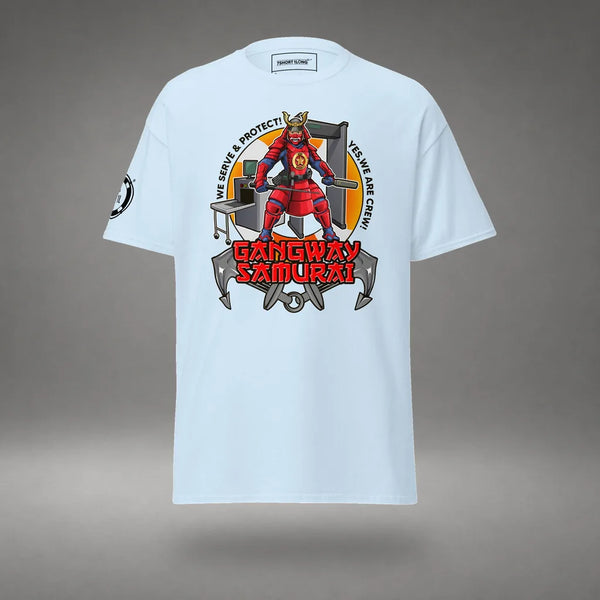
That is also why the security team has its own designs in the ship department crew apparel line. The ship security department t-shirt is for the team that runs the gangway. The gangway samurai ship security hoodie is for the watch standing in the wind at 0300, checking passes nobody thanks them for.
Source note
Facts in this article are based on the IMO's public pages on SOLAS Chapter XI-2 and the ISPS Code (entry into force 1 July 2004, security levels, SSO and CSO roles): imo.org, SOLAS XI-2 and the ISPS Code. The cyber requirements come from the IMO's maritime cyber risk page (Resolution MSC.428(98) and the MSC-FAL.1/Circ.3 guidelines): imo.org, maritime cyber risk management. This article is editorial context for crew, not legal or security advice, and it quotes no restricted plan content.
FAQ
What is ship security?
Ship security is the system of procedures, roles, equipment, and crew awareness used to protect a vessel from unauthorized access and security threats.
What does ISPS mean?
ISPS means International Ship and Port Facility Security Code. It entered into force on 1 July 2004 as an amendment to SOLAS.
What are the ISPS security levels?
Level 1 is normal operations. Level 2 applies when there is a heightened risk. Level 3 applies when a security incident is probable or imminent.
Who is responsible for ship security?
The master and the Ship Security Officer have formal roles, but every crew member contributes by following procedures and reporting suspicious activity.
What does SSAS mean on a ship?
SSAS is the Ship Security Alert System required by SOLAS regulation XI-2/6. It sends a covert alert to authorities ashore without sounding any alarm on board.
What is a citadel on a ship?
A citadel is a fortified safe space with communications and supplies where the crew musters during a pirate boarding and stays out of reach until help arrives.
YES, WE ARE CREW.
Gear for the watchShip Department Collection · Seafarer T-ShirtsBuild your Sign On Set · Build your Sailor Set