Martin Lex is the pen name of the 7S1L safety desk: SOLAS, lifesaving and firefighting gear, muster drills, emergency signals and safe work on board. Portrait is illustrative.
7 short 1 long is a ship emergency alarm pattern. COLREG sound signals are navigation and collision-prevention signals used between vessels.
They are not the same thing.
That distinction matters because people search for ship horn meanings, cruise ship alarms, fog signals, one long blast, short blasts, and the 7 short 1 long emergency alarm as if they all belong to one simple code. They do not. One belongs to onboard emergency organization. The other belongs to navigation rules and vessel-to-vessel communication. This article covers the COLREG side of that line. The emergency alarm itself (what it means, when it sounds, what happens on board in the minutes after) has its own full article: What Does 7 Short and 1 Long Mean on a Ship?
What 7 short 1 long means
Seven short blasts followed by one long blast is the ship's general emergency alarm. SOLAS Chapter III requires the alarm system, and the LSA Code describes the signal as seven or more short blasts followed by one long blast, sounded on the ship's whistle or siren and on electrically operated bells or klaxons. On a cruise ship, it is connected with muster instructions, assembly stations, life jackets, crew direction, and public announcements.
For crew, the pattern is tied to assigned duties. A deck officer, engineer, rating, hotel crew member, security guard, cabin steward, galley worker, or guest services team member may have a specific emergency role. The sound is short. The organization behind it is not. Off watch, the pattern doubles as crew identity: the same sequence sits across a seafarer emergency signal t-shirt or a SOLAS emergency signal crew snapback cap, readable at a glance by anyone who has ever stood a muster station.
What COLREG sound signals are for
COLREG is the Convention on the International Regulations for Preventing Collisions at Sea. The IMO describes COLREG as the convention covering rules that help prevent collisions, including steering and sailing rules, lights and shapes, and sound and light signals.
That means COLREG sound signals sit in a navigation context. They are about vessels understanding each other in situations such as maneuvering, restricted visibility, overtaking, channels, bends, uncertainty, and danger.
COLREG even defines the sounds. Rule 32 sets a short blast at about one second and a prolonged blast at four to six seconds. The rules say prolonged, not long.
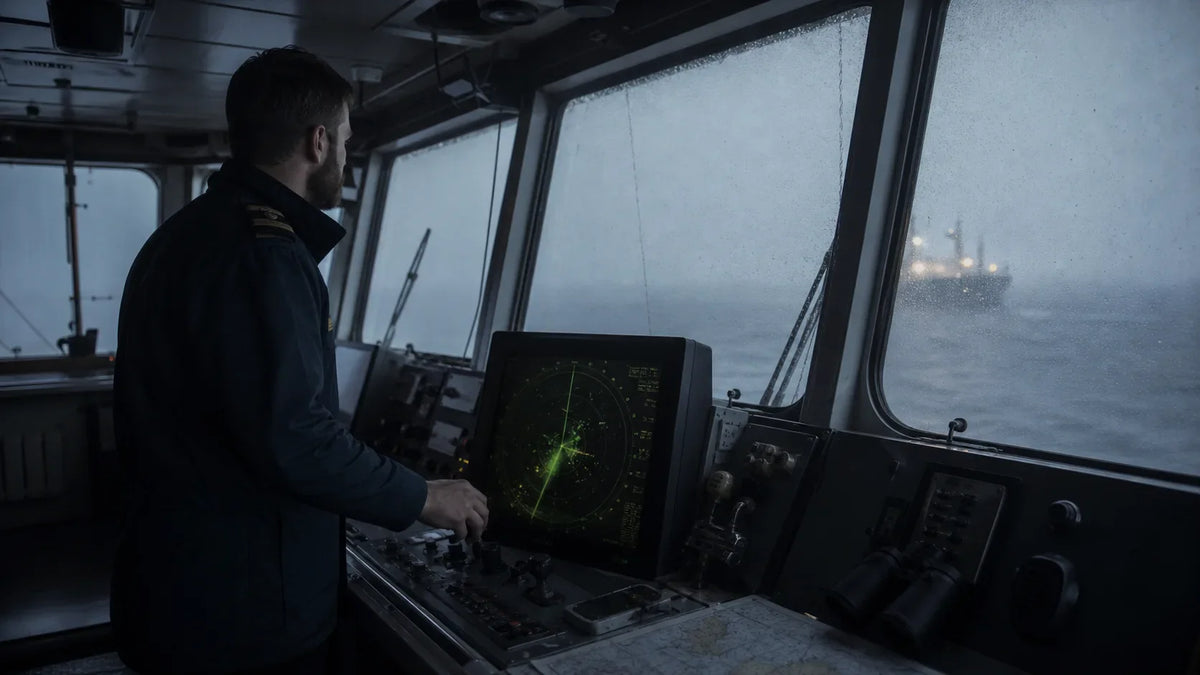
A bridge team does not treat COLREG sound signals as decoration. In fog, traffic, narrow channels, port approaches, and close-quarters situations, sound is one part of a wider navigation picture with radar, AIS, lookout, lights, VHF, speed, helm orders, and the officer's judgment.
The Rule 34 maneuvering signals, one by one
Rule 34 covers power-driven vessels in sight of one another, maneuvering under the steering and sailing rules. Each signal announces what a vessel is doing with helm and engine.
One short blast: altering course to starboard
Two vessels crossing in open water, in sight of each other. The give-way vessel comes to starboard to pass astern of the other and sounds one short blast. The other bridge can match the sound to what radar and compass bearing already show.
Two short blasts: altering course to port
Same logic, other direction. Two short blasts tell the other vessel that the swing to port is deliberate, not an autopilot drift.
Three short blasts: operating astern propulsion
Three short blasts mean the engine is going astern. A ferry sounds it backing off a berth. A bulk carrier arriving at an anchorage may sound it while taking the way off the ship. The signal does not promise the ship is already moving backward. On a loaded vessel, astern power can take long minutes to show in the water.
Five or more short blasts: doubt, or danger
Rule 34(d) is the signal watchkeepers treat as the wake-up call. When one vessel cannot understand the intentions or actions of the other, or doubts whether the other is taking sufficient action to avoid collision, she sounds at least five short and rapid blasts. An officer on a container ship watching a crossing vessel hold course and speed will reach for the whistle button and the VHF at nearly the same moment. Five rapid blasts in the dark are hard to misread.
Overtaking in a narrow channel
In a narrow channel or fairway, overtaking has its own dialogue under Rule 34(c). Two prolonged blasts followed by one short: I intend to overtake you on your starboard side. Two prolonged followed by two short: on your port side. The vessel being overtaken agrees by sounding one prolonged, one short, one prolonged, one short. If she doubts the move is safe, she answers with the five-blast doubt signal instead.
One prolonged blast at a bend
A vessel nearing a bend or a channel area where other vessels may be hidden behind an obstruction sounds one prolonged blast. Any approaching vessel on the far side answers with the same. River pilots use this signal constantly.
Fog signals under Rule 35
Rule 35 governs restricted visibility: fog, mist, falling snow, heavy rain. In or near it, by day or night, the signals change completely, because nobody can see anybody.
- A power-driven vessel making way sounds one prolonged blast at intervals of not more than two minutes.
- Underway but stopped and making no way: two prolonged blasts in succession, about two seconds apart.
- A vessel not under command, restricted in her ability to maneuver, constrained by her draft, sailing, fishing, or towing another vessel: one prolonged followed by two short blasts.
- At anchor: rapid ringing of the bell for about five seconds at intervals of not more than one minute, with vessels of 100 meters or more adding a gong aft.
- Aground: the anchor signal plus three separate and distinct strokes on the bell before and after the rapid ringing.
An anchor watch in fog is where many cadets meet this rule in person. Bell forward, stopwatch running, and somewhere in the grey an inbound tanker announcing herself with one prolonged blast every two minutes. Which signals a crew hears most depends on the trade; our overview of ship types explained for crew maps who sails where.
Why the two systems never mix
The confusion is understandable. Both use short and long sound patterns. Both may involve horns, whistles, alarms, or public address systems depending on the vessel and situation. Both can be heard by people who do not work at sea.
But the audience is different.
The general emergency alarm speaks inward. It organizes people on the ship.
COLREG sound signals speak outward. They help vessels communicate navigation intentions or warn of a situation.
That is the clean difference.
The paper trail behind each system is different too. The emergency alarm comes out of SOLAS, the convention that regulates the ship as a workplace and the crew's response to fire, flooding, and abandonment. COLREG regulates the encounter between vessels. Two conventions, two purposes, one whistle in common. A signal drilled at the muster station says nothing to the ship across the fairway, and a maneuvering signal has no muster list behind it.
Whistle, bells, klaxons: the equipment splits the same way
Rule 33 tells vessels what sound gear to carry for navigation: a whistle from 12 meters of length, a bell in addition from 20 meters, a gong from 100 meters. That equipment exists to be heard outside the hull.
The general emergency alarm runs on different hardware. Whistle or siren, yes, but also electrically operated bells or klaxons wired through accommodation and machinery spaces, backed up by the public address system. It has to reach an oiler standing next to a running main engine and a steward asleep after a late shift. The overlap on the whistle is one honest reason guests mix the two systems up: the same horn that answers a bend signal can carry the emergency pattern a minute later. The pattern is what tells you which system is speaking.
Cruise guests usually search the emergency alarm
Cruise guests often search after hearing a muster drill, cabin announcement, alarm test, or safety briefing. Their real question is usually: what should I do if I hear 7 short and 1 long?
The answer is not to decode every maritime sound signal. The answer is to listen to the ship's announcements, follow crew instructions, know the muster station, and stay out of the crew's way while they move people safely. You can hear the pattern itself, with audio, on our cruise ship emergency alarm page.
That is why cruise guest safety content should stay practical. It should reduce confusion on board, not turn emergency signals into trivia.
Seafarers need the larger sound-signal discipline
For professional seafarers, the distinction is part of the wider discipline of safety at sea. The general emergency alarm belongs to onboard response. COLREG sound signals belong to navigation. SOLAS, STCW, company SMS, bridge procedures, emergency plans, and vessel-specific training all sit around those subjects in different ways.
An officer on watch does not learn sound signals as isolated sounds. They are tied to risk, visibility, traffic, rules of the road, equipment status, human attention, and the condition of the vessel. An engineer hearing the general alarm below decks may think first about emergency station and machinery safety. A cruise crew member may think about passenger movement, stair towers, and assigned muster duties.
Same sea. Different signals. Different jobs.
Sound signals are drilled after sign-on. A contract deserves the same attention before it. The free MLC Contract Check reviews a seafarer employment agreement clause by clause against MLC 2006 in about a minute, in the browser, with no account.
A simple way to remember it
If the sound is telling people on your ship to respond to an emergency plan, think onboard alarm.
If the sound is helping vessels communicate navigation information or warning in traffic, think COLREG.
Do not replace official training, vessel procedures, or bridge instructions with an online article. Ships are not controlled by internet summaries.
Related reading: What Is SOLAS? and the Safety at Sea collection.
Source note
This article is editorial context for crew and readers. It is not navigation training and no substitute for COLREG instruction, vessel procedures, or company safety systems. Signal descriptions follow the International Regulations for Preventing Collisions at Sea, 1972 (Rules 32 to 35) and the SOLAS and LSA Code requirements for the general emergency alarm.
- IMO: Convention on the International Regulations for Preventing Collisions at Sea (COLREG), 1972
- IMO: SOLAS Convention, 1974
- IMO: STCW Convention
- US Coast Guard Navigation Center: Navigation Rules (COLREG text, Rules 32 to 35)
FAQ
Is 7 short 1 long a COLREG sound signal?
No. 7 short 1 long is the ship general emergency alarm, required under SOLAS and described in the LSA Code. COLREG sound signals are navigation and collision-prevention signals used between vessels.
What is COLREG?
COLREG is the Convention on the International Regulations for Preventing Collisions at Sea. It covers collision-prevention rules, including lights, shapes, and sound and light signals.
What does one short blast from a ship mean?
Under COLREG Rule 34, one short blast from a power-driven vessel in sight of another means "I am altering my course to starboard." Two short blasts mean a turn to port, and three short blasts mean the vessel is operating astern propulsion.
What do five short blasts from a ship mean?
At least five short and rapid blasts is the COLREG doubt signal under Rule 34(d). It means one vessel does not understand the intentions or actions of the other, or doubts that enough is being done to avoid collision.
What should cruise guests do when they hear 7 short 1 long?
They should listen to announcements, follow crew instructions, go where directed, and avoid blocking corridors, stairways, muster stations, or crew movement.
Can this article replace official maritime training?
No. It is an explanation for searchers and readers. Professional crew must follow official training, vessel procedures, company safety systems, and applicable rules.
YES, WE ARE CREW.
Gear for the watchSafety at Sea Collection · Seafarer T-ShirtsBuild your Sign On Set · Build your Sailor Set