Martin Lex is the pen name of the 7S1L safety desk: SOLAS, lifesaving and firefighting gear, muster drills, emergency signals and safe work on board. Portrait is illustrative.
What is shore leave? It is the permission and the practical chance for a seafarer to leave the ship while the vessel is in port. In crew life, that small window matters more than people ashore understand.
It may mean a phone call home, a SIM card, a quiet meal, a walk outside the terminal, a visit to a seafarer center, a chapel, a pharmacy. Or simply standing somewhere that is not steel deck.
This guide explains what shore leave means, what the Maritime Labour Convention, 2006 actually says about it, why it still falls through in modern ports, and how a few hours ashore work in practice: gangway log, shore pass, terminal shuttle, seafarer center, and the walk back up the gangway before sailing time.
What is shore leave, and what it is not
Shore leave is time off the ship during a port call. It is measured in hours, not days. The ship stays the seafarer's workplace and home. Shore leave interrupts that loop for an afternoon or an evening, then the contract continues.
Shore leave and annual leave are two different things, and the two get mixed up constantly. Annual leave is the paid leave a seafarer earns under the employment agreement and normally takes at home, between contracts. Shore leave happens during the contract, in whatever port the schedule delivers, on whatever afternoon cargo operations allow. Nobody flies home on shore leave. You walk to a gate.
Who gets ashore depends on the day. An AB coming off the 4 to 8 watch may have a free afternoon while the vessel discharges. An oiler in the middle of a purifier overhaul may not. On a cruise ship, a cabin steward can get three hours in a port that passengers booked a year in advance, and spend them in a mall with free wifi instead of at the beach. All of that counts as shore leave. None of it is guaranteed.
What MLC 2006 says about shore leave
The Maritime Labour Convention, 2006 covers shore leave in Regulation 2.4, titled Entitlement to leave. Paragraph 2 says seafarers shall be granted shore leave "to benefit their health and well-being", consistent with the operational requirements of their positions.
Two things follow from that sentence. First, shore leave is a recognized entitlement under international maritime labour law, not a favor the company hands out. Second, the entitlement is conditional. Cargo work, safe manning, watchkeeping, and security duties come first, and the Convention says so in the same breath.
Regulation 4.4 adds a second anchor. Ratifying states must ensure that shore-based welfare facilities, where they exist, are accessible to all seafarers, whatever their nationality and whatever flag flies on the stern. That is the legal ground under every seafarer center shuttle waiting outside a terminal gate.
What the Convention does not do is spell out procedures. The shore leave sentence in Regulation 2.4 stands almost alone, with no detailed standard behind it that says how many hours, how often, or who pays for the shuttle. How shore leave works on any given day is decided by the master, the company, the terminal, and the port state.
One practical note for anyone signing a contract. Shore leave itself rarely shows up as a clause in a Seafarer Employment Agreement, but leave, hours of rest, and repatriation do, and weak wording there shapes life on board later. The free MLC Contract Check reads a contract clause by clause against MLC 2006 in about a minute, in the browser, with no account. Worth running before sign-on, not after.
Why shore leave is not guaranteed in practice
Modern port calls are short. Container ships turn around in hours. Tankers berth at isolated terminals far from any town. Bulk carriers anchor or work cargo around the clock. Cruise crew work while passengers walk ashore.
Even when shore leave is possible on paper, watch schedules, cargo operations, inspections, immigration rules, terminal distance, security restrictions, fatigue, and lack of transport can make it impossible to use.
Security is the gate most crews meet first. Since 2004, access to port facilities has run under the ISPS Code, the security regime explained in our article on ship security. The Code itself is not the villain here. Part A, section 16.3.15 requires every port facility security plan to include procedures for facilitating shore leave and for access by seafarer welfare and labour representatives. The drafters knew security fences would otherwise lock crews in. Practice varies anyway. One terminal runs a free escort van to the gate every half hour. The next one demands a paid escort booked through the agent, and the price ends the discussion.
Visas are the second gate. The United States is the clearest example: a foreign crew member needs a crewmember visa, normally issued as a combined C-1/D, arranged long before the ship arrives. At the port, border officers decide who may actually land. A seafarer without a valid visa stays on board for the entire stay, even if the ship sits alongside for a week. Other port states admit crew on the strength of a seafarer's identity document and the crew list. The difference decides whether a crew change in one country feels routine and a port call in another feels like house arrest.
Then there is geography. A liquid cargo terminal can sit an hour from the nearest town, with no public transport and a taxi fare that eats a day's pay. At anchorage, shore leave depends on a launch service that may not run at all. And after a six-hour cargo watch plus mooring stations, some crew look at the gangway, do the math on sleep, and stay in their bunk. That is not laziness. That is life at sea doing its arithmetic.
How a shore leave actually works, from gangway to gate
On most merchant ships the sequence is short and routine. The master's standing orders and the day's work plan set who can go and when everyone must be back, usually stated as a back-on-board time with a safe margin before departure or the end of cargo.
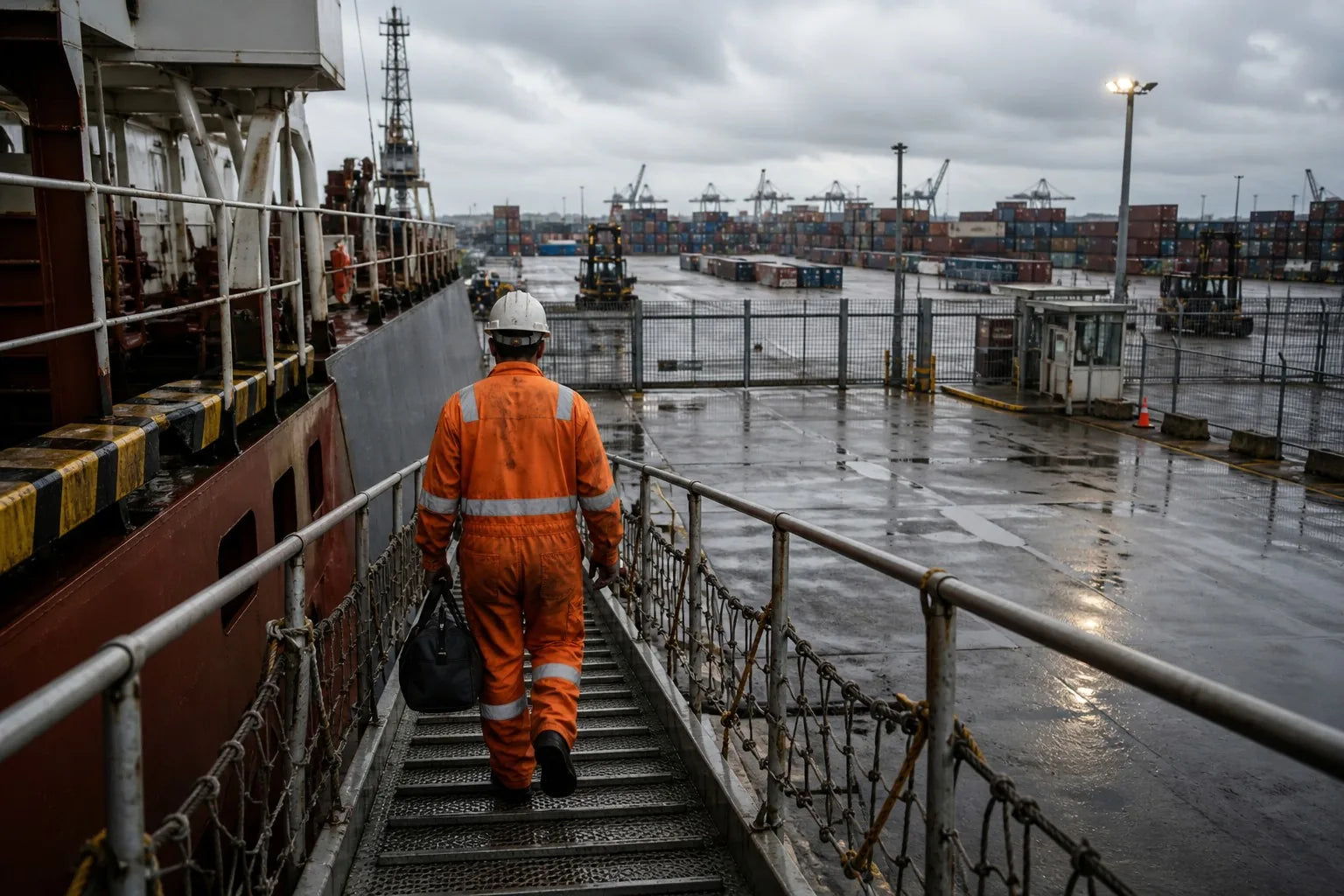
The crew member tells the duty officer and signs out in the gangway log: name, time out, expected return. Then the documents. Passport or seafarer's identity document. The shore pass, if immigration or the terminal issued one. And the agent's card with the ship's name, berth number, and the agent's phone number. That card matters. After eight months on board, "which berth are we at" is an easy thing to forget at midnight in a city you have never seen in daylight.
Inside the terminal, crew walk marked routes or ride the escort van. Nobody strolls between container stacks. Straddle carriers do not brake for sightseers, and the terminal rules say so on every sign. At the gate, the shore pass is checked against the crew list, sometimes in thirty seconds, sometimes not.
Outside the fence, in many ports, a minibus from the local seafarer center waits, driven by a chaplain or a volunteer who has done the same run for years and knows exactly which mall has the cheap SIM cards. Where there is no shuttle, the agent can usually name a taxi company that knows the terminal.
Coming back, the same in reverse: gate, escort, gangway, sign in. Miss the back-on-board time and the whole ship hears about it at breakfast. Delay the sailing and the office hears about it too. Most crews never test this. The margin is respected because everyone wants shore leave to survive as a habit on that ship.
Seafarer centers: what waits at the end of the shuttle
Seafarer centers exist because crews have a few hours and very specific needs. The Mission to Seafarers works in over 200 ports and runs seafarer centers, its Flying Angel clubs, in more than 120 of them. Stella Maris, the Catholic maritime ministry, has port chaplains in over 300 ports worldwide. Deutsche Seemannsmission runs stations in German ports and at locations abroad. Different flags on the door, same idea inside.
The offer is practical. Wifi that works. SIM cards. Money transfer. A small shop with toiletries and snacks. A pool table, a bar with prices set for crew wages, a chapel, and someone to talk to who is not on the crew list. No membership, no dress code, no questions about rank or religion at the door.
When nobody can get ashore, many of these organizations reverse the trip. Chaplains and ship visitors come up the gangway with SIM cards, woolly hats, and time to listen in the mess room. For a fitter working a coal berth an hour from the city, the center at the gate, or the visitor at the top of the gangway, is the shore leave.
Making a short shore leave count
Three hours ashore reward ten minutes of planning on board:
- Fix the back-on-board time in your head before you leave the gangway. Treat it as sailing time minus a margin, not as a suggestion.
- Carry the agent's card or a photo of it: ship's name, berth, phone number. If your phone dies, the paper does not.
- Decide the two things that matter most before the van leaves. For most crew that is calling home and buying basics. Set up messaging and offline maps while ship wifi still works. Our guide to apps for seafarers covers what to install before you lose signal.
- Small bills in local currency help. Center shuttles often run on donations, and the driver has no card reader.
- Dress for the gate, not the deck. Terminals want closed shoes, so out of the coveralls and into a clean seafarer t-shirt and a hoodie for the ride. The flip flops stay in the daypack until the beach or the center.
- Go with a shipmate. Phones die, taxis get lost, and two people remember a berth number better than one.
Why it matters
Shore leave is part of crew welfare. It breaks the closed loop of cabin, mess room, work area, watch. It gives seafarers a few hours of normal life during a contract that can run nine months.
For many crew, the most valuable part is not sightseeing. It is buying basics, calling family, visiting a seafarer center, or sitting quietly away from the ship.
That is also why shore leave comes up in every honest conversation about mental health at sea. Months of the same corridors, the same faces, the same alarms wear on anyone. A few hours where the ground does not move resets more than the mood.
That gap between the right and the reality is why seafarer missions, chaplains, port welfare committees, unions, and crew advocates keep raising shore leave. The right exists. Using it is another matter.
The 7SHORT1LONG view
Shore leave is central to life between ports. It is not a luxury postcard. It is recovery, dignity, and a reminder that the person in coveralls, hotel uniform, or engine-room clothes has a life beyond the vessel.
7SHORT1LONG® talks about shore leave with respect for crew time. Not as tourist travel content. 7S1L is a Seafarer Identity Brand, and shore leave is one of the few hours of a contract where that identity gets to stand still on solid ground.
Source note
For formal context, see the International Labour Organization's Maritime Labour Convention resources and maritime welfare organizations such as ISWAN, Stella Maris, Mission to Seafarers, and Deutsche Seemannsmission.
Specific references used in this article: the ILO MLC FAQ on the right to shore leave (Regulation 2.4, paragraph 2, and Regulation 4.4), Transport Canada's Ship Safety Bulletin on access to shore leave (ISPS Code shore leave facilitation), the U.S. Department of State's crewmember visa page (C-1/D), The Mission to Seafarers, Stella Maris, and Deutsche Seemannsmission.
This article is editorial context for crew, not legal advice. For a live dispute about leave or shore leave, talk to the ITF, your union, or a port welfare organization.
FAQ
What does shore leave mean?
Shore leave means a crew member is allowed and practically able to leave the ship during a port call. It usually lasts a few hours and ends at a fixed back-on-board time.
Do seafarers have a right to shore leave?
MLC 2006, Regulation 2.4, says seafarers shall be granted shore leave to benefit their health and well-being, consistent with the operational requirements of their positions. That is a real entitlement, but a conditional one, and in practice access varies widely by ship, port, and company.
Why do seafarers sometimes miss shore leave?
Short port stays, watches, cargo work, inspections, terminal distance, immigration rules, fatigue, or security restrictions can make shore leave impossible.
How long does shore leave last?
There is no fixed length. It depends on the port stay, the work plan, and the back-on-board time the master sets. On a fast container call it may be two or three hours. On a longer stay it can be most of a day.
Do seafarers need a visa for shore leave?
It depends on the port state. The United States requires a crewmember visa, normally a combined C-1/D, and border officers decide at the port who may land. Many other countries admit crew on their seafarer's identity documents and the crew list.
Why does shore leave matter?
It supports welfare, family contact, basic errands, rest, and mental distance from the ship during long contracts.
YES, WE ARE CREW.
Gear for the watchCrew Welfare at 7S1L · Seafarer HoodiesBuild your Sign On Set · Build your Sailor Set