Martin Lex is the pen name of the 7S1L safety desk: SOLAS, lifesaving and firefighting gear, muster drills, emergency signals and safe work on board. Portrait is illustrative.
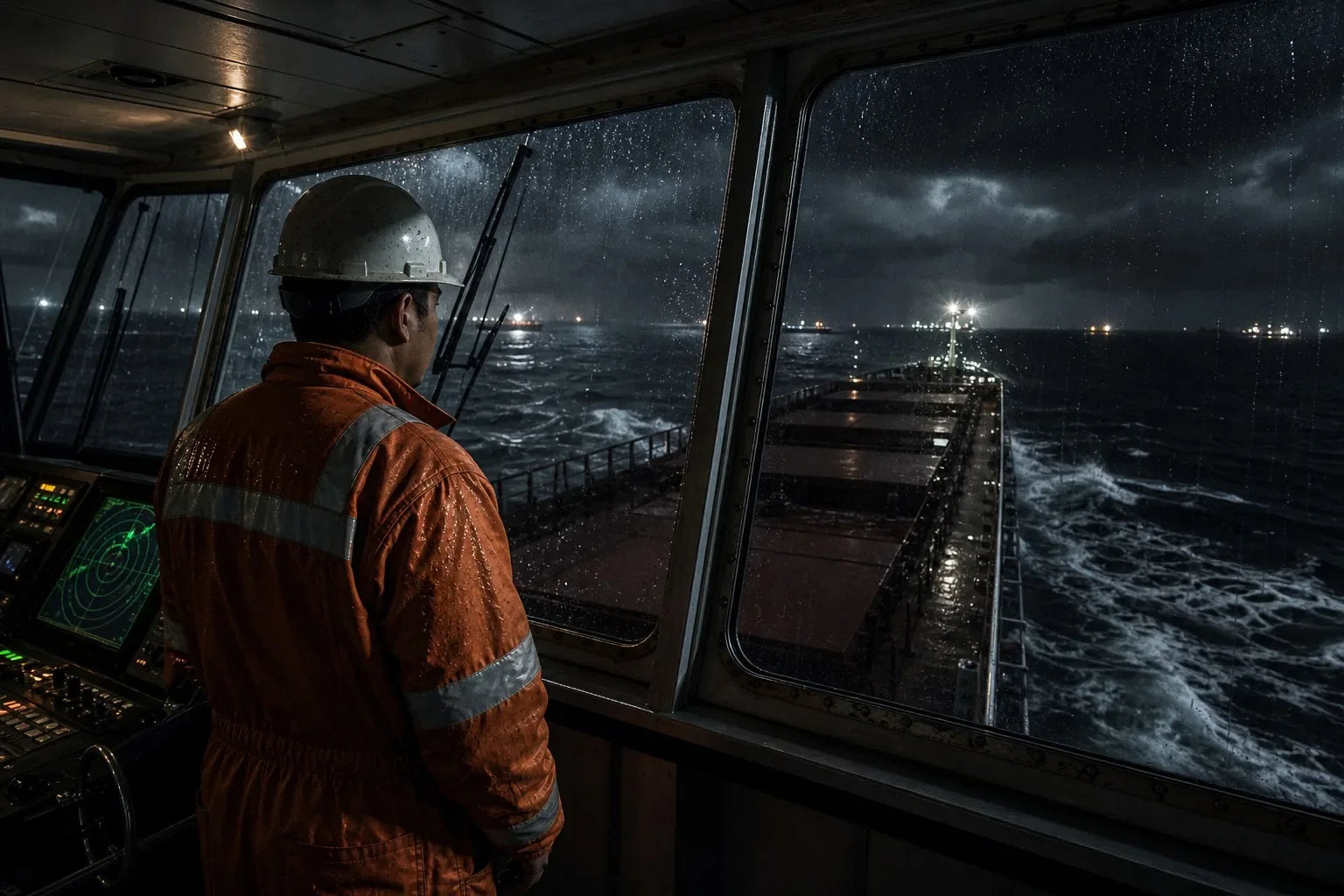
Modern seafarers work with radar, ECDIS, GMDSS, AIS, weather routing, company procedures, and port state inspections. They also still hear the old sea superstitions. Do not rename a ship without care. Do not mock the weather. Do not ignore the feeling that something is wrong.
That does not mean professional crew believe every myth. It means sea culture remembers. Before digital navigation and satellite calls, sailors used stories to explain risk, respect the ocean, and pass warnings from one generation to the next.
This is the longer list. For each belief: where it comes from, as far as anyone can honestly trace it, and whether crew today still pay attention. Some live on in the mess room. Some survive only as jokes on the gangway. A few had a practical core all along.
The sea superstitions you still hear
No whistling on the bridge
The old belief was that whistling "calls up a wind." Sailors on square riggers treated the wind as something you did not mock or summon carelessly. The practical version survives: the bridge is a working space, and noise that is not a report or an order does not belong there. A cadet who whistles on watch still gets a look from the officer of the watch. The stated reason today is discipline. The reflex is older than the explanation.
No bananas on board
Mostly a fishing-boat superstition, with a partly documented practical origin: bananas ripen fast, give off ethylene gas, and could spoil other cargo sharing a hold. The darker origin stories, lost banana schooners, spiders in the bunches, are told with confidence but thin on records. Charter fishing skippers still ban bananas with a straight face. Merchant crew mostly treat it as a joke, which is why a crew humor hoodie about sharing bananas lands in a mess room where the superstition itself never would.
No sailing on a Friday
An old superstition tied to Good Friday and the crucifixion. Nobody schedules around it now. Charter parties, berth windows, and tides decide the departure, and you will still hear the joke on the mooring deck on a Friday sailing. One warning: the famous story of a Royal Navy ship named HMS Friday, launched on a Friday, lost with all hands, is itself a myth. No such ship existed. A superstition grew its own fake evidence, which tells you how these things spread.
Renaming a ship is bad luck
Some owners still hold a renaming ceremony: strike every trace of the old name from the hull, the boats, and the ring buoys before the new one goes on. There is a practical layer underneath. A renamed ship often means a change of owner, flag, or management, and crew know that can mean a change in how the vessel is run and how the wages arrive. That instinct is worth keeping. If you are joining a vessel that just changed hands, run the employment agreement through the free MLC Contract Check before you sign. It checks a contract clause by clause against MLC 2006 in about a minute, in the browser, no account. The old sailors distrusted a new name. The modern version is distrusting an unchecked contract.
Women on board
The old European belief held that a woman aboard angered the sea, while a carved woman on the bow calmed it. The contradiction was never resolved because it was never logic. It was folklore from an era of all-male crews, when every misfortune needed a cause. The industry has the numbers to close it: the BIMCO and ICS Seafarer Workforce Report counted over 24,000 women working as seafarers in 2021, and the IMO runs a dedicated Women in Maritime program. On cruise ships, mixed crews are simply the crew. Anyone reciting this superstition today is not preserving tradition. They are behind.
The albatross
Killing one brings bad luck. Coleridge fixed the belief in the culture with "The Rime of the Ancient Mariner" in 1798, but the idea predates the poem. Seabirds following a ship meant the ship was not alone, and some sailors held that the birds carried the souls of drowned shipmates. Deep-sea crew still watch the birds on long crossings. Not out of fear. After three weeks of open water, an albatross holding station off the bridge wing is company.
Cats bring luck
The lucky ship's cat has one of the cleanest practical origins on this list. Cats killed the rats that ate stores, chewed cordage, and carried disease, so a good mouser genuinely made a voyage safer. Naval and merchant ships carried cats for centuries. Today quarantine rules keep animals off most working vessels, so the tradition survives ashore: terminal cats fed at the port gate, and crew photos to prove it.
The Klabautermann
Northern European crews, especially in the German and Baltic trades, told of the Klabautermann: a ship's kobold who lived in the hull and helped with the caulking. Hearing him knock and work below meant the ship was sound. Seeing him meant the ship was doomed. The folklore encodes a real truth of wooden ships: a hull under constant maintenance is safe, and the day the maintenance stops is the day to worry. Any engineer on watch recognizes the logic, even without a kobold in the engine room.
Poseidon, Neptune, and crossing the line
Behind most of these beliefs stands the oldest one: the sea as a power you pay respect to. Greek crews named it Poseidon, Roman crews Neptune, and sailors made offerings before a voyage. One living remnant is the line-crossing tradition, where a first equator crossing is still marked on many ships with a visit from "King Neptune." That ceremony deserves its own telling. Here, just this: few sea rituals still get a whole crew off schedule and into costume. The sea god survives on skin and on cotton too. A Poseidon t-shirt with a bulk carrier design reads differently on someone who has stood a watch in heavy weather, and the whole range of ship type t-shirts works the same way: the myth only carries weight when the ship behind it is real.
St. Elmo's fire
A blue glow dancing on mastheads and yardarms during electrical storms. Sailors named it after St. Erasmus of Formia, called Elmo, a patron saint of Mediterranean seafarers, and read the light as protection. In substance this one is not folklore at all: it is corona discharge, a documented atmospheric phenomenon, still seen from bridge wings today. The superstition was only ever the interpretation. The fire is real.
 Free crew appSeafarer Contract CheckCheck your contract clause by clause against MLC 2006 and flag state regulations. The check is free. On iPhone, Android or in the browser.
Why sea myths survived
The sea has always been bigger than the ship. Weather changes. Machinery fails. Ports close. Cargo shifts. A watch can move from routine to serious in minutes.
Myths gave older crews a language for uncertainty. They sat beside practical seamanship, not always against it.
What still lives in the mess room
Ask around during coffee time and the honest answer is: a few of these still breathe. The whistling rule gets enforced. The unease around a renamed, reflagged ship stays alive because it is grounded in pay and management, not magic. Friday sailings still get the joke. Neptune still boards at the equator on ships that keep the tradition.
Others are folklore only. Nobody counts bananas in the provisions. Nobody blames a woman on the crew list for a storm. The albatross is watched with binoculars, not dread.
The same instinct kept maritime tattoo tradition alive, and that one is still going strong. The old luck symbols, swallows, nautical stars, HOLD FAST across the knuckles, carry the same cargo of protection and memory. We wrote about them in the real meaning behind seafarer tattoos, and about the man who standardized half of that imagery in who was Sailor Jerry. Superstition fades. Symbols stay.
The professional line
On a modern vessel, training and procedure come first. A superstition does not replace a passage plan, a maintenance schedule, a security check, an enclosed-space permit, or an emergency drill.
Dismissing all tradition misses something, though. Ship culture is built from work, memory, jokes, warnings, and small rituals that help crew carry long contracts and repeated risk. For the unromantic version of that daily reality, read our real look at working at sea. The myths make more sense against the workload they grew out of.
Faith is not superstition
One distinction matters here. Many seafarers hold real religious faith, and that is not the same category as a banana ban. An AB praying before departure, a crew Mass arranged by Stella Maris in port, a quiet visit to the Seemannsmission chapel after a hard crossing: that is conviction, not luck management. The two have lived side by side on ships for centuries without merging. We keep them apart too, which is why the storm story from Matthew 8 gets its own serious treatment in Jesus calms the storm instead of a place on this list.
What 7SHORT1LONG takes from it
7SHORT1LONG® uses maritime tradition only when it strengthens crew identity. No fantasy pasted over the working sea. The strongest symbols are the ones that still feel true in a mess room, on a night watch, at a port gate, or during a hard crossing. That standard covers every design 7S1L prints, Poseidon over a bulk carrier or a kraken on a seafarer t-shirt: the monster is old, but the ship it attacks is the one you actually sail on.
Source note
This article is editorial context on maritime folklore. Origins are stated only as far as records support them; unverified stories are marked as such in the text.
- Samuel Taylor Coleridge, "The Rime of the Ancient Mariner" (1798), the literary source of the albatross belief.
- BIMCO and International Chamber of Shipping, Seafarer Workforce Report 2021: over 24,000 women recorded in the global seafarer workforce.
- IMO, Women in Maritime program.
- St. Elmo's fire as corona discharge is standard atmospheric physics, documented in meteorological reference works.
FAQ
Do seafarers still believe in sea superstitions?
Some do, some do not. Most treat them as tradition, humor, or cultural memory rather than literal rules.
Why should you not whistle on a ship?
The old belief is that whistling calls up wind. The practical reason is that the bridge is a working space and unnecessary noise does not belong there.
Why are bananas considered bad luck on a boat?
The belief comes mainly from fishing culture. A practical core exists: bananas ripen fast, release ethylene gas, and could spoil other cargo in a shared hold. The dramatic stories about lost banana ships are unverified.
Is it bad luck to rename a ship?
By tradition, yes, unless a renaming ceremony removes every trace of the old name. In practice a renamed ship often signals new owners or management, which is a real reason for crew to check their contracts carefully.
What is the Klabautermann?
A ship's kobold from German and Baltic maritime folklore who helps maintain the hull. Hearing him work meant the ship was sound. Seeing him meant the ship was lost.
Are sea myths useful today?
As culture, yes. As safety procedure, no. Professional training and shipboard rules always come first.
YES, WE ARE CREW.
Gear for the watchShip Type T-Shirts · Ship DepartmentBuild your Sign On Set · Build your Sailor Set