Martin Lex is the pen name of the 7S1L safety desk: SOLAS, lifesaving and firefighting gear, muster drills, emergency signals and safe work on board. Portrait is illustrative.
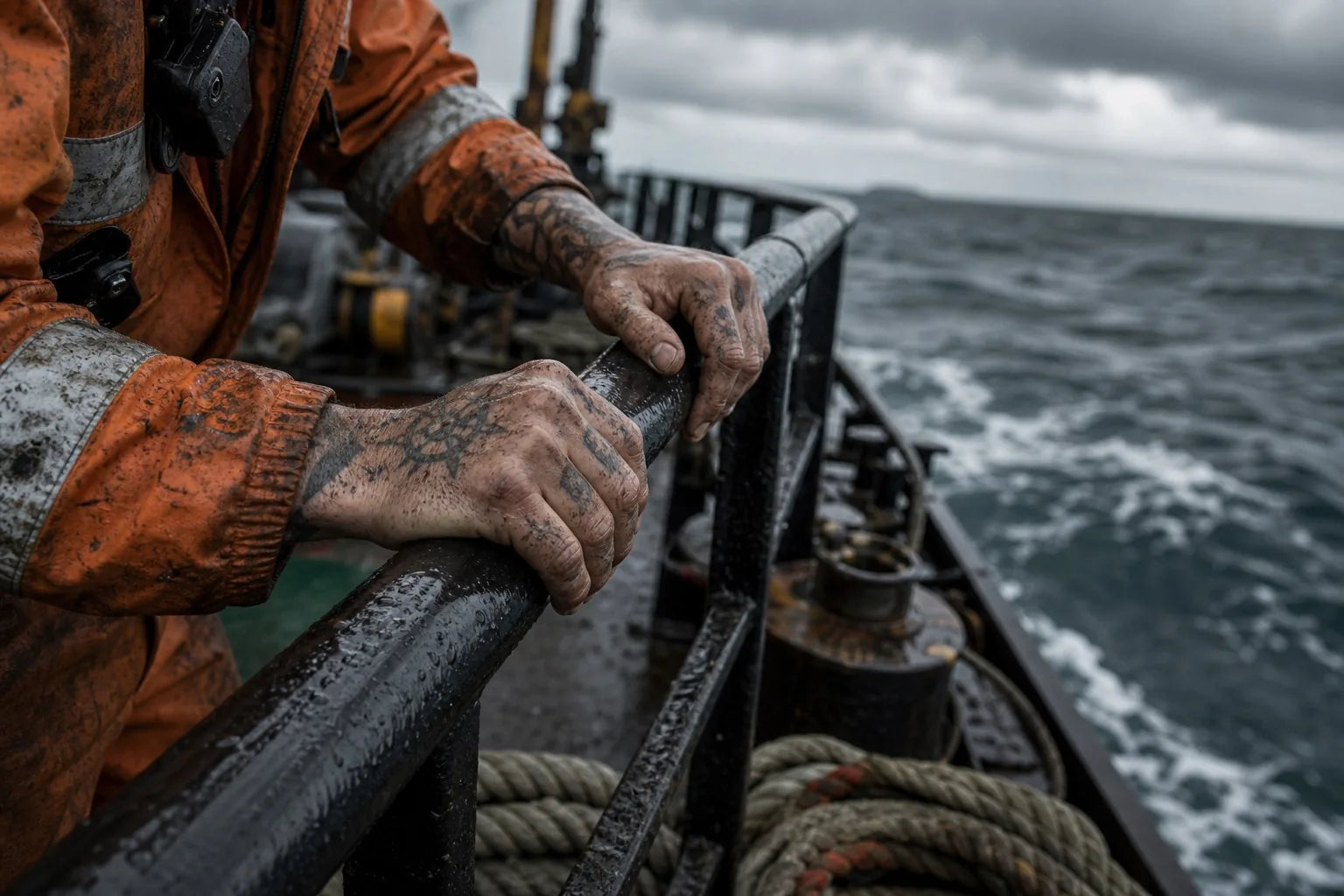
HOLD FAST is one of the strongest phrases in seafarer tattoo culture. It belongs to hands, rope, weather, deck work, and the old idea that a sailor must keep grip when the ship and the sea are moving against them. That is the short version of the hold fast tattoo meaning. The long version runs through the age of sail, through navy and merchant decks, through port tattoo shops, and onto the knuckles of crew still signing on today.
The meaning fits on eight knuckles: keep your grip, stay with the ship.
Like many maritime tattoos, the phrase has traveled through ports, generations, and different kinds of ships. Some meanings are documented. Others survive as working tradition, repeated in mess rooms, tattoo shops, and stories told between contracts. This article keeps those two categories apart, because honest tattoo history is worth more than a neat dictionary.
Hold fast tattoo meaning: keep your grip
In plain language: keep your grip. On deck that is literal. Lines move. Steel gets wet. Weather changes. A handhold matters.
The traditional placement puts one letter on each finger, four and four, so the phrase reads across both hands when they grip a rope. The Royal Museums Greenwich lists the knuckle version among classic sailor tattoos and records the old belief plainly: the words were said to help the bearer grip the rigging better. Said to. The museum chooses its words carefully, and so should anyone writing about sailor ink.
As a tattoo, the phrase became a statement of endurance. Stay steady. Do the work. Do not let go when the ship, the weather, the contract, or life ashore is pulling hard.
Where the phrase comes from
Hold fast was working language before it was ink. On a sailing ship, hauling a line was one order and holding it was another. When the call came to hold fast, the crew stopped hauling and held the line exactly where it was, whatever the sail was doing at the other end. Some etymologies trace the order back through the Dutch houd vast, hold tight, the same root usually given for the word avast. Whether a bosun in 1780 cared about Dutch grammar is another question. He cared that the line did not run.
The tattoo grew out of that deck. In the age of sail, crew worked aloft on yards and footropes, in weather, often at night. A topman stood on a swaying footrope with both arms in the canvas, which is where the old saying comes from: one hand for yourself, one for the ship. A lost grip could mean going over the side, and recovery from a seaway was never certain. The old story says sailors put the phrase on their knuckles as a working charm, eight letters read across two hands on a rope. How much of that is documented and how much is lore passed between shipmates is hard to pin down. Honest tattoo history says so instead of pretending.
How sailor ink entered the written record
Sailors marked their skin long before anyone wrote the practice down properly. The word itself arrived late: tattoo comes from the Tahitian tatau, to mark, and first appeared in print in the published account of James Cook's 1769 voyage. Crews had carried crosses, initials, and anchors on their arms well before the word existed.
The clearest early records are bureaucratic, not romantic. From the 1790s, American seamen carried Seamen's Protection Certificates as proof of citizenship, and the personal description on the certificate listed distinguishing marks and scars. The US National Archives holds series of these applications, including a Philadelphia run from 1792 to 1861. That is where many sailor tattoos enter history: not as art, but as identification. An anchor on the left forearm, initials on the right hand, noted by a clerk at a port office so a boarding officer could tell one seaman from another.
That paper trail is also why museums write about sailor tattoos with caution. The certificates prove that seamen were tattooed and what the marks looked like. They do not prove what any mark meant to the man wearing it. Meaning lived in the fo'c'sle, and the fo'c'sle did not keep minutes.
Why tattoos matter to crew
For many seafarers, tattoos mark more than style. They mark a ship, a port, a department, a crossing, a loss, a faith, a family, or a hard part of life at sea that does not need a long explanation.
HOLD FAST is one phrase in a larger working vocabulary. A swallow traditionally marked sea miles logged. An anchor often marked an Atlantic crossing or simply stability. A turtle marked crossing the equator. The exact meanings shift by era, port, and crew, and honest tattoo culture leaves room for that.
A deckhand, bosun, engineer, cook, steward, or cadet may all carry different symbols. The reason is often the same. The sea changes people, and some crew choose to carry that change visibly. How the work itself does that shaping is a longer story, told in how life at sea shapes identity and discipline.
Where much of this visual language was shaped, and by whom, is covered in Who Was Sailor Jerry?
Placement and variants
The knuckle placement is the classic. One letter per finger, HOLD on one hand, FAST on the other, thumbs left out. The phrase reads correctly when both fists close on a line, which is the point.
Not everyone wants hand ink. Many cruise lines and some shipping companies still restrict visible tattoos in their grooming standards, and knuckles are impossible to cover in any uniform. So the phrase moved. Along the forearm. Inside a rope or a banner. Next to an anchor or a shackle. Same words, same job, different skin.
A cadet or junior officer thinking about knuckle letters should read the company grooming policy first and the contract second. The grooming standard usually sits in the company handbook the contract points to. While that contract is open anyway, running it through the free MLC Contract Check takes about a minute and shows clause by clause how it holds up against MLC 2006, with no account and no upload. The tattoo waits. A career setback does not undo itself as easily.
The classic motifs, honestly told
HOLD FAST sits inside a larger set of crew symbols. Here is the traditional list, with the certainty level it deserves. Every meaning below is tradition as recorded by maritime museums and navy heritage pages, not law. Meanings shifted by port, by decade, and between navy and merchant service. Two sailors in the same watch could give two different answers.
The swallow is the mileage bird. The common version says one swallow for 5,000 nautical miles logged, a second for 10,000. Swallows were also among the first birds a lookout saw near land, so the bird carried a second cargo: homecoming. A swallow always finds its way back. There is even a legend that ties the motif to a mutiny on a ship named Swallow, which is exactly the kind of story that should be labeled legend.
The anchor is usually read two ways. As a service mark it was said to show a sailor who had crossed the Atlantic. As a plain symbol it meant stability, the one object on board whose whole job is to hold. Both readings coexist. Nobody adjudicates.
The fully rigged ship traditionally marked a sailor who had rounded Cape Horn under sail. The shellback turtle marked crossing the equator, a line ceremony that still exists on naval and cruise vessels. A dragon was said to mark service on a China station, which places it firmly in navy tradition rather than merchant work.
A pig on one foot and a rooster on the other was an old charm against drowning. The story goes that both animals traveled in wooden crates, and when a ship went down the crates floated. Sometimes the animals reached shore where sailors did not.
The nautical star was carried as a mark for finding the way back: to the ship, to port, to home. The compass rose carries the same freight, keeping course, and it has probably outlived the star in modern shops. A rope tattooed around the wrist was said to mark a deckhand, ink you could read like a rank badge. And the dagger runs darker: a dagger through a swallow is often described as mourning for a shipmate lost at sea, though dagger designs carried a dozen local meanings and most of them are unrecoverable now.
Treat all of these as tradition with local variations, not fixed law. Meanings shifted by port, by navy or merchant service, and by decade. Any tattoo shop that sells you one true dictionary of sailor ink is selling. The instinct behind the ink, protection, luck, a hedge against a sea that does not negotiate, is the same instinct that runs through the rest of the old beliefs, covered in sea myths and superstitions seafarers still talk about.
 Free crew appSeafarer Contract CheckCheck your contract clause by clause against MLC 2006 and flag state regulations. The check is free. On iPhone, Android or in the browser.
What crew get inked today
Walk through any crew mess today and the old flash is still there, but it shares skin with new material. No organization keeps statistics on what seafarers tattoo, so what follows is observation, not survey data.
Coordinates are common: the home port, the house, the place someone was standing when the agency called with the first contract. Dates in plain numerals, a sign-on date, a child's birthday missed at sea. Names go where the old sailors put saints.
Ship silhouettes have joined the fully rigged ship. An AB who has spent eight years on bulk carriers gets the profile of a bulker, hatch covers and all, not a clipper he never sailed. Engine crew lean toward their own machinery: a propeller on the calf, a piston, a turbocharger cross-section for the ones who really commit. Deck officers get compass roses and cardinal marks. Galley crew get knives and roses, same as cooks ashore, because a galley is a kitchen that moves.
Faith travels too. Crosses, psalms, a small Santo Niño, Arabic script, a verse reference on a forearm. On ships where the crew list covers four religions and ten nationalities, nobody blinks. And flags: the sun and stars of the Philippines, the Indian tricolor worked into an anchor, worn by crew who spend ten months a year away from the country on their skin.
The equator ceremony survives, so shellback ink survives with it, especially on cruise ships where the crossing gets a certificate and a party. HOLD FAST itself is still requested, mostly on forearms now, grooming standards being what they are.
Identity or costume
Here is the honest tension. All of this flash is public domain. A guest on a cruise can walk into a shop in Miami and leave with a swallow, an anchor, and HOLD FAST on the knuckles, having never held anything faster than a railing. No tattoo police will stop it.
Crew mostly do not care about gatekeeping. But there is a difference, and everyone on a crew ladder knows it. A swallow over logged sea miles is a record. A swallow over no miles is a picture. Both are legal. Only one is a document.
The same line runs through clothing, which is why it matters to a Seafarer Identity Brand. Anchor prints on a marina polo are costume. A motif worn by someone who musters when the alarm sounds is identity. The full argument is in seafarer identity is not maritime fashion: the difference is never the symbol, it is the life behind it.
What 7SHORT1LONG takes from the tradition
7SHORT1LONG® does not copy old tattoo culture blindly. The stronger path is respect: understand the working meaning before turning any symbol into a design.
That is how the tattoo shirt series was built. Instead of reprinting hundred-year-old navy flash, the designs apply the old visual language, bold linework, banners, honest symbols, to the ships crew actually sail now. A seafarer tattoo t-shirt with a bulk carrier design for the ore and grain trades. A tanker ship tattoo t-shirt for the crews who live with cargo watch and terminal pressure. A container ship tattoo t-shirt for the box-boat schedules that never slow down. Same tradition, current fleet.
HOLD FAST works because it is direct. No fake poetry. No tourist nautical cliché. A phrase that belongs to hands, weather, duty, and staying with the ship.
Source note
Historical claims in this article are drawn from museum and archive sources: the Royal Museums Greenwich pages Facts about tattoos and Tattoos in Europe, and the US National Archives on Seamen's Protection Certificates. Where a meaning rests on sailor tradition rather than documentation, the text says so. Descriptions of modern crew tattoos are editorial observation, not survey data.
FAQ
What is the meaning of a hold fast tattoo?
Keep your grip and stay steady. The old belief, recorded by the Royal Museums Greenwich, was that the words on a sailor's knuckles would help him grip the rigging. In tattoo culture it stands for endurance and deck work.
What does hold fast mean on a ship?
As a deck order it means stop hauling and hold the line where it is. The tattoo carries the same instruction into the rest of a working life.
Where is HOLD FAST traditionally tattooed?
Across the knuckles, one letter per finger on both hands, so it reads when the hands grip a line.
Do you have to earn a HOLD FAST tattoo?
Tradition ties it to deck work, and some crew still see it that way. No tattoo shop checks a seaman's book. Most crew care less about gatekeeping and more about whether you know what the phrase means before you wear it.
Is HOLD FAST only a navy tattoo?
No. It shows up on navy, merchant, and fishing crews alike. The phrase belongs to anyone whose hands have held a line in weather.
Are tattoos allowed for cruise ship crew?
Policies vary by company. Many cruise lines still restrict visible tattoos in their grooming standards, and hands, neck, and face are the usual problem zones. Check the grooming policy in the company handbook before the ink, not after.
YES, WE ARE CREW.
Gear for the watchSeafarer T-Shirts · Crew Best SellersBuild your Sign On Set · Build your Sailor Set