Martin Lex is the pen name of the 7S1L safety desk: SOLAS, lifesaving and firefighting gear, muster drills, emergency signals and safe work on board. Portrait is illustrative.
Walk onto a merchant vessel and one of the first divisions you learn is deck vs engine. It is printed into the routine of the ship. Bridge watches, engine rounds, cargo work, mooring stations, maintenance plans, drills, handovers, and department pride.
The division is not about ego. It is about responsibility. Deck and Engine solve different problems inside the same hull.
This guide covers both worlds the way crew live them: the jobs, the ranks, the watch system, a typical day on each side, the career ladders, the moments both departments work as one, and the mess room rivalry that never dies. If you are choosing a side before your first contract, or trying to explain your job to someone at home, start here.
The deck department
The deck department handles navigation, cargo operations, mooring, deck maintenance, safety equipment, bridge watches, gangway routines, and the movement of the ship through ports and open water.
The master carries overall authority. The chief officer usually manages cargo, stability, and deck operations. Watchkeeping officers handle navigation and bridge duties. Ratings, led by the bosun on most ships, carry the physical deck work: lines, painting, maintenance, lookout, cargo support, and preparation for port.
If you are an AB or an ordinary seaman, this is where your working day happens. Rust never sleeps and neither does the paint locker.
In port the department changes shape. The chief officer runs the cargo plan. The duty officer walks the deck with a radio and a ballast sequence in his head. An AB stands gangway watch, checking passes at the top of the accommodation ladder while the terminal moves cargo a few meters away.
The engine department
The engine department keeps propulsion, power, pumps, generators, steering gear, auxiliary systems, refrigeration, fuel systems, and technical maintenance alive.
The chief engineer leads the technical side. Other engineers, ETOs, fitters, motormen, oilers, and wipers carry the work through engine-room watches, planned maintenance, repairs, rounds, and troubleshooting under pressure.
The engine room runs hot, loud, and vertical. Nobody walks through it by accident.
The work follows the planned maintenance system: running hours on the main engine, generator overhauls, purifier cleaning, pump seals, filters, and the spare parts inventory that decides whether a job takes an afternoon or waits for the next port. When something fails at sea, there is no workshop to call. The people in boiler suits are the workshop.
Who is awake when: the watch system
A deep-sea ship never stops, so the day is cut into watches. On a three-watch ship the classic pattern is 4 to 8, 8 to 12, and 12 to 4, run twice around the clock. On many ships tradition puts the chief officer on the 4 to 8, the second officer on the 12 to 4, and the third officer on the 8 to 12, with an AB standing lookout on the bridge at night.
The engine side once mirrored that pattern watch for watch. On many modern ships the machinery spaces are certified for unattended operation at night (UMS), so engineers work days and one duty engineer carries the alarm. When a generator trips at 0300, the panel in that engineer's cabin does not care whose turn it was.
Whether you keep watches or work days, the rest rules are the same on both sides of the ship. The Maritime Labour Convention, 2006 sets a minimum of 10 hours of rest in any 24-hour period and 77 hours in any 7-day period, and rest may be split into no more than two blocks, one of them at least six hours. That is the paper version. Port calls, drills, bunkering, and breakdowns test those numbers on every contract.
A typical day, both sides of the hull
Rank, ship type, and trade change the details. The shape below is a plain sea day on a cargo ship, no port call, no drama.
Deck: an AB on the 4 to 8
Called at 0330. Coffee in the mess room, then up to the bridge for lookout in the dark. Handover from the 12 to 4: traffic, course, weather coming. At 0600 first light, at 0800 handover and breakfast.
Day work follows the bosun's plan: chipping and priming on the foredeck, greasing mooring winches, checking lashings, washing down after a dusty cargo. Smoko at 1000. Lunch at 1200. In the afternoon maybe an hour on safety equipment checks with the third officer, lifebuoys and hydrostatic releases, then back to the paint. Evening watch 1600 to 2000 if the schedule demands it, otherwise rest, phone, laundry, sleep before the next 0330 call.
Engine: an oiler on day work
0750 in the engine control room. The second engineer runs through the day: generator number two is due a filter change, the purifier room needs cleaning, and the fresh water pump has a weeping seal. Rounds first. Temperatures, pressures, levels, sounding the bilges, a hand on each running machine because a bearing tells you things a gauge does not.
The morning goes to the generator. The afternoon goes to the purifier room, which is nobody's favorite space on the ship. Log entries, grease rounds, a wash down, boiler suit in the laundry bag. If the oiler is also the duty rating, the evening includes one more set of rounds before the engine room goes quiet on UMS. Quiet, but never off.
Career paths: two ladders, one ship
Both departments run on certificates of competency under the IMO STCW Convention. Sea time plus study plus exams, at every step.
On deck, the officer ladder runs from deck cadet to third officer, second officer, chief officer, and master. The rating ladder runs from ordinary seaman to AB, and for many, to bosun. Some ABs cross over and sit for an officer license after years on deck. It is a hard road and a respected one.
On the engine side, the ladder runs from engine cadet or wiper to fourth engineer, third engineer, second engineer, and chief engineer. Fitters and motormen build the kind of hands-on skill that shore workshops pay well for, which is why engine careers often fork: stay at sea for rank, or take the trade ashore.
Electro-technical officers hold their own STCW certification, introduced with the 2010 Manila amendments, and on modern tonnage the ETO's workload keeps growing with every new automated system.
One thing is identical on both ladders: the contract you sign decides your wage scale, your hours, and your way home. Before any sign-on, run the agreement through the free MLC Contract Check. It checks a contract clause by clause against MLC 2006 in about a minute, in the browser, no account. For the wider picture of ranks and roles across the industry, read our real look at working at sea jobs.
Where deck and engine work as one
The department line is real, but the ship draws over it several times a week. Three moments show it best.
Drills
The general emergency alarm, seven short blasts and one long, calls both departments to the same muster list. Fire teams mix by design: an engineer who knows what is behind a bulkhead, deck crew on hoses and boundary cooling, the third officer counting heads at the muster station. Abandon ship drills put engineers in lifeboats and ABs on the falls. Nobody musters by department. Everybody musters by station.
Bunkering
Bunkering is an engine operation with a deck safety net. The chief engineer owns the transfer and signs the bunker delivery note. Deck plugs the scuppers, rigs the spill equipment, and posts a watch at the manifold and the gangway. One overflow can end careers and close a port to the ship, so both departments treat the checklist as law.
Arrival and departure
An hour before the pilot, the bridge rings standby and the engine room answers. Engineers stand by for maneuvering, ready for the telegraph to swing from full ahead to dead slow to astern within minutes. On deck, mooring parties go forward and aft, the bosun on the drum end, the chief officer or second officer running the station. Thruster power, anchor gear, winch hydraulics: every mooring depends on machinery the engine department kept alive all crossing. When the last line is fast, both departments made that happen, even if only one of them saw the berth.
Deck vs engine: the mess room rivalry
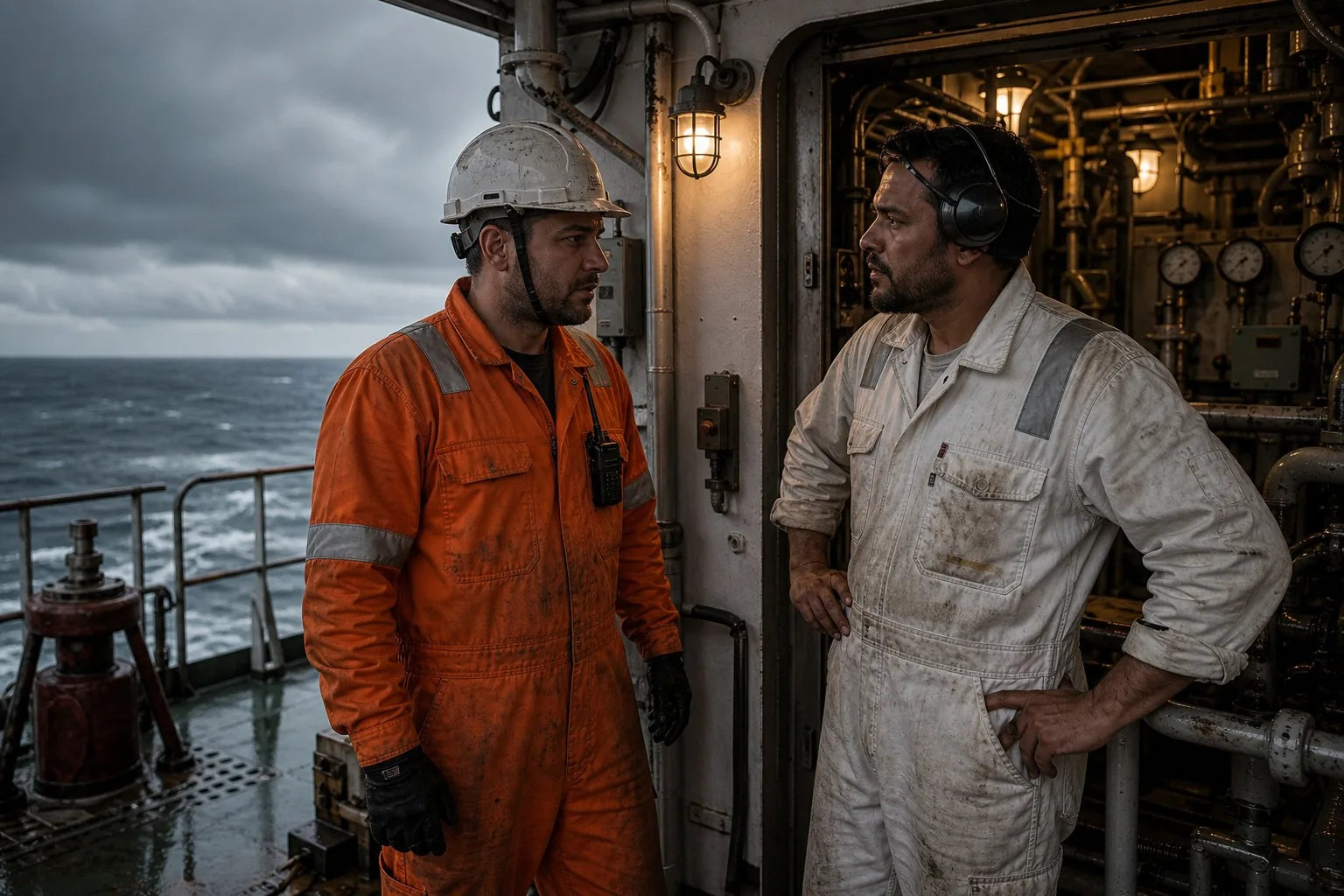
Deck is visible: bridge windows, cargo decks, pilot ladders, mooring stations, and gangways. Engine is often hidden: heat, alarms, machinery spaces, control rooms, tools, vibration, and maintenance jobs that passengers and shore visitors never see. That difference creates jokes, rivalry, and real pride.
The scene is familiar. Mess room, port day, one coffee machine, two departments, and the old question waiting under the surface. Who really runs the ship?
Deck will say the bridge gets the vessel where it needs to be. Navigation, cargo plans, mooring stations, stability, pilotage, paperwork, and the master's authority all sit on that side of the ship.
Engine will answer without looking up from the coffee. Without propulsion, power, pumps, fuel, compressors, steering gear, air conditioning, and a thousand hidden systems, the bridge is only a room with windows.
Deck officers joke that engineers live underground. Engineers joke that deck officers only point and talk on the radio. Ratings on both sides know the truth is less clean and more useful. Ask an oiler about the air conditioning and you will hear about it for the rest of the watch.
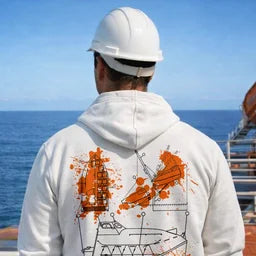
The rivalry is old. Deck ran ships for centuries before the first engineer stepped aboard with the shift from sail to steam. Engineers have been reminding them of it ever since. The argument is now shipboard heritage, worn openly: the deck vs engine department t-shirt puts both worlds on one chest, and the deck vs engine department hoodie does the same for cold bridge wings and over-cooled control rooms.
And the joke has a hard edge where it stops. During drills, mooring, blackout recovery, steering problems, fire response, cargo operations, or heavy weather, the ship needs both departments to speak clearly and act without ego. The general alarm settles the argument faster than any mess room debate. Seven short, one long, and the coffee stays where it is. Both departments move to their muster stations without another word about who runs the ship.
One hull, different worlds, shared responsibility.
Cruise ships add a third world
On cruise ships, hotel and catering form a large third department: cabins, restaurants, bars, entertainment, laundry, guest services, cleaning, and medical support. They work under the same vessel reality, but their daily pressure is different, and they are usually the largest group on board by headcount. A cabin steward and a motorman sail on the same ship and barely cross paths outside the crew mess.
The technical side changes too. A cruise ship is a floating power plant with a hotel on top, so the electrical and automation workload is heavy and ETOs and electricians form a bigger team than on most cargo ships. Galley refrigeration, stage machinery, cabin air handling: when it fails, a guest notices within the hour. How that guest-facing pressure compares with cargo routine is its own topic: cruise ship life vs cargo ship life.
Department structure also shifts with what the ship carries. A tanker, a bulk carrier, and a container ship split the same deck and engine work in different proportions. The overview is here: ship types explained for crew.
That matters for 7SHORT1LONG® because crew identity is not one flat thing. Department, rank, vessel type, and contract life all shape how crew see themselves. It is why 7S1L builds ship department crew apparel instead of generic boat prints: a bosun, an engineer, a steward, and a cook do not experience the same ship in the same way, and the shirt should know the difference.
Source note
Watchkeeping standards and certificates of competency, including the ETO certification from the 2010 Manila amendments: IMO STCW Convention. Minimum rest hours (10 in any 24, 77 in any 7 days, split into no more than two periods): ILO Maritime Labour Convention, 2006, Standard A2.3. Watch patterns, drill practice, and bunkering routines described above reflect common industry practice and vary by ship, flag, and company. This article is editorial context for crew, not legal advice.
FAQ
What is the difference between deck and engine?
Deck handles navigation, cargo, mooring, and vessel movement. Engine handles propulsion, power, machinery, and technical systems.
Who is more senior, the captain or the chief engineer?
The master has overall command of the vessel. The chief engineer leads the technical department and carries major responsibility for the ship's machinery. They are department heads of equal standing, but the master's authority over the vessel is absolute.
What ranks are in the deck department?
Master, chief officer, second officer, third officer, deck cadet, bosun, able seaman (AB), and ordinary seaman (OS).
What ranks are in the engine department?
Chief engineer, second engineer, third engineer, fourth engineer, electro-technical officer (ETO), fitter, motorman, oiler, and wiper.
Is deck or engine better for a maritime career?
Neither is better, they lead different places. Deck leads toward command and commercial operations. Engine builds technical skill that transfers well to shore jobs in power plants, workshops, and ship management. Choose by what you want to be doing at 0400.
Is the deck vs engine rivalry real?
Yes, but mostly as shipboard humor and department pride. During drills, mooring, and emergencies the rivalry stops, because the ship only works when both departments act as one crew.
YES, WE ARE CREW.
Gear for the watchShip Type T-Shirts · Ship DepartmentBuild your Sign On Set · Build your Sailor Set