
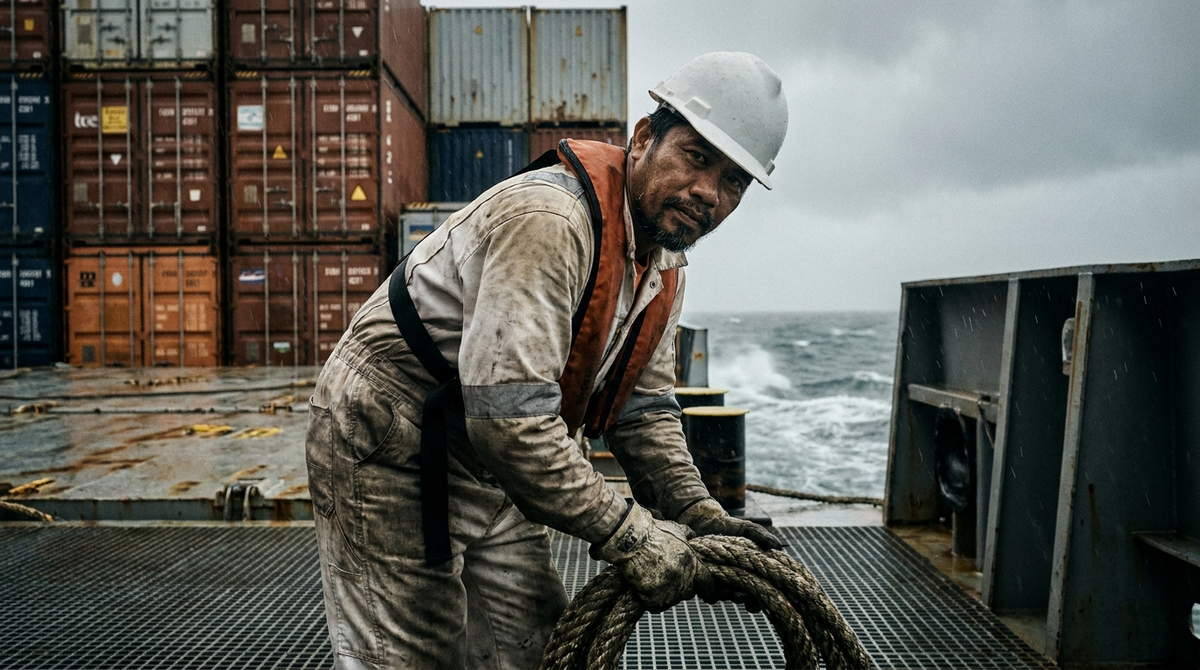
Walk any crew corridor in the world fleet and you will hear Tagalog, Bisaya or Ilocano before long. On the bridge, in the engine room, behind the galley pass, at the cabin trolley on a cruise ship: the Philippines crews the world like no other nation.
The numbers carry the point. The Department of Migrant Workers counted 504,057 Filipino seafarer deployments in 2024, across deck, engine, and the huge cruise hotel departments. Sea-based workers sent home 7.139 billion US dollars in 2025, according to Bangko Sentral ng Pilipinas data reported in the Philippine business press. The 2026 Seafarer Workforce Report from BIMCO and the International Chamber of Shipping ranks the Philippines first in the world in both the officer and the rating category.
Behind those tables stand ABs on a bulk carrier foredeck in the Bay of Biscay, oilers on the four to eight, second engineers signing on for a fourth contract through the same Manila agency. This is where that came from, how the system around it works, and where it still fails the people inside it.
Why there are so many Filipino seafarers
It did not happen by accident. Decades of maritime schools, a manning industry built around Manila, English as a working language, and a labor system that trains, certifies and deploys crew at a scale no other country matches. A cadet from Iloilo or Cebu enters a pipeline that leads to tankers under European management, boxships on the Asia loops, cruise ships out of Miami.
English is the practical hinge. Bridge orders, safety briefings, port state control interviews, guest contact on a cruise ship: a crew that takes a pilot's instruction without a second pass through translation is worth money to an owner.
That same training system has been under a microscope for twenty years. The European Maritime Safety Agency audited Philippine certification repeatedly, and the audits kept naming the same shortcomings: missing training equipment, inconsistent assessment between institutions. In March 2023 the European Commission decided to keep recognizing Philippine STCW certificates, which kept tens of thousands of Filipino officers eligible for EU-flagged ships. For a cadet choosing a school, that is the difference between a certificate that travels and one that does not.
The state machinery behind a Filipino contract
The Department of Migrant Workers, which absorbed the old POEA, sits behind every legal deployment. Filipino crews sign through licensed manning agencies on a standard employment contract whose terms are public. Read them before the agent summarizes them for you. The standard is your floor, and a floor only helps if you know where it is. That contract covers Filipino crew on foreign-flag ships. On the few ships that fly the Philippine flag itself, the labor department signs the MLC papers, as our guide to Philippine flag labor law explains.
Two things changed that floor recently. Republic Act 12021, the Magna Carta of Filipino Seafarers, was signed on 23 September 2024 and pulled scattered rules into one statute. Then the DMW issued a new Standard Employment Contract under Department Circular No. 07, Series of 2026, effective 3 July 2026, replacing the POEA contract in use since 2010.
The detail worth knowing at the crewing office table: base disability compensation rose from 50,000 to 55,000 US dollars, with Grade 1 disability at 66,000. The mandatory allotment stays at a minimum of 80 percent of monthly salary, but salary now includes fixed or guaranteed overtime, not basic wage alone. Abandonment is formally defined, including non-payment of wages for two months or failure to arrange repatriation. Wages continue during a piracy incident, and the occupational disease list now covers mental health conditions.
None of that replaces the MLC 2006 floor underneath it. The ILO minimum basic wage for an able seafarer sits at USD 690 per month from 1 January 2026, and we broke down what that covers in the minimum wage post. Hotel crew on cruise ships carry the same seafarer rights as the deck and engine side: your MLC rights in the hotel department.
Where Filipino crews actually sail
The stereotype is ratings only. The BIMCO and ICS figures say otherwise: 203,179 Philippine officers, first in the world ahead of India, China, the Russian Federation and Indonesia, and first for ratings as well. Add the two categories and the Philippine share works out to roughly 18 percent of a global pool of about 2.57 million seafarers. Close to one in five.
The spread across ship types is wide. Bulk carriers and boxships take large numbers of deck and engine ratings. Tankers under European or Japanese management run mixed crews with Filipino officers moving up through second and chief officer. Cruise is its own world: galley, housekeeping, laundry, guest contact, hundreds of Filipino crew on one ship, the longest contracts and the most guest-facing pressure. For the difference between a cargo watch and a cruise hotel shift, start with our look at working at sea jobs.
The report also flags where the pressure is heading. For 2026 it estimates a shortage of 39,100 STCW certified officers against a surplus of 56,890 ratings, and projects a need for 113,735 more officers by 2030. A competent Filipino rating faces competition. A Filipino officer with a clean record and an endorsement EU owners accept does not. That gap decides careers.
 Free crew appSeafarer Contract CheckCheck your contract clause by clause against MLC 2006 and flag state regulations. The check is free. On iPhone, Android or in the browser.
Nine months, and the people counting them
Remittance day explains the contracts. An AB's allotment pays tuition in Batangas. A steward's overtime becomes a roof in Leyte. The 7.139 billion dollars is a pillar of the Philippine economy, built nine months at a time by people who miss the birthdays the money pays for.
The allotment rule is why the money moves so reliably. At least 80 percent of monthly salary goes to a designated allottee in the Philippines through an authorized bank, with the employer providing the facility at no cost to the seafarer. Crew call it the padala. It arrives whether or not the internet worked that week.
Then there is the box. The balikbayan box is a customs category before it is a tradition: under the Customs Modernization and Tariff Act, qualified Filipinos abroad send personal and household effects duty and tax free up to 150,000 pesos, across up to three shipments a year, counted cumulatively. Inside: chocolate, shoes, a school bag, something bought in Rotterdam because the ship was there in October and Christmas is in December. Picking things that survive the contract instead of the first wash is the whole point of gifts that actually work on contract.
Seafaring runs in families here in a way outsiders underestimate. A father who sailed bulkers, a son at a maritime school in Cebu, an uncle who is a bosun on a chemical tanker and tells him which agencies to avoid. That knowledge beats any recruitment poster.
The honest part
Filipino seafarers carry a system that still charges some of them for the privilege of working in it. RA 12021 is blunt: in no event shall recruitment or placement fees, visa and related costs be levied or collected, directly or indirectly, from seafarers or their families. The practice did not disappear when the law was signed. It changed names. Training packages, medical bundles, processing charges, cash advances repaid out of the first allotment. If that sounds familiar from your last sign-on, read what manning agencies may and may not charge you before you pay anything.
The second problem is volume. The Philippines produces far more maritime graduates than there are cadet berths, and a diploma without sea time does not make an officer. That leaves a crowded entry level, long waits for apprenticeship slots, and the quality spread between institutions the EMSA audits kept naming. An officer shortage and a ratings surplus in the same country at the same time is not a contradiction. It is a training bottleneck.
Before you sign
Have these straight before you leave the agency office:
- Which standard contract applies to you, and whether a CBA sits on top of it.
- The exact basic wage, what counts as fixed overtime, and how leave pay is calculated.
- The allotment percentage, the allottee, and the bank.
- Contract duration and what happens at extension, including who pays for the flight.
- Every charge you have been asked to pay, in writing, with a receipt.
Take the paperwork with you and check it clause by clause against MLC 2006 in the free MLC Contract Check. It runs in your browser, takes about a minute, needs no account, and the contract data stays on your device. Doing that before the flight is cheaper than after sign-on.
Crew identity, worn
7SHORT1LONG® built the Filipino Sailor range for this crew. The Filipino sailors t-shirt is for the mess room and the flight home. The Filipino sailor hoodie is for the night watch, the cold store, the airport at 03:00 with a seaman's book in the front pocket. Take both as the Filipino sailor set if you want the flag and the signal on one contract.
Not a souvenir. A marker for the people who hold up a fifth of the world fleet and rarely get named for it. 7S1L is a Seafarer Identity Brand: you are crew, or you are not.
Source note
Sources: Department of Migrant Workers deployment statistics, the BIMCO and ICS Seafarer Workforce Report 2026, BSP remittance data as reported by BusinessWorld, the text of Republic Act 12021, the ILO minimum wage decision for able seafarers, and the European Commission on recognition of Filipino seafarers' certificates. This article is editorial context, not legal advice. For a decision about your own contract, use the contract text and a union or legal adviser.
FAQ
How many Filipino seafarers are there?
The Department of Migrant Workers recorded 504,057 seafarer deployments in 2024, including cruise hotel crew. The BIMCO and ICS Seafarer Workforce Report 2026 counts 203,179 Philippine officers, the highest of any country, and also ranks the Philippines first for ratings.
Why are there so many Filipino seafarers?
Maritime schools at scale, a Manila-centered manning industry, English as a working language, and a state system that trains, certifies and deploys crew through licensed agencies. Family tradition keeps the pipeline filled from one generation to the next.
How much do Filipino seafarers send home?
Sea-based workers remitted 7.139 billion US dollars in 2025, according to Bangko Sentral ng Pilipinas figures reported in the Philippine business press. That was about a fifth of all overseas Filipino remittances that year.
What contract do Filipino seafarers sign?
A standard employment contract issued by the Department of Migrant Workers. The current version took effect on 3 July 2026 under DMW Department Circular No. 07, Series of 2026, replacing the POEA contract in use since 2010. A CBA can sit on top of it.
Do Filipino seafarers have to pay placement fees?
No. Republic Act 12021 states that recruitment or placement fees, visa and related costs may not be collected from seafarers or their families, directly or indirectly. Charges repackaged as training, medical or processing costs fall under the same ban.
YES, WE ARE CREW.


Gear for the watchSeafarer T-Shirts · Crew Best Sellers· Mariners Neck GaitersFilipino Sailor Set · Build your Sailor Set


