
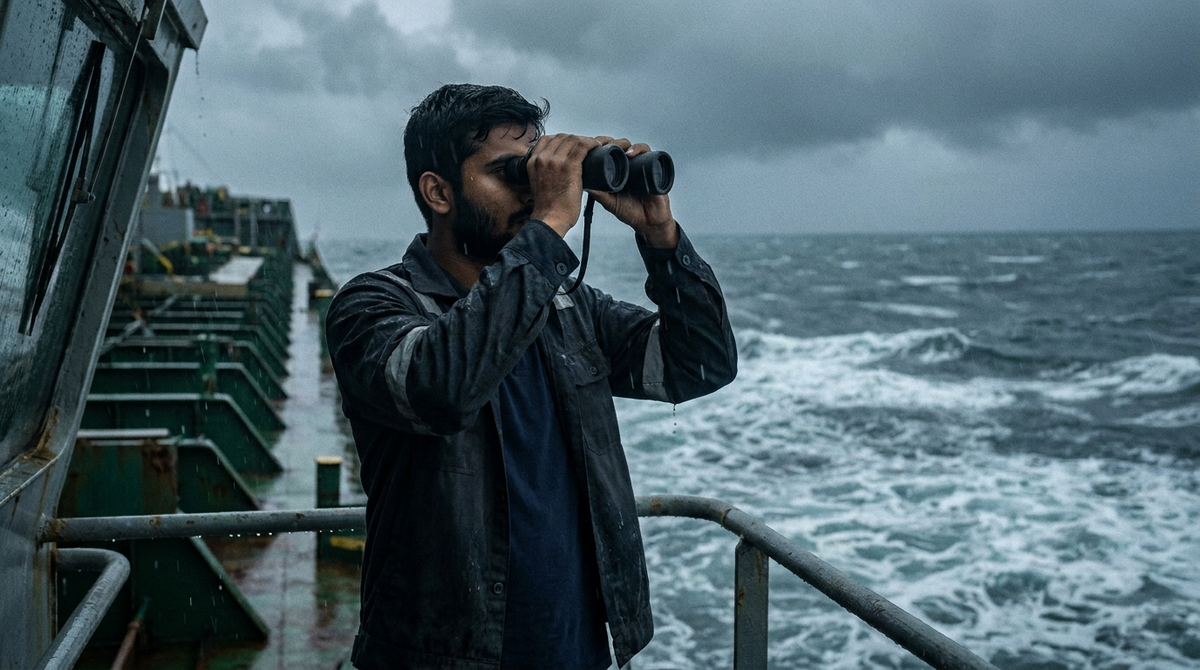
Ask a superintendent who runs the bridge teams on the world's tankers and the answer comes fast: a large share of them come from India. Mumbai, Chennai, Delhi, Kochi. The officer's blazer is a family achievement, framed on a wall long before the first command.
India put more than 313,000 seafarers into the world fleet in 2025, and the growth curve points up. Where the Philippines dominates in total numbers, India built its name on the officer ladder: second in the world for officer supply, with a reputation concentrated in tankers, gas carriers and the technical trades where certificates decide careers.
That is the short version. The longer one runs through an examination system, a licensing directorate in Mumbai, a lot of unpaid waiting between contracts, and the worst abandonment figure of any nationality in 2025. Indian seafarers carry all of it at the same time, and the officer stripes do not cancel any of it out.
The numbers behind the officer nation
The BIMCO and ICS Seafarer Workforce Report 2026, published on 25 June 2026, counts 311,936 Indian seafarers in the global STCW certified workforce. That is 12.16 percent of the world total, second place behind the Philippines. Split by role, India supplies 140,718 officers, which is 13.41 percent of every certificated officer afloat, and 171,218 ratings.
Ten years earlier the same survey put India fifth, at 5.2 percent of the workforce, behind China, the Philippines, Indonesia and the Russian Federation. The share more than doubled in a decade. That kind of movement does not happen by chance in an industry that runs on certificates.
The market those officers step into is tight. The same report puts global supply at roughly 2.57 million seafarers against a shortage of 39,100 STCW certified officers, and estimates that 113,735 additional officers will be needed by 2030 to crew the world merchant fleet. A chief mate with a valid tanker endorsement is not struggling for a berth in that market. A fresh deck cadet very often is. Both things are true at once, and the gap between them is where most Indian maritime careers are decided.
The officer pipeline
Behind it stands a system: the Directorate General of Shipping, the maritime academies, the IMU entrance exams, and a culture that treats a chief engineer's ticket the way other families treat medicine or engineering degrees. A cadet from a small town in Kerala can end up commanding a VLCC, and everyone in the neighborhood knows what that means.
The Directorate General of Shipping sits under the Ministry of Ports, Shipping and Waterways and does the unglamorous half of the work. It approves the training institutes, issues certificates of competency, and runs the Indian National Database of Seafarers. An Indian cadet has an INDoS number before the first entry ever gets stamped into a continuous discharge certificate. Indian Maritime University was created by an Act of Parliament in 2008 and sits at the top of a wide field of DG Shipping approved academies feeding deck and engine cadets into the fleet.
Then there is English. It is the working language of the bridge, of the ISM paperwork, of the port state control officer and the terminal loading master. Indian cadets arrive already operating in it. That is not a small thing at 0300 when a master has to argue a cargo figure with a surveyor and every word ends up in a statement of facts.
The rank structure those careers climb is its own subject: merchant ship ranks explained, from cadet to master.
Where Indian officers actually sail
The concentration is in tankers, gas carriers and the technical fleets, and it shows in who runs the cargo watch. Product tankers, crude carriers, LPG and LNG: these are the ships where an endorsement is worth money, where the vetting inspection never really ends, and where a mistake on a manifold has consequences that reach the beach. Indian officers built a reputation there over decades, and companies keep hiring against that reputation. What that watch feels like from the inside is covered here: tanker ship life, safety, cargo watch and terminal pressure.
Container and bulk fleets carry large Indian contingents too, often mixed with Filipino ratings, and the mixed crew is the normal case rather than the exception. A ship can run with an Indian master, a Ukrainian chief engineer, Filipino ABs and an Indonesian cook, and nobody aboard finds that remarkable. The Indian sailor t-shirt exists for the part of that arrangement that does not show up on the crew list: where you are from stays yours, whatever flag is on the stern.
Women at sea, finally counted
The most striking Indian number is the newest one. The count of Indian women seafarers grew from about 1,600 in 2021 to more than 7,000 by 2025. Deck and engine cadetships, cruise hotel roles, and a visible handful of women with command-level tickets. Small against the total, growing fast, and changing what an Indian crew photo looks like.
The Ministry of Ports, Shipping and Waterways has put policy behind it, including scholarship schemes for women taking pre-sea courses at approved training institutes. Whether the retention follows the recruitment is a separate question, and it will take another decade of data to answer honestly.
The career that ends ashore
An Indian officer's path rarely stops at master or chief engineer. It bends toward the office: marine superintendent, technical superintendent, designated person ashore, port captain, vetting inspector, examiner. Shipmanagement offices in Mumbai, Singapore, Dubai and Hamburg are staffed with people who did their time on deck and in the engine room first, and it is one of the few maritime careers with a credible second act on land.
That is part of why families push for it. Nine months away is easier to justify at home if everyone can name where it leads. The cadet on the first flight to Singapore, the second engineer studying for the chief's oral between contracts, the superintendent who still opens a tank inspection report the way he was taught on a product tanker: same person at three points on a line. The Indian sailor hoodie gets worn on all three, usually at the airport.
 Free crew appSeafarer Contract CheckCheck your contract clause by clause against MLC 2006 and flag state regulations. The check is free. On iPhone, Android or in the browser.
The honest part
The junior end of the ladder is the hard end. Cadets and freshly certificated third officers in India routinely wait between contracts with no pay and no guarantee, chasing onboard training slots that are scarcer than the academy intake suggests. Crewing agents know it. So does every family that funded a pre-sea course expecting a berth to follow.
That waiting is exactly the pressure that recruitment fees feed on. Under MLC 2006 Regulation 1.4, seafarers must not be charged fees for placement, and any company recruiting Indian seafarers, for Indian-flagged or foreign-flagged ships, needs a Recruitment and Placement Services Licence from the Directorate General of Shipping. Ask what the licence number is. Ask what any payment is actually for. Our breakdown of manning agency fees and what you must never pay for applies directly.
Then the number nobody in Indian shipping enjoys quoting. The ITF recorded a record 6,223 seafarers abandoned on 410 ships in 2025, and Indian crew were the worst affected nationality with 1,125 seafarers abandoned, ahead of Filipino crew at 539 and Syrian crew at 309. Wages owed came to 25.8 million US dollars. Most of those ships flew flags of convenience. Being the second largest supplier of officers also means being the largest supplier of people left on an anchored ship without wages, food or a way home.
The contract is still the contract
An officer's stripes do not change the paperwork rules. The SEA, the CBA it names, the wage annex, the rest hour records: the same MLC framework covers a master and a wiper. India ratified the MLC 2006 on 9 October 2015 and the convention entered into force for India in 2016, and Indian crews sail under every flag in the registry list, which makes flag state knowledge part of the job. Our seven contract red flags read the same in Mumbai as in Manila, and so does the wage annex: check the figure in the contract against the current ILO minimum wage benchmark for able seafarers before you sign anything.
The comparison is worth making the other way as well, because the two largest crew nations solved different problems: how the Philippines built its position in the world fleet. Before sign-on, read the contract clause by clause. The free MLC Contract Check runs in the browser, takes about a minute, needs no account, and keeps the document on your own device.
Worn identity
The Indian Sailor Set carries the flag next to the signal. For the cadet on the first flight to Singapore, for the chief engineer on leave in Pune, for the family that waited nine months. 7SHORT1LONG® is a Seafarer Identity Brand, and that distinction matters here: the flag on the sleeve is not a souvenir of a country, it is a statement about who does the work. Crew identity, not costume.
Source note
Figures in this article come from Directorate General of Shipping: Indian seafarer strength, the BIMCO and ICS Seafarer Workforce Report 2026, ICS: global supply and demand for seafarers, Shipping Tribune: India and the global officer demand, ITF Seafarers: abandonment figures for 2025, and the ILO record of MLC 2006 ratifications. This article is editorial context for crew, not legal advice. For a decision on a specific contract, use your union, your flag state administration, or a maritime lawyer.
FAQ
How many Indian seafarers are there?
The BIMCO and ICS Seafarer Workforce Report 2026 counts 311,936 Indian seafarers, 12.16 percent of the global STCW certified workforce. Indian government reporting put employment above 313,000 in 2025.
Which country supplies the most seafarers, India or the Philippines?
The Philippines is first overall and India second, both for total seafarers and for officers. India supplies 140,718 officers, 13.41 percent of the world's officer workforce.
Why is India known for officers?
A dense academy system under the Directorate General of Shipping, competitive entrance exams, English as a working language, and decades of placement into tanker and technical fleets where certificates carry the career.
Are there women among Indian crews?
Yes, and the number is rising fast: from roughly 1,600 registered women seafarers in 2021 to more than 7,000 by 2025.
Do Indian seafarers have to pay recruitment fees?
No. MLC 2006 Regulation 1.4 prohibits charging seafarers for placement, and any agency recruiting Indian seafarers must hold a Recruitment and Placement Services Licence from the Directorate General of Shipping.
Are Indian seafarers affected by abandonment?
Yes, more than any other nationality. The ITF recorded 1,125 abandoned Indian seafarers in 2025, out of a record 6,223 seafarers abandoned worldwide on 410 ships.
YES, WE ARE CREW.


Gear for the watchSeafarer T-Shirts · Crew Best Sellers· Mariners Flip FlopsIndian Sailor Set · Build your Sailor Set


