Martin Lex is the pen name of the 7S1L safety desk: SOLAS, lifesaving and firefighting gear, muster drills, emergency signals and safe work on board. Portrait is illustrative.
Tanker ship life is controlled by risk.
Every ship has risk, but tankers carry a different kind of pressure. Cargo, vapor, pollution prevention, terminal rules, enclosed spaces, fire safety, static electricity, permits, checklists, mooring, manifold watches, and cargo control room routines shape the day. The deck is a controlled area, and the crew treats it that way.
That is why life on a tanker often feels disciplined, serious, and procedural. A tanker can look quiet from the shore. On board, the job depends on attention.
Tanker work starts before cargo moves
Cargo operations do not begin when a valve is opened. They begin with preparation: planning, paperwork, safety meetings, line checks, equipment checks, communication with the terminal, and the vessel's own procedures.
Deck crew, officers, engineers, ratings, and terminal staff may all touch the operation in different ways. How that work splits between departments is its own story, told in Deck vs Engine: The Two Worlds of a Merchant Vessel. A missed detail can affect safety, pollution prevention, cargo quality, schedule, and the crew's workload. The pressure is not only the cargo itself. It is the expectation that every step is controlled.
On a tanker, routine is not boring. Routine is protection.
Cargo watch is not standing around
People ashore may see a crew member near the manifold and think the person is simply standing watch. A seafarer knows the watch is active.
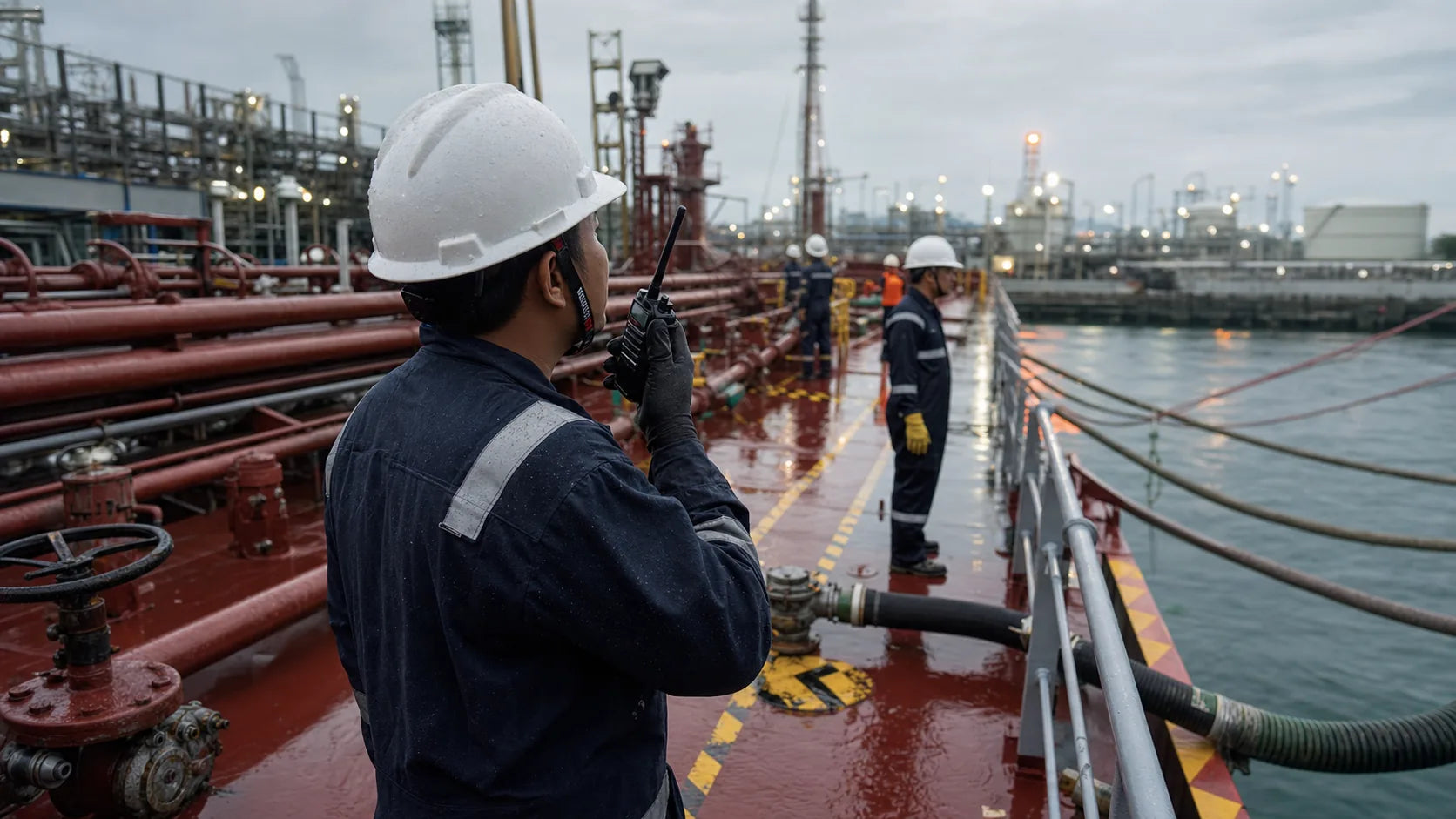
The manifold is where ship meets shore. The hoses or loading arms connect there, which makes it the most likely place for a leak. The watchkeeper checks the connections and the drip trays under them. Scuppers are plugged before cargo starts, so a spill stays on deck instead of running into the water. Moorings get the same attention: a tanker that shifts along the berth puts strain on connected arms, and terminals will stop cargo for slack lines.
Inside the cargo control room, an officer follows tank levels, pressures, and the loading rate. On deck, the AB reports by radio. Levels are logged and checked against the loading plan, hour by hour. If the figures drift, cargo may be going somewhere it should not, and the watch is the first line that catches it.
The terminal is part of the watch too. The ship/shore safety checklist agreed before the operation sets who does what, how the two sides communicate, and what the emergency stop signal is. That signal is agreed in advance for a simple reason: when it is needed, there is no time to discuss it.
The point is simple: tanker cargo watch is not a ceremonial post. It is a safety position.
Inert gas: an atmosphere no one can breathe
An oil cargo tank is not full of air. It is kept inerted: filled with low-oxygen gas from the ship's inert gas system so the vapor space above the cargo cannot burn. Under SOLAS, the oxygen content in an inerted cargo tank stays at 8 percent by volume or less. Fire needs more than that. So does a person.
That is the hard rule behind enclosed space entry on tankers. The same atmosphere that protects the ship from explosion cannot support life. Nobody enters a tank without a permit, ventilation, and atmosphere tests. Nobody skips those steps for a dropped tool. Crews drill this because the losses in this exact scenario are real, and rescuers who rush in unprotected become casualties themselves.
The requirement has tightened over the years. Since 2016, new oil and chemical tankers of 8,000 dwt and above must be fitted with inert gas systems, down from the earlier 20,000 dwt threshold.
Tank cleaning follows the same logic. On crude carriers, tanks are washed with the cargo itself, a MARPOL technique called crude oil washing (COW), and it is only done in inerted tanks. Product and chemical tankers wash between grades so the next cargo arrives clean. Every wash is planned in the same order: atmosphere first, static risk second, then the machines.
No phone on deck: ignition discipline
On a tanker, an ordinary mobile phone is treated as an ignition source. It stays inside the accommodation. On the cargo deck the crew carries intrinsically safe radios and torches, certified so they cannot produce a spark able to ignite vapor. Smoking happens only in designated spaces, and at many terminals not at all while cargo moves.
PPE follows the cargo. Cotton or antistatic coveralls instead of synthetics that build static charge. Safety boots, gloves matched to the product, goggles. On chemical and gas tankers, respirators or full suits when the procedure demands it. A bosun who sends a rating back inside to change out of a fleece jacket is not being difficult. That fleece can carry a static charge onto a deck full of hydrocarbon vapor.
Vetting: SIRE 2.0 and the inspector on board
Tankers live under a second inspection regime beyond port state control: vetting. Oil majors and charterers will not fix a tanker without an acceptable vetting result, so these inspections decide whether the ship keeps trading. The current standard is SIRE 2.0, the digital, tablet-based version of the Ship Inspection Report Programme that OCIMF (the Oil Companies International Marine Forum) launched in September 2024.
For the crew, SIRE 2.0 is personal in a way the old checklist was not. The question set is compiled for each inspection, and the inspector does not only read documents. He watches people work and asks them questions: the AB about the moorings he tends, the third officer about the fire plan, the pumpman about the cargo lines. Human factors are graded alongside hardware.
The days before a vetting inspection are tense on almost every tanker. The days after a clean one carry the quiet pride of the job.
Tanker endorsements and the pay that comes with them
Nobody works cargo on a tanker with a standard certificate alone. STCW requires tanker endorsements on top: basic and advanced training for oil and chemical tanker cargo operations under Regulation V/1-1, and basic and advanced training for liquefied gas tankers under Regulation V/1-2. Basic training covers the hazards and first response. The advanced endorsement, required for officers with direct cargo responsibility, takes approved sea service on that tanker type on top of the course.
Those endorsements are one reason tanker jobs generally pay above comparable ranks on dry cargo ships. There is no single global figure, and offers vary by rank, flag, trade, and company. The pattern across the market is qualitative but consistent: gas tends to top chemical, chemical tends to top product and crude, and all of them tend to top the same rank on a bulker or a boxship. The premium pays for the extra certificates, the extra inspections, and the extra weight of the work.
Higher pay does not make a contract fair by itself. Before you sign on for a tanker, run the agreement through the free MLC Contract Check. It reads your contract clause by clause against MLC 2006, takes about a minute, and the data stays in your browser.
 Free crew appSeafarer Contract CheckCheck your contract clause by clause against MLC 2006 and flag state regulations. The check is free. On iPhone, Android or in the browser.
Terminal pressure
Terminal time can be intense. The ship is alongside, cargo is moving or being prepared, external parties are involved, and every delay has a cost. There may be inspections, paperwork, sampling, line-up checks, gangway control, stores, crew change, bunkers, waste, port state questions, and shore-side expectations happening close together.
Crew still need rest. They still need meals. They still need clear handovers. The Maritime Labour Convention sets a broad international framework for seafarer working and living conditions, but the lived reality depends on schedule, company culture, route, port, and enforcement.
Shore leave is the quiet loss of tanker ship life. Oil and gas terminals sit behind security fences, often far outside town, and many do not let crew through the gate at all. Turnarounds are short, the gangway is controlled, and the berth can be a restricted area from arrival to departure. A tanker seafarer can sail for months and see terminals, not countries. What that means over a contract is covered in What Is Shore Leave.
That is why tanker ship life can feel compressed. The ship may spend days at sea and then arrive at a terminal where the work becomes dense.
Safety culture is visible in small actions
Good tanker safety culture lives in small actions, not on posters: closing a valve carefully, checking a gasket, keeping a radio clear, wearing the right gear, stopping someone from walking into the wrong area, questioning an unclear instruction, and reporting something before it becomes a problem.
IMO's MARPOL framework is central to the prevention of pollution from ships, and IMO's wider safety conventions shape the international system around merchant shipping. STCW provides the global convention for training, certification, and watchkeeping standards for seafarers.
A tanker crew member does not need every regulation on the wall to know the feeling: if the ship is careless, the sea pays first, and the crew pays too.
Tanker ship life vs container and bulk
Tanker life differs from container ship life and bulk carrier life because the cargo risk behaves differently. Container ships are shaped by schedules, port rotation, lashing, stowage, stack heights, and fast terminal work. Bulk carriers are shaped by cargo holds, dust, grabs, ballast, hatch covers, and loading stress.
Tankers are shaped by liquid cargo systems, manifold discipline, tank atmosphere concerns, pollution prevention, terminal checks, and cargo control routines.
None is automatically harder. They demand different habits. For the full map of vessel types, read Ship Types Explained for Crew, for the wider comparison Cruise Ship Life vs Cargo Ship Life, and for the shirts that mark the difference the tanker ship crew collection.
What tanker crew know
Tanker crew know the smell of wet deck gear, the weight of a long watch, the sound of cargo pumps, the seriousness of a permit, the tension of a terminal call, and the tired focus after a night operation.
They know that nobody outside the industry sees most of the discipline. They also know that the discipline is the job.
7SHORT1LONG® puts that identity on the ship type you actually sail. The Christian Angel Protection Tanker T-Shirt carries a guardian over a laden tanker, and the tanker ship tattoo t-shirt puts the vessel in old-school flash style. Both are drawn for tanker crew, not for tourists.
Source note
This article is editorial context for seafarers, not legal advice. The regulatory facts above come from these sources:
- IMO: Marine Environment (MARPOL)
- IMO: STCW Convention
- ILO: Maritime Labour Convention, 2006
- OCIMF: SIRE 2.0
- NorthStandard: SOLAS inert gas amendments for new tankers from 2016
FAQ
What is tanker ship life like?
Tanker ship life is shaped by cargo safety, terminal work, pollution prevention, cargo watches, checklists, controlled deck areas, and disciplined crew routines.
Is working on a tanker dangerous?
Tanker work carries serious risk, which is why procedures, training, safety equipment, cargo controls, permits, and terminal rules matter. Conditions vary by vessel, cargo, company, route, and crew discipline.
What does tanker cargo watch involve?
Cargo watch can involve monitoring lines, manifold areas, leaks, pressure, tank levels, communication, deck access, moorings, weather, and emergency readiness according to vessel and terminal procedures.
What training do you need to work on a tanker?
On top of standard certificates, STCW requires tanker endorsements: basic and advanced oil and chemical tanker cargo operations under Regulation V/1-1, and basic and advanced liquefied gas tanker training under Regulation V/1-2. Advanced levels require approved sea service on that tanker type.
Do tanker seafarers get paid more?
Generally yes. Tanker ranks usually earn above comparable positions on bulk or container ships because of the required endorsements and the cargo risk. Exact figures vary by rank, flag, trade, and company, and there is no single global number.
Is tanker ship life harder than container ship life?
Not automatically. Tankers, container ships, and bulk carriers have different pressure. Tankers are more defined by liquid cargo systems, cargo safety, and terminal discipline.
YES, WE ARE CREW.
Gear for the watchShip Type T-Shirts · Ship DepartmentBuild your Sign On Set · Build your Sailor Set