
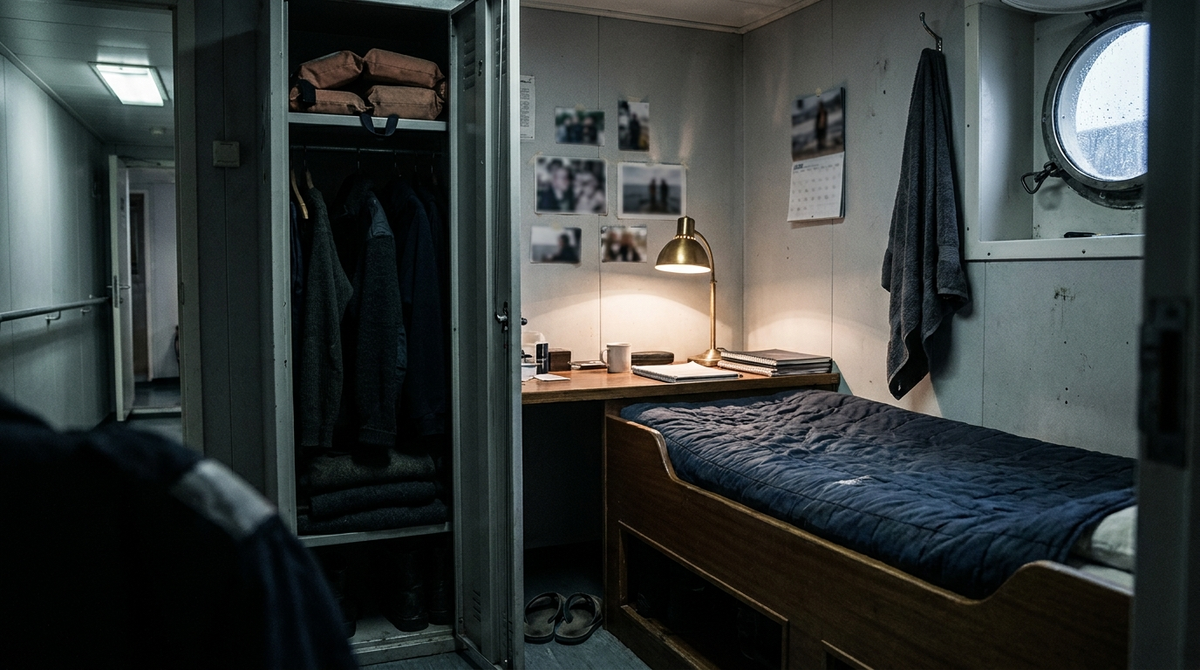
A ship cabin is not a small room. It is a system with a bunk in it. One locker, one desk, one chair that doubles as a valet stand, a porthole if the rank allows, and nine months of a person's life folded into it.
What crew keep in that space follows rules learned the hard way, usually in the first contract.
Life in a ship cabin is also regulated, which surprises most people ashore. Floor area, berth size, locker volume, headroom, heating and noise are written into the Maritime Labour Convention, 2006. The law sets the box. What happens inside it is on the seafarer.
What a standard cabin actually contains
Strip out the personal things and a rating's cabin on a modern bulk carrier comes down to four elements. A single berth against the bulkhead, drawers underneath. A desk with a chair, a reading lamp and a socket panel that is never enough. A steel clothes locker, full height, one rail and one shelf. And a wet unit: shower, toilet and basin moulded into one corner, with a drain that gurgles when the ship rolls.
Think of it as a student room with a very heavy door. Officers berth higher in the accommodation block and get more of everything, sometimes a day cabin for paperwork. A cadet gets the smallest room on the corridor, often next to the laundry.
What the MLC says about seafarer accommodation
Regulation 3.1 and Standard A3.1 of the MLC 2006 set the minimum, literally down to the floor. On ships other than passenger ships, each seafarer is to be provided with an individual sleeping room. A single berth room must have at least 4.5 square meters of floor area on ships under 3,000 GT, 5.5 square meters between 3,000 and 10,000 GT, and 7 square meters at 10,000 GT and above. Officers get more. Berths measure at least 198 by 80 centimeters, headroom at least 203 centimeters where free movement is necessary, and the clothes locker must hold a minimum of 475 liters plus a drawer of at least 56 liters.
Those numbers explain the packing culture better than any advice column. 475 liters sounds generous until a boiler suit, safety boots, a wash bag, shore clothes and nine months of working laundry go into it.
Standard A3.1 also covers what you only notice when it fails: heating for cold conditions, air conditioning on most foreign-going ships, ventilation that works with everything shut in heavy weather, and accommodation protected against excessive noise and vibration. The binding noise limits sit in the IMO Code on Noise Levels on Board Ships, mandatory under SOLAS for new ships of 1,600 GT and above since 1 July 2014. A 2022 amendment added social connectivity to the same standard: reasonable access to ship-to-shore telephone and internet where available, at reasonable charges, in force since 23 December 2024.
Passenger ships are the exception written into the rule. There the individual sleeping room requirement does not apply and shared cabins are lawful. That one line is why cruise crew and cargo crew describe two different versions of the same job.
Accommodation sits in the same convention as your wages, your hours and your repatriation, so the cabin question and the contract question are one question. Before you sign, run the agreement through the free MLC Contract Check. It reads the document clause by clause in about a minute, in your browser, no account needed.
The locker decides everything
Whatever comes up the gangway has to fit the locker, survive the ship's laundry, and hold value through humidity, engine-room dust and a vibrating hull. Cotton that dries slowly loses. Anything fragile loses. Anything oversized loses on day one, when the kit bag will not close.
The winners are boring and beloved: quick-dry towels, dark clothes that hide work stains, quality socks in quantity, flip flops for the shower run and the cabin floor, a headlamp for the 03:40 call-out, a power strip because cabins never have enough sockets, and one set of shore clothes that still looks like a decision.
The flip flops deserve their own sentence. The pair under the bunk is the most used footwear on any ship, cabin to shower to laundry to mess, and crews replace them contract after contract. Ours live here: Seafarer Flip Flops.
One warm layer earns its space too. Accommodation air conditioning runs cold, and the cabin at 04:00 in the North Atlantic is a different climate from the cabin at anchor off Singapore. A heavy seafarer hoodie gets worn off watch, in the mess, and on the flight home.
The wall above the desk
Photos, taped, always. A calendar with days crossed off, which nobody admits to and everybody keeps. A copy of the safety card. Sometimes a small flag. The cabin wall is the most honest social media at sea: no filter, one follower, updated when the missing gets loud.
Under the mattress or in the locker's back corner: the document folder. SEA original, seafarer's book, certificates, wage statements. MLC Standard A2.1 gives you the right to keep your signed contract, and the cabin is where it lives. The sign-on checklist covers the full folder.
Then the part no regulation describes: cable management. Chargers, a hotspot, a fan, a speaker, sometimes a small kettle that officially does not exist. Crew run cables along the deckhead trim and keep the multi-socket off the deck because of wash-down water. On many ships the coffee gear is the real secret: a French press, a hand grinder, a jar of something better than what the messman brews. It goes back in the locker before the inspection.
 Free crew appSeafarer Contract CheckCheck your contract clause by clause against MLC 2006 and flag state regulations. The check is free. On iPhone, Android or in the browser.
Sleeping when the watch says so
The cabin is a bedroom at hours that make no sense ashore. A 12 to 4 watchkeeper sleeps twice a day in blocks that never add up to a night, and cargo watch in a terminal ruins the plan again. This is where the room stops being decoration and becomes equipment.
Blackout first: a towel or a spare blanket over the porthole, taped at the edges, because daylight in the Red Sea at 14:00 is not a suggestion. Then earplugs, foam, in quantity. Then position. A cabin aft, above or beside the engine room, carries a low vibration you feel through the mattress rather than hear. Midships is quieter but rides the roll differently, and forward accommodation pitches.
Broken sleep is a working problem, not a comfort issue. Our guide to mental health for seafarers covers what long contracts do to it.
Cleaning and the cabin inspection
The cabin is inspected. Standard A3.1 requires inspections on board by or under the authority of the master at intervals not exceeding seven days, to confirm that seafarer accommodation is clean, decently habitable and in good repair. Each result has to be recorded and available for review.
In practice a chief officer walks the accommodation on a Saturday morning, opens doors, checks the deck, the shower drain and the deckhead for signs of a leak. It is a welfare provision, and it catches real defects: mould behind a locker, a dead cabin fan, a shower that nobody reported.
Shared space, unwritten rules
Junior ranks often share, and sharing has law: respect the sleeper after night watch, headphones after 22:00, the alarm answered on the first ring, cleaning split without discussion. A cabin mate who breaks these rules becomes famous on board within a week, and not in the good way.
On cruise ships sharing is normal rather than exceptional. Crew cabins sit low in the vessel, often below the waterline, two or four berths to a room, no porthole, one bunk curtain doing the whole job of a door. For the honest comparison, read cruise ship life versus cargo ship life.
What to bring so life in a ship cabin stays bearable
After the safety kit and the paperwork, the list gets short and specific. Something to darken the porthole. Earplugs. A power strip with a long cable. A quick-dry towel that still smells fine in month four. Tape and hooks that do not damage paint, because nothing gets nailed to a ship. Printed photos, not only files on a phone.
Then one thing with no function at all, and it is the reason people survive nine months in seven square meters: a piece of home that belongs to you and not to the company. A mug. A flag. A seafarer daily life hoodie that has nothing to do with the ship's uniform. The cabin is the only square on board where your name, not your rank, decides what goes on the wall.
What people pack into this world for someone they love is its own art: the seafarer care package follows the same locker rules. Before a first contract, the real look at working at sea sets the expectations the brochure will not.
Source note
Accommodation standards come from MLC 2006 Title 3, Regulation 3.1 and Standard A3.1: ILO: Maritime Labour Convention, 2006. The seven-day inspection duty is Standard A3.1, paragraph 18: ILO MLC FAQ on accommodation inspections. Floor areas, berth dimensions, locker volumes and headroom follow MCA: MSN 1844 (M) Amendment 1. Noise limits come from the IMO Code on Noise Levels on Board Ships, adopted by IMO Resolution MSC.337(91).
This article is editorial context on how crew accommodation works in practice. It is not legal advice. Minimum standards vary with flag state implementation, ship type, tonnage and build date. Your flag administration or your union is the authority on your ship.
FAQ
What is life in a ship cabin like on a cargo ship?
A bunk, a locker, a desk and a small bathroom, shared or private by rank. Clean, steel, functional. Officers usually berth higher in the accommodation block; ratings lower, closer to the engine's hum.
How big is a seafarer's cabin?
Under MLC 2006 Standard A3.1 a single berth sleeping room must have at least 4.5 square meters of floor area on ships under 3,000 GT, 5.5 square meters between 3,000 and 10,000 GT, and 7 square meters at 10,000 GT and above. Officers are entitled to more, and berths must measure at least 198 by 80 centimeters.
Do seafarers get their own cabin?
On ships other than passenger ships, MLC 2006 requires an individual sleeping room for each seafarer. Passenger ships are exempt, which is why cruise crew commonly share a cabin with two or four berths.
What should I bring for my first cabin?
Less than you think: quick-dry towel, flip flops, dark durable clothes, socks, headlamp, power strip, chargers, earplugs, something to darken the porthole, a document folder, and photos. The locker is the limit, not your ambition.
Can I decorate my cabin?
Within reason and the master's standing orders, yes: photos, a calendar, small personal items. Nothing that blocks safety equipment, nothing glued or nailed to the ship, everything stowed for heavy weather.
Are ship cabins inspected?
Yes. MLC 2006 Standard A3.1 requires inspections by or under the authority of the master at intervals not exceeding seven days, to confirm that accommodation is clean, decently habitable and in good repair. The results must be recorded.
7SHORT1LONG® is a Seafarer Identity Brand. One locker, nine months, no wasted space.
YES, WE ARE CREW.


Gear for the watchShip Type T-Shirts · Ship Department· Mariners Neck GaitersBuild your Sign On Set · Build your Sailor Set


