
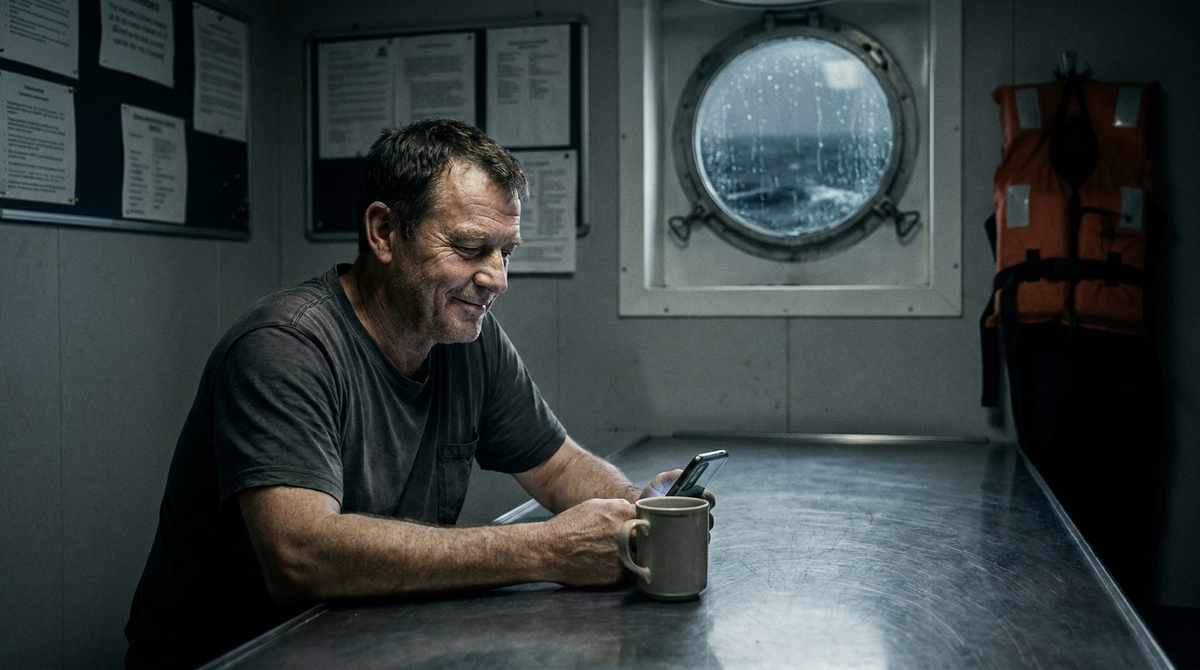
A container ship's mess room at 21:30. Half the table is eating late after cargo watch. The other half is looking at phones, because somewhere it is morning and a daughter is getting ready for school. Social life at sea now runs on two channels at once.
It happens in the gaps: after watch, before sleep, on the gangway where the signal is one bar stronger. Whether those gaps hold a conversation or a loading screen depends on the ship's internet. Ten years ago that mess room was full. Not happier. Fuller. There was nowhere else to be.
Before the ship had real internet
Ask a bosun who signed his first contract around 2012 what contact with home cost. Satellite time was sold by the minute or the megabyte and rationed hard. Plenty of ships ran one terminal in the ship's office: text e-mail only, no attachments, released once a day when the master let the queue go. A voice call was for births and deaths.
The rest happened ashore. Out through the port gate with a prepaid card, into the seafarer center run by the Mission to Seafarers or Stella Maris, then queue behind six other crew who also had twenty minutes before the bus left. Those centers exist because the industry could not connect its own crews, and on a short port stay they still do that job. It is one reason shore leave mattered more than the crewing schedule admitted.
The law caught up in December 2024
Since 23 December 2024, amendments to the MLC 2006 require shipowners to provide seafarers with internet access on board, so far as reasonably practicable, with any charges kept reasonable in amount. Social connectivity is now written into the recreational facilities the Convention expects on a ship. The ILO adopted the change in 2022, after the pandemic showed every flag state what isolation does to a crew.
Read the entitlement exactly. It does not promise free internet. It sets no minimum speed, no monthly allowance, no guarantee the signal reaches your bunk rather than one corner of the crew mess. An owner selling vouchers at a fair price on a working connection is inside the Convention. An owner charging port-shop prices for a link that dies at every satellite handover is arguing about the word reasonable, and that argument belongs to the flag state and your union. Elastic wording, and crews know it. The direction is still set.
What the numbers say
The Mission to Seafarers tracks this every quarter in its Seafarers Happiness Index. In the second quarter of 2025, overall happiness rose to 7.54 out of 10, and crews named connectivity as a driver: video calls, daily contact, entertainment on the long stretches between ports. In the third quarter the index fell back to 7.05. Connectivity was the only category that still improved.
Read that twice. Food, workload, wages, shore leave all slid. The internet was the one thing that kept getting better, and it is carrying more of crew morale than any single factor should have to. Ben Bailey of the Mission to Seafarers called that quarter a clear warning sign and blamed operational pressure, admin load and crew shortages.
Hardware is why the connectivity line keeps climbing. Low-orbit satellite service spread through the merchant fleet faster than almost any technology before it, reaching roughly a quarter of satellite-connected vessels within about two years. Maersk, Hapag-Lloyd, MOL and NYK rolled it out fleet-wide, and the International Chamber of Shipping reports crew retention as the reason owners pay for it.
Why a video call beats a text
Ask anyone on month five of a nine month contract. A chat message is proof of life. A video call is presence: the kitchen at home, a parent looking older, a kid holding up a school project to the camera. An oiler coming off a hot watch can sit on his bunk and be in two places for twenty minutes.
It cuts the other way too. Bad news arrives in real time now, and there is no port chaplain standing next to you when it does. A father in hospital, a court date you cannot attend: it lands on a bunk in the South China Sea four hours before watch. Our guide to mental health for seafarers covers the weight a data plan cannot carry.
The mess room empties
When every cabin has a working signal, the crew mess stops filling up. ISWAN has measured this since 2019 through its Social Interaction Matters project: live trials on 21 vessels from 10 shipping companies, then 176 seafarers on six commercial, cruise and yacht vessels tracked for three months with interviews and wearable data. Connectivity came out contested. It is called a barrier to interaction most often by shore staff and by seafarers with 20 years or more at sea.
What crews describe is plainer. The DVD nights stopped. The card game stopped. On a 20-hand bulker with four nationalities and a split rotation, the difference between a crew and twenty strangers sharing a hull was always the mess room. Now the mess room competes with a phone, and the phone has the family in it.
Nobody wants the old system back. The ship gained a connection and lost a room. The law caught up. The mess room did not.
 Free crew appSeafarer Contract CheckCheck your contract clause by clause against MLC 2006 and flag state regulations. The check is free. On iPhone, Android or in the browser.
What crew community needs now
ISWAN's recommendations out of those trials are cheap and unglamorous. A voluntary social ambassador on every vessel. Free Wi-Fi for all crew instead of a voucher economy that splits the ranks, because when contact costs money an AB on a lower wage rations gigabytes his chief engineer never thinks about. Regular review of the recreation facilities, not a broken table tennis table in a store room for four years.
The rest is deliberate time, and on a ship that has to be planned like anything else. A barbecue on the aft deck after tank cleaning, organized by somebody who just came off watch. Karaoke in the crew mess on Saturday, badly. A gym that works. Crew who pull on a seafarer hoodie and go up top at 20:00 because somebody said they would be there. Same principle as a drill: it happens if it is on the plan and one person owns it.
Quiet needs protecting too. A cabin is a bedroom, an office and now a phone booth. Anyone sharing one on a cruise ship knows what that means at 03:00 ship time. Designated call areas and quiet hours read like bureaucracy. They are how two people in one cabin get sleep.
Social life at sea depends on the ship and the company
A large cruise ship carries over a thousand crew, a crew bar, a crew gym and staff whose job includes crew events. Social life survives the phone there, because there is a critical mass and a room to be in. A handysize bulker with 20 hands and a six-on six-off rotation has none of that, which is cruise ship life versus cargo ship life in one sentence. Then the money. Some operators give crew unlimited free Wi-Fi and say so in the recruitment ad. Others sell vouchers by the gigabyte, or throttle the link so hard that video dies while a class inspection uploads. Two ships in one fleet can sit further apart than two companies.
Ask before you sign
Connectivity is decided before the gangway. Put it to the crewing agent in writing:
- Crew Wi-Fi at sea, or only alongside?
- Free, capped, or paid by voucher, and at what price per gigabyte?
- Does the signal reach the cabins or only the crew mess?
- Is it cut during cargo operations, in port, or in certain waters?
- Does the cap survive a video call, or is it burned by Tuesday?
The answers tell you how the company thinks about its crew. While you are there, run the contract itself through our free MLC Contract Check. It reads your SEA clause by clause against MLC 2006 and marks what is missing. About a minute, no account, and the text stays in your browser.
We also covered the phone setup before joining a ship and the apps that help during a contract. Both matter more when bandwidth is thin.
7SHORT1LONG® is a Seafarer Identity Brand, and this is the part of crew life it exists for: sailing with people you did not choose and building something anyway. The One Sea One Crew t-shirt puts it in four words. The mess room says it better.
Source note
This article is editorial context, not legal advice. The legal position comes from the ILO summary of the 2022 MLC amendments, the wellbeing figures from the Seafarers Happiness Index published by The Mission to Seafarers, the social interaction research from the Social Interaction Matters project run by ISWAN, and the retention argument for low-orbit satellite service from the International Chamber of Shipping. For your own contract, the flag state administration and your union are binding.
FAQ
Is internet access for seafarers mandatory now?
Since 23 December 2024 the MLC 2006 requires shipowners to provide internet access on board so far as reasonably practicable, with reasonable charges if any. Real obligation, real wiggle room.
Does the MLC give seafarers a right to free internet on board?
No. It requires social connectivity and internet access so far as is reasonably practicable, with any charges reasonable in amount. Free crew Wi-Fi is a company decision recommended by ISWAN, not a right.
Do all cargo ships have crew Wi-Fi?
No. Adoption grew fast with low-orbit satellite service and many major fleets now run it, but quality, caps and cost still differ widely. Ask in writing before you sign.
Has better internet made social life at sea worse?
It changed it. Crews report emptier mess rooms since cabins got a usable signal, and ISWAN found connectivity is called a barrier to interaction most often by shore staff and by seafarers with 20 years at sea.
Why do video calls matter so much at sea?
Contracts run for months and port stays are short. The Seafarers Happiness Index links connectivity to family relationships and mental health, and in late 2025 it was the only wellbeing category still improving.
YES, WE ARE CREW.


Gear for the watchCrew Welfare at 7S1L · Seafarer Hoodies· Seafarer HoodiesBuild your Sign On Set · Build your Sailor Set


