
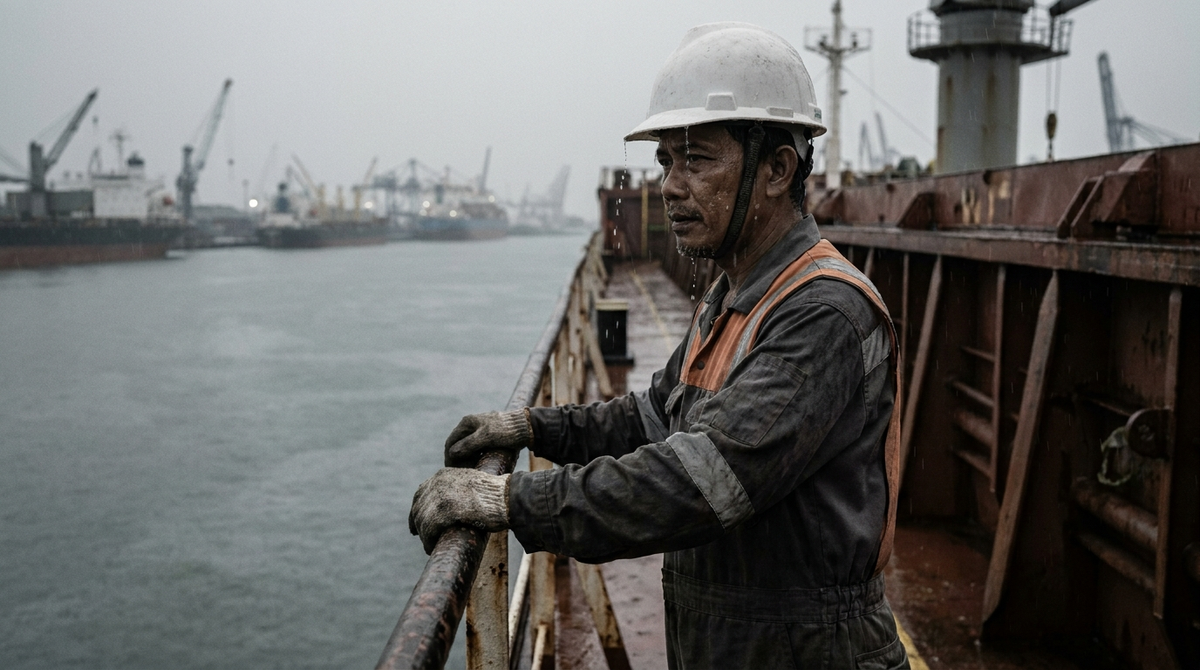
The world's largest archipelago produces seafarers the way other countries produce commuters. Seventeen thousand islands make the sea a road, not a border, and Indonesian seafarers have carried that instinct into every corner of the world fleet.
Indonesia sits among the top seafarer supply nations on earth. The 2026 BIMCO and ICS Seafarer Workforce Report puts the country fifth, with 72,304 officers and 110,940 ratings, behind the Philippines, India, China and the Russian Federation. On cruise ships, Indonesian crew fill the hotel decks shoulder to shoulder with Filipino colleagues: cabin stewards, waiters, galley teams, bar staff from Bali, Java and Sulawesi.
And yet the country rarely gets named. Crewing talk defaults to Manila and Mumbai. Indonesia puts more than 180,000 certified seafarers into the world fleet and still sits in the second row of the conversation. That gap, between the size of the workforce and the volume of the talk, is the quiet part of the quiet giant.
The scale of the Indonesian seafarer workforce
The BIMCO and ICS workforce report comes out every five years and is the closest thing shipping has to a census. The 2026 edition counts 2,565,580 seafarers worldwide. Indonesia's share of that, officers and ratings together, is 183,244. Fifth place, ahead of every European supply nation. For scale, the Philippines reports 203,179 officers and 256,968 ratings, which is where the reputation of Filipino seafarers comes from.
Merchant ships are only part of the picture. Indonesia's transport ministry estimates around 300,000 Indonesians work on foreign-flagged vessels of every type, a figure cited by the foreign ministry's citizen protection directorate in July 2026. The distance between that estimate and the workforce report count is mostly fishing crew. That is where the story gets harder.
Why an archipelago builds crew
There is no single land route through Indonesia. Pelni, the state passenger and cargo line, runs a fleet of 26 ships across more than 90 ports, and its longest rotation covers roughly 8,700 kilometres from Surabaya on Java to Merauke in Papua and back again, about a month at sea with a dozen port calls on the way. Families use it. Traders use it. Deck ratings start on it.
The domestic fleet is the entry ramp. A young rating from Sulawesi does not step off a beach onto a Panamax. He works coasters, ferries, tugs, the wooden Pinisi freighters still moving cement and rice between islands, then takes his STCW courses and goes deep sea. By the time he signs on to a bulker in Singapore he has stood watches, handled mooring lines in a swell and slept in a bunk that moves. Life at sea is not a discovery for him. It is the family trade, and often the family income.
Where Indonesian seafarers sail
Three worlds, mainly. The deep-sea cargo fleet, on bulkers, boxships and tankers under Asian and European management. The cruise industry, where Indonesian hospitality has been a fixture for decades. And the fishing and offshore fleets closer to home, the hardest and least visible corner of the trade.
In the engine room, Indonesian oilers and motormen are a standing presence on ships managed out of Singapore and Hong Kong. On deck, ABs and bosuns. In the hotel department of a cruise ship, cabin stewards, assistant waiters, galley and bar crew, often on eight or nine month contracts with a second and third season on the same vessel. Departments and ranks work the same way under every flag, and the ladder is worth knowing before the first sign-on: merchant ship ranks set out who signs what and who answers to whom.
The cruise side matters for rights: hotel crew are seafarers in full under the MLC, with the same contract protections as any AB, which we laid out in the hotel department post.
Where the certificates come from
Indonesian certification runs through the Directorate General of Sea Transportation under the transport ministry, which approves and audits the training institutes. The names on crew lists repeat: STIP Jakarta, BP3IP Jakarta, PIP Semarang, PIP Makassar, Poltekpel Surabaya. Dozens of smaller centres across the country run the basic safety training courses required under STCW.
Quality varies by school, the way it does in every supply country. What does not vary is the paperwork burden on the seafarer himself. A cadet pays for courses, medical certificate, seaman's book and often the flight, all of it before anyone has guaranteed him a berth. That is where the trouble usually starts. On shore.
The manning reality
Indonesian crews sign through manning agencies concentrated in Jakarta and Surabaya, onto ships flying every flag in the book. That makes the basics non-negotiable: a signed SEA in hand before the flight, recruitment free of placement fees under MLC Standard A1.4, and a wage annex with the split written out. Indonesian law adds one more paper, the Perjanjian Kerja Laut, and no seafarer may be placed on board without it, whatever the flag. How the PKL sits next to the SEA is in our guide to Indonesia flag labor law.
Placement fees charged to the seafarer are prohibited under the MLC. They are also common, and they are usually dressed as something else. A training deposit. A document processing charge. An advance the agency will quietly recover from the first three months of wages. We went through the mechanics in the piece on manning agency fees. If money is moving from the seafarer to the agency, the contract is already the wrong contract.
The second thing to check is the wage figure itself. The ILO benchmark for an able seafarer is a reference point, not a market rate, and an Indonesian AB joining a Singapore-managed bulker should know both numbers before he signs anything. The 2026 minimum wage figures are the starting line. Then read the document properly: the free MLC Contract Check runs a seafarer employment agreement clause by clause against MLC 2006 in about a minute, in the browser, with no account and nothing uploaded.
 Free crew appSeafarer Contract CheckCheck your contract clause by clause against MLC 2006 and flag state regulations. The check is free. On iPhone, Android or in the browser.
The fishing fleet is a separate problem
The MLC does not cover fishing vessels. That exclusion is written into the convention itself, and it leaves the crews who need protection most outside the instrument that protects everyone else. Indonesia is the largest sending country for migrant fishing crew, and the reporting on what happens to them is not ambiguous.
The Environmental Justice Foundation published findings in July 2026 on Indonesian fishers aboard foreign distant-water vessels, mainly Chinese and Taiwanese flagged. The documented pattern: recruitment debt taken on before departure, salary deductions nobody explains, confiscated identity documents, and rest periods cut to around four hours a day. Crews stay offshore for months because the catch is transhipped at sea rather than landed, which removes the one thing a port call gives a seafarer: a way out. EJF's chief executive described the abuse and mismanagement as systemic across the Chinese distant-water fleet.
There is movement. Indonesia ratified ILO Convention No. 188, the Work in Fishing Convention, in April 2026, with a one-year window to rewrite the rules on recruitment, training and certification of fishing crew before it applies. Ratification is a date on a document. Whether it reaches a squid jigger two thousand miles offshore depends on port state inspection and on whether the agencies in Jakarta ever face a consequence.
What the money carries
Ask an Indonesian AB why he is doing nine months and the answer is rarely about the sea. A house being finished in Cilacap. A younger sister's school fees. A mother's medication. Remittances from Indonesian workers abroad run to billions of US dollars a year in Bank Indonesia and World Bank figures, but no agency publishes a clean seafarer-only split, so any precise seafarer remittance number is an estimate dressed as a fact.
The suitcase says the rest. Sambal in screw-top jars, wrapped in a towel so it survives the baggage handlers. Instant noodles in the outside pocket. Kerupuk that will be crumbs by Rotterdam and eaten anyway. Rendang vacuum-packed by an aunt who does not trust ship food. Nine months is a long time to eat someone else's cooking, and on a mixed-crew ship the mess room becomes a standing negotiation about whose sambal is on the table.
Kesatuan Pelaut Indonesia, the Indonesian seafarers' union and an ITF affiliate, has pushed mental health training and outreach together with the transport ministry and Indonesian operators. Real work, and welcome. It does not reach the fishing crews. Same gap, again.
Identity, worn
The Indonesian Sailor Set puts the Merah Putih next to the signal. For the steward on his fourth Caribbean season, the oiler on a bulker out of Singapore, the families on Java who count the months. Crew identity, from a nation the industry relies on and rarely names.
The pieces work the way crew clothing works. The Indonesian sailor t-shirt goes in the bag for port days and the flight home. The Indonesian sailor hoodie earns its place on a February gangway watch in Northern Europe, where the crew is Indonesian and the weather is not. Nobody on board needs the flag explained to them. That is exactly why it gets worn.
Source note
Workforce figures: BIMCO and ICS Seafarer Workforce Report 2026 (BIMCO summary, ICS on global supply and demand). Country context: UNCTAD maritime profile, Indonesia. The 300,000 estimate for Indonesians on foreign-flagged vessels is a transport ministry figure cited by the foreign ministry and reported by The Jakarta Post, July 2026. Fishing sector findings: Environmental Justice Foundation, July 2026. The April 2026 ratification of ILO Convention No. 188 was reported by Mongabay. Remittance context: Bank Indonesia and World Bank.
This article is editorial context for crew, not legal advice. For a contract or a complaint, use an ITF inspector, a Kesatuan Pelaut Indonesia representative, or the flag state administration named in your seafarer employment agreement.
FAQ
How many Indonesian seafarers are there?
The BIMCO and ICS Seafarer Workforce Report 2026 counts 72,304 Indonesian officers and 110,940 ratings, which ranks Indonesia fifth among seafarer supply nations. Indonesia's transport ministry separately estimates around 300,000 Indonesians working on foreign-flagged vessels of all types, including fishing.
Where do Indonesian seafarers mostly work?
Deep-sea cargo ships, cruise hotel departments, and regional fishing and offshore fleets. Manning for the merchant fleet runs mainly through agencies in Jakarta and Surabaya.
Do Indonesian cruise crew have the same rights as deck crew?
Yes. The MLC covers everyone working on board a merchant or passenger ship. Hotel and hospitality crew hold full seafarer contract rights, including the wage, repatriation and complaint protections.
Does the MLC cover Indonesian fishing crew?
No. Fishing vessels are excluded from the MLC 2006. Fishing crew are covered by ILO Convention No. 188, the Work in Fishing Convention, which Indonesia ratified in April 2026 with a one-year period to bring its national rules into line.
Where do Indonesian seafarers get trained and certified?
Through institutes approved and audited by the Directorate General of Sea Transportation, including STIP Jakarta, BP3IP Jakarta, PIP Semarang, PIP Makassar and Poltekpel Surabaya, plus dozens of smaller centres running STCW basic safety training.
7SHORT1LONG® is a Seafarer Identity Brand. Seventeen thousand islands, one signal.
YES, WE ARE CREW.


Gear for the watchSeafarer T-Shirts · Crew Best Sellers· Seafarer iPhone CasesIndonesian Sailor Set · Build your Sailor Set


