Martin Lex is the pen name of the 7S1L safety desk: SOLAS, lifesaving and firefighting gear, muster drills, emergency signals and safe work on board. Portrait is illustrative.
Ask who was Sailor Jerry and most people point at a rum bottle. The honest answer is older and better. Sailor Jerry was the nickname of Norman Keith Collins, a U.S. Navy veteran and tattoo artist who worked out of Honolulu. His name is now tied to American traditional tattooing, sailor flash, port-city ink, and the visual language many people still connect with seafaring.
He was not a skipper, a master, or a merchant officer. He was a tattooist who spent his working life around sailors. That distinction gets lost constantly, and it matters.
For 7SHORT1LONG®, the point is not to copy old tattoo art as decoration. The point is to understand why those symbols carried weight for crew. A ship, a crossing, a port, a risk, a memory, a hand on the line.
Who was Sailor Jerry? Norman Keith Collins, 1911 to 1973
Collins was born on January 14, 1911, in Reno, Nevada. He learned hand-poked tattooing young, on the road, and picked up machine work in Chicago before he ever saw the Pacific. At 19 he enlisted in the U.S. Navy. Sea time took him through Southeast Asian ports, where he saw disciplined, large-scale tattoo traditions that Western street shops had no answer to yet.
The Navy years were real service, not a marketing story. But his life's work started when he settled in Hawaii in the 1930s and set up in Honolulu's Chinatown. His shops sat on and around Hotel Street, a short walk from the harbor. His final studio at 1033 Smith Street still operates as a tattoo shop today.
He died in Honolulu on June 12, 1973, at age 62. He never saw the brand that now carries his name. More on that below.
Hotel Street: the tattoo capital of the wartime Pacific
To understand the ink, you have to understand the street. During World War II, Honolulu's Chinatown was the pressure valve of the Pacific war. Local reporting describes tens of thousands of soldiers, sailors, and war workers moving through the Hotel Street district on a single day: bars, pool halls, photo studios, brothels, and tattoo parlors packed into a few blocks near the waterfront.
A rating came off a ship at Pearl Harbor with liberty measured in hours, not days. Shore leave was a queue. You stood in line for a drink, a photo, and a tattoo, and the tattoo was the only thing you kept. A simple piece cost a few dollars. The saying of the era was blunt: stewed, screwed, and tattooed.
Collins worked in the middle of that. His shop was not a studio with consultations and mood boards. It was fast, high-volume work for young men shipping out toward a war zone, some of whom would not come back. That pressure produced the style. Bold lines that hold on skin for decades. A limited palette that stays readable. Symbols that say something in one glance across a mess room.
What is flash, and why it fit the waterfront
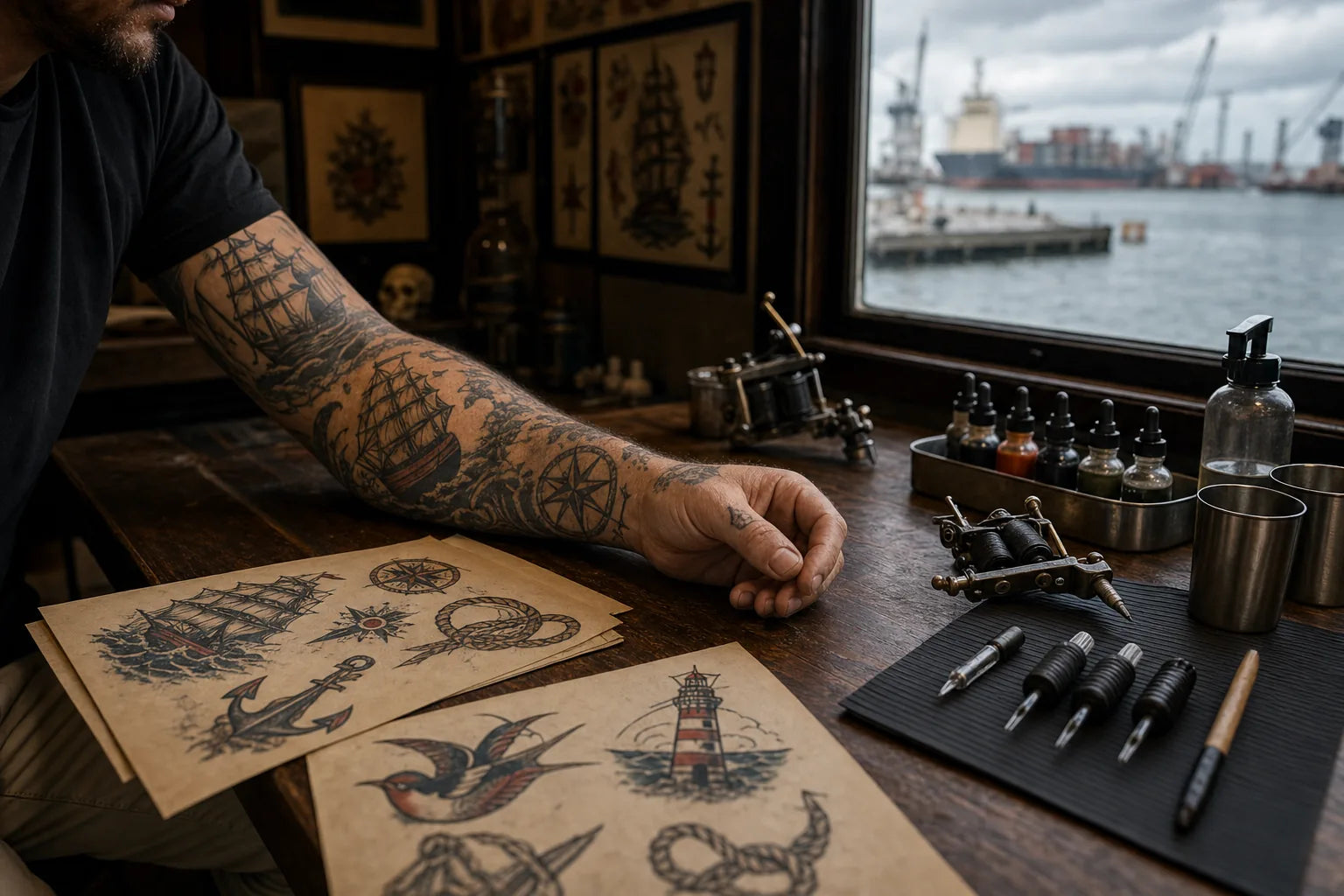
Flash is the sheet of pre-drawn, ready-to-tattoo designs on a shop wall. You point, you pay, you sit. For Hotel Street it was the only system that worked: a line of sailors out the door and liberty ending at a fixed hour.
Collins turned flash from a menu into a language. Anchors, swallows, ships under sail, daggers, hearts, hula girls, banners carrying a name or a port. Each sheet was a set of ready answers to the same question: what do you want to remember, and what do you want it to say without you talking?
That is why old flash still reads clearly today. It was engineered for distance, for aging skin, for a single look on a gangway. Design under constraint. The constraint was the job.
The craft: Japanese technique, American directness
Speed was half the craft. The other half was study. He kept up a long correspondence with Japanese tattoo masters, including Kazuo Oguri, known as Horihide, at a time when traditional Japanese tattooing barely spoke to the West. From that exchange he took ideas about composition, background, and how a large piece moves with the body, and folded them into the bold American line he already had.
He also pushed the trade forward on the unglamorous side. He mixed his own pigments, built his own needle formations, used single-use needles, and was one of the first tattooers to sterilize equipment with an autoclave. On a crowded wartime street, that was discipline, not decoration. Any bosun would recognize the logic: keep your gear clean, because the consequences land on someone's body.
Two of his students carried the work on: Ed Hardy and Mike Malone. When Collins died in 1973, Malone bought the shop and kept it open. Hardy later trained in Japan, on connections that traced back to Collins's letters. The line from a Hotel Street counter to modern tattooing runs straight through those two names.
 Free crew appSeafarer Contract CheckCheck your contract clause by clause against MLC 2006 and flag state regulations. The check is free. On iPhone, Android or in the browser.
Why sailors carried ink
Maritime tattoos were records of movement and identity. A swallow, ship, anchor, rope, dagger, or banner marked a story that did not need explaining in every port.
Not every meaning was universal. The language changed by era, by port, by Navy or merchant crew, by artist. Strong maritime design should avoid fake certainty and treat the tradition as something living, not as a decoded dictionary.
This article stays with the man. The motifs themselves, from HOLD FAST to swallows and full-rigged ships, have their own article, and the older beliefs behind some of them live in our piece on sea myths and superstitions.
The man versus the brand on the bottle
Here is the part most answers skip. Norman Collins never founded the rum company. He died in 1973. The brand came 26 years later. In 1999, Ed Hardy and Mike Malone partnered with the Philadelphia marketer Steven Grasse to form Sailor Jerry Ltd., licensing Collins's flash for clothing and, soon after, a spiced rum. Since 2008 the brand has belonged to William Grant & Sons, a Scottish distiller.
Nothing wrong with a rum. But be honest about what happened: a body of work made for working sailors between crossings became a lifestyle print for people who have never stood a watch. The man tattooed crew. The brand sells the look of crew. Those are two different things, and we have written before about why seafarer identity is not maritime fashion.
How 7SHORT1LONG uses tattoo tradition
Only when it belongs to the working sea. A tattoo-style design should connect to crew life. Vessel type, department, shore leave, safety at sea, long contracts, or the quiet identity of people who work between ports.
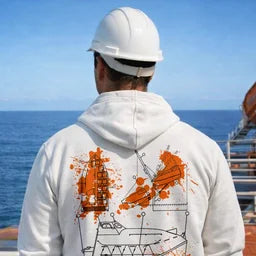
That is why our tattoo-style pieces name the ship instead of a fantasy. A cruise ship seafarer tattoo t-shirt for the people who crew those floating cities, a bulk carrier tattoo design for the crews riding those long, slow hulls. The full range sits in our seafarer t-shirts collection. If the design would look at home on a tourist, it does not ship.
One more difference between then and now. The sailors in Collins's chair signed their articles and hoped for the best. Today's crew can check first: the free MLC Contract Check reads an employment agreement clause by clause against MLC 2006 before you sign on. About a minute, no account, the contract stays in your browser.
It should never feel like a costume.
Source note
For background on Norman Collins and sailor tattoo tradition, see public biographical references such as the Sailor Jerry biography. For wartime Hotel Street and Chinatown, see Denby Fawcett's reporting for Honolulu Civil Beat. Brand history and ownership are documented by William Grant & Sons. This article uses the history as context, not as an exhaustive biography.
FAQ
Who was Sailor Jerry?
Norman Keith Collins (1911 to 1973), a tattoo artist associated with Honolulu and with American traditional sailor tattoo style. A Navy veteran, not a ship's officer.
Was Sailor Jerry a real sailor?
He served in the U.S. Navy, so the sea time was real. His life's work happened in the tattoo shop, inking sailors in Honolulu, not on the bridge of a merchant vessel.
Did Sailor Jerry create Sailor Jerry rum?
No. Collins died in 1973. The brand was founded in 1999 by his former students Ed Hardy and Mike Malone with marketer Steven Grasse, and William Grant & Sons has owned it since 2008.
What is tattoo flash?
Flash is the pre-drawn designs displayed on a tattoo shop's wall, made to be tattooed quickly and repeatedly. Collins's flash sheets became the core vocabulary of American traditional tattooing.
Why are tattoos connected to seafarers?
For many sailors, tattoos carried memory, identity, port history, crossings, work, faith, and survival.
YES, WE ARE CREW.
Gear for the watchSeafarer T-Shirts · Crew Best SellersBuild your Sign On Set · Build your Sailor Set