Written for seafarers Reviewed for accuracy by crew who have stood the watch.
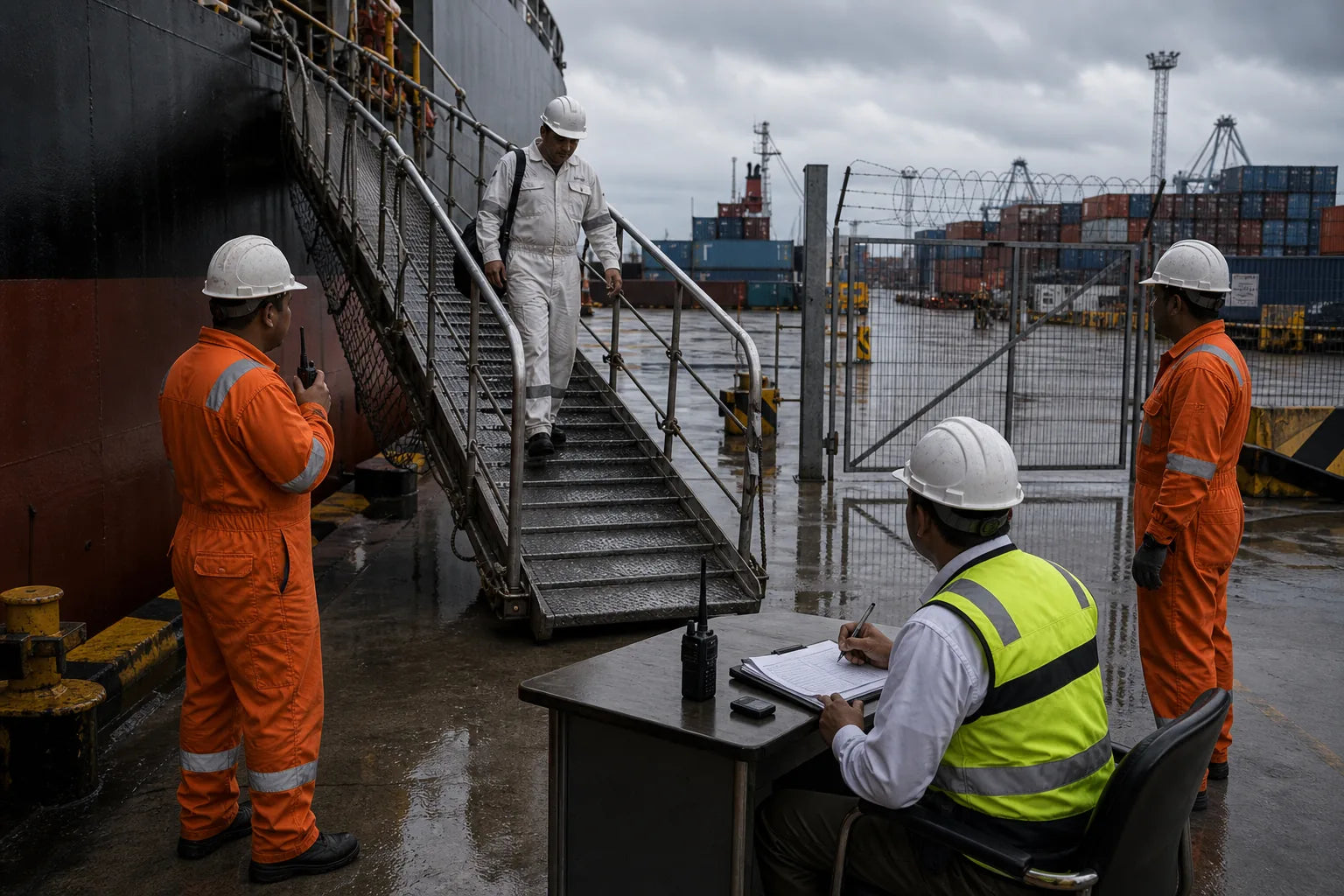
Ship security starts at the gangway. Who comes on board. Who leaves. Which contractor has permission. Which area is restricted. Which bag, vehicle, launch, or visitor does not feel right.
Piracy gets the headlines. Daily security for crew looks smaller: access control, port calls, cargo areas, passenger spaces, engine rooms, bridge access, and the quiet habit of reporting something early.
What ship security means
Ship security is the system used to protect the vessel, crew, passengers, cargo, and port operation from unlawful acts, unauthorized access, smuggling, sabotage, cyber risk, and other threats.
On a working ship, that system includes the Ship Security Plan, security levels, drills, gangway procedures, restricted areas, ID checks, visitor logs, lighting, cameras, communications, and crew instructions.
The ISPS context
The International Ship and Port Facility Security Code, usually called the ISPS Code, entered into force on 1 July 2004 as an amendment to SOLAS. It created a common security framework for ships and port facilities worldwide.
Crew meet ISPS through security levels, Ship Security Officer duties, access control, port facility coordination, and the requirement to pay attention when the vessel is alongside or at anchor.
Security Level 1 is the normal operating condition. Level 2 raises protective measures for a heightened risk. Level 3 applies when an incident is probable or imminent. Most crew spend an entire career at Level 1 and still run the drills, because the system only works when the habit is already there.
Roles on board
The master carries overall authority. The Ship Security Officer (SSO) coordinates the security plan on board. The Company Security Officer (CSO) supports from shore. But the system only works when ordinary crew participate: the rating at the gangway, the steward near passenger areas, the engineer entering restricted spaces, and the deck team near cargo operations.
Security is a shared habit, not a badge on one person's chest.
Modern threats are mixed
Security can mean piracy risk in certain waters, stowaway risk in port, cargo tampering, unauthorized boarding, suspicious visitors, drone observation, or cyber weakness in ship systems and company networks.
Not every crew member is a security specialist. Every crew member can still notice what belongs and what does not.
The 7SHORT1LONG view
7SHORT1LONG® respects the working culture behind ship security: alertness, responsibility, low-profile discipline, and care for the crew around you. The signal is not theatre. It belongs to people who understand that readiness matters before the alarm.
FAQ
What is ship security?
Ship security is the system of procedures, roles, equipment, and crew awareness used to protect a vessel from unauthorized access and security threats.
What does ISPS mean?
ISPS means International Ship and Port Facility Security Code. It entered into force on 1 July 2004 as an amendment to SOLAS.
What are the ISPS security levels?
Level 1 is normal operations. Level 2 applies when there is a heightened risk. Level 3 applies when a security incident is probable or imminent.
Who is responsible for ship security?
The master and the Ship Security Officer have formal roles, but every crew member contributes by following procedures and reporting suspicious activity.
YES, WE ARE CREW.
Gear for the watchShip Department Collection · Seafarer T-Shirts